
Mammogram BI-RADS 4 or 5: what happens next?
A mammogram classified ACR 4 or 5 (BI-RADS) is not a cancer diagnosis: it means a biopsy is needed to decide. In ACR 4, the probability of malignancy is highly variable; in ACR 5, it is high. The histological result (B1 to B5) then guides management, decided with the surgeon.
Just received a BI-RADS 4 or 5 result? Dr Zeitoun reviews your mammogram, quickly arranges the biopsy with his network of referring radiologists, then takes over as soon as the result comes back to decide what's next. You don't have to coordinate the steps yourself.
A letter, a report, and a few characters that tighten your stomach: BI-RADS 4 or BI-RADS 5 (ACR 4 or 5 in France). The first thing to know is that this classification is not a diagnosis. It is a way for the radiologist to say how suspicious a finding looks, and therefore what to do about it.
From BI-RADS 4 onwards, the plan is clear: a biopsy is needed. Not because it is necessarily cancer — many BI-RADS 4 findings turn out benign — but because only tissue analysis gives the answer, and gives it quickly. BI-RADS 5 is more worrying, but the principle is the same: biopsy first, decide afterwards.
This article doesn't give you the cold definition of each category. It explains what actually happens: the timing before the biopsy, how it is done, what the B1 to B5 results mean, and what I decide depending on what the biopsy shows. It draws on ACR BI-RADS, the recommendations of the French HAS and INCa, and the B classification of biopsies.
A BI-RADS 4 or 5 result in hand?
Review of your mammogram · arranging the biopsy · decision as soon as the result is in
A worrying result — what it really means
Receiving a mammogram classified BI-RADS 4 or 5, often by letter or through your GP, almost always causes worry. That is normal, and it is legitimate. First, three markers to understand what this result means — and what it doesn't.
It is not a diagnosis
The BI-RADS classification expresses a level of suspicion about an image, not a certainty. Until tissue has been analysed, nothing is settled — that is the whole point of the biopsy.
The waiting is hard
The period between the result and the biopsy, then waiting for the analysis, is often the hardest part. Knowing what to expect helps: here is how long a biopsy result takes and how to get through this period.
You are not alone
The breast surgeon's role is precisely to coordinate these steps — biopsy, result, decision — so that you don't have to organise them yourself.
A point that often goes unsaid: across all findings classified BI-RADS 4, a majority turn out to be benign after biopsy. The BI-RADS classification exists precisely to let nothing slip through — not to announce a diagnosis.

What your BI-RADS number means
BI-RADS and ACR are exactly the same scale: "BI-RADS" (Breast Imaging Reporting and Data System) is the international term, "ACR" the term used in France. The radiologist assigns this score, on the imaging (mammogram, ultrasound or MRI), from 0 to 6. It sums up the level of suspicion and indicates what to do — without making a diagnosis. For a full read of a mammogram, see how to read your mammogram.

| Category | Meaning | Usual action |
|---|---|---|
| BI-RADS 0 | Incomplete assessment | Additional imaging |
| BI-RADS 1 | Normal mammogram | Routine follow-up |
| BI-RADS 2 | Benign finding | Routine follow-up |
| BI-RADS 3 | Probably benign (< 2% risk) | Short-interval follow-up (often 6 months) |
| BI-RADS 4 | Suspicious (4A low · 4B moderate · 4C high) | Biopsy recommended |
| BI-RADS 5 | Highly suggestive of malignancy (> 95%) | Biopsy, then organise treatment |
| BI-RADS 6 | Cancer already proven by biopsy | Work-up and treatment underway |
BI-RADS 4: "suspicious", not "malignant"
BI-RADS 4 covers a wide range of risk, which is why it splits into 4A (low suspicion), 4B (moderate) and 4C (high). In every case, the biopsy settles it. A BI-RADS 4A very often comes back benign.
BI-RADS 5: high probability, but we confirm
BI-RADS 5 signals a highly suggestive finding. The biopsy remains essential: it confirms, characterises the type of lesion and its features, all of which are needed to build a tailored treatment. We never treat "blind".
And BI-RADS 3? Monitoring, not an immediate biopsy
Many patients confuse BI-RADS 3 and 4. Yet they are very different: a BI-RADS 3 finding is probably benign (over 98% of these images are, less than 2% risk of cancer). So the rule is not biopsy but short-interval monitoring, whose schedule depends on the type of finding:
— for a mass, the follow-up is often a targeted ultrasound, with a view if needed; — for microcalcifications, a mammogram at 6 months, then 12 and 24 months. If the image stays stable, it is reclassified BI-RADS 2 (benign); if it changes, a biopsy is then done.
An immediate biopsy may still be offered for a BI-RADS 3 if the uncertainty is too hard to live with, or if a pregnancy or IVF is under way. This is decided together, at the consultation. It is only from BI-RADS 4 that biopsy becomes the rule.
If your report also mentions dense breasts (density C or D), note that this makes the mammogram harder to read and may justify a complementary ultrasound or MRI.
The biopsy: how, by whom, in what timeframe
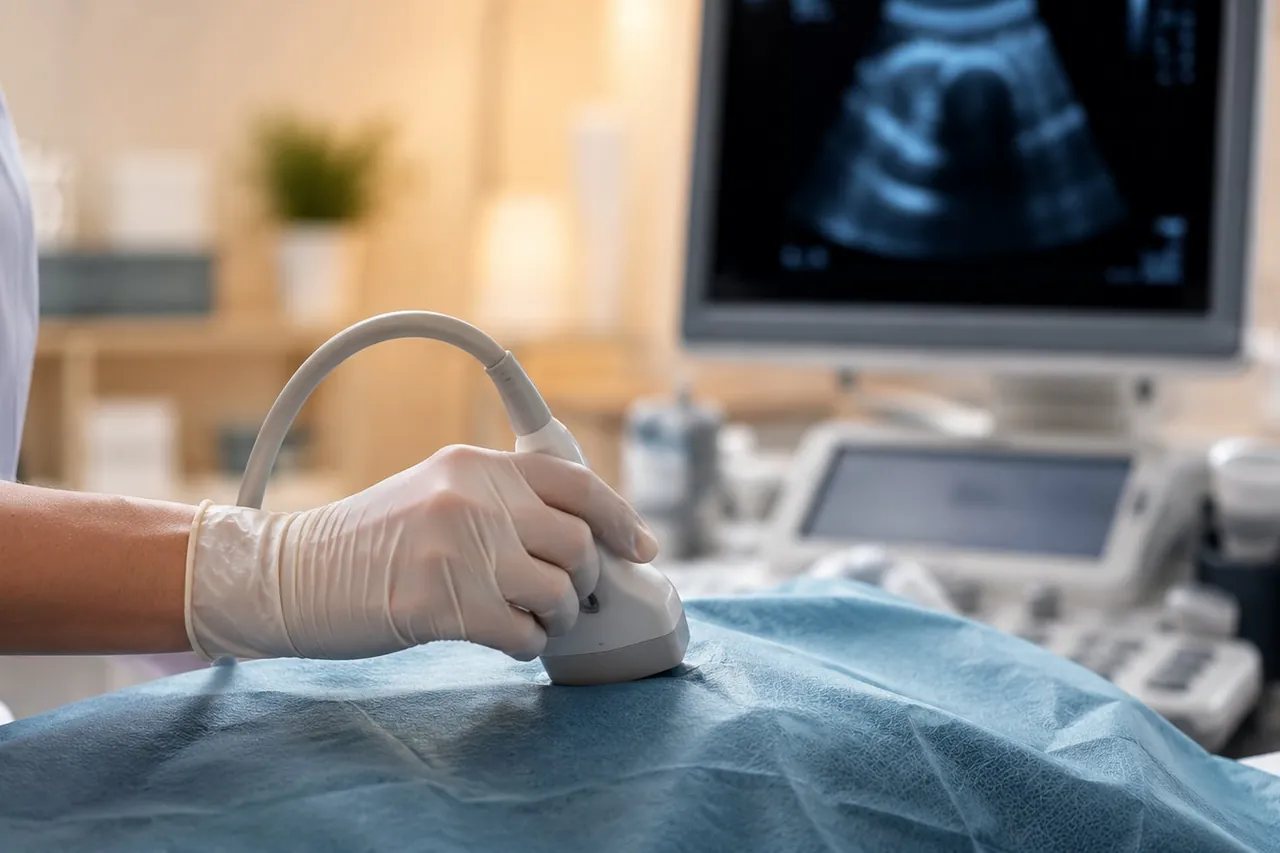
The biopsy means taking small fragments of tissue through the skin, guided by imaging, to send to the pathologist. It is a day-case procedure, under local anaesthesia, with no hospital stay. The type of biopsy depends on what needs to be sampled.
Core biopsy
For a mass visible on ultrasound. A needle takes a few cores of tissue. Quick, precise, and the most common.
Vacuum-assisted biopsy
For microcalcifications not visible on ultrasound. A suction system takes more material, targeting the finding on the mammogram.
MRI-guided biopsy
For a finding visible only on MRI. Rarer, reserved for situations where the finding is seen neither on ultrasound nor mammogram.
How long, and who performs it?
The biopsy is performed by a breast radiologist. I arrange it with my network of referring radiologists, usually within a few days of the consultation. The procedure itself takes a few minutes.
The histopathology result follows. When I arrange the biopsy myself through my network, it most often comes back within about two weeks. It is this result — not the image — that determines what's next. For the timing details, see how long a biopsy result takes; to decode the report, how to read your pathology report.
The biopsy results: B1 to B5
The pathologist grades the sample on an international scale, from B1 to B5. This letter directly guides what to do. From now on, it is this — not the initial BI-RADS number — that matters.

Two classifications not to confuse: BI-RADS/ACR and B1–B5
Given by the radiologist, on the imaging, before any sampling. It is a level of suspicion (0 to 6) that says whether to biopsy. BI-RADS 4 or 5 = "a biopsy is needed".
Given by the pathologist, under the microscope, after the biopsy, on the pathology report. It is the actual result: what the lesion truly is.
In short: BI-RADS/ACR decides whether to biopsy; B1–B5 says what it is. Two systems, two people, two moments — it is normal not to have the same number on both sides.
| Class | What it means | What I do next |
|---|---|---|
| B1 | Normal or non-representative tissue | Check the right area was sampled; re-biopsy if discordant. |
| B2 | Benign lesion (cyst, fibroadenoma…) | If concordant with the image: return to routine follow-up, no surgery. |
| B3 | Uncertain potential: atypia, papilloma, radial scar… | Often an excision (surgical or vacuum excision) for full analysis. |
| B4 | Suspicious of malignancy (inconclusive sample) | Re-biopsy or excision to confirm. |
| B5 | Malignant — B5a: in situ (DCIS) · B5b: invasive | Work-up, MDT, then tailored oncological surgery. |
The crucial point: concordance
A biopsy result is never read on its own: it is always compared with the image. If a highly suspicious finding (BI-RADS 4C or 5) comes back benign, the result is discordant: we don't settle for it, we re-sample the lesion so as not to miss a cancer. This consistency check is one of the breast surgeon's essential roles. Common B3 lesions — such as atypical ductal hyperplasia or intraductal papilloma — are subject to specific recommendations.
After the biopsy: the next step, depending on the result
Here, concretely, is what happens at the consultation once the result is known. Nothing is decided alone: everything is discussed with you, and in case of cancer, at a multidisciplinary team meeting.
Concordant benign lesion
The large majority of cases. If the result matches the image, we reassure you and you return to routine follow-up, without surgery. Sometimes we simply keep short-interval monitoring.
Lesion of uncertain potential
We often propose removing the lesion (surgical or vacuum excision) to analyse it fully and make sure no cancer is hiding alongside. The decision takes into account the exact type of lesion and your context.
Confirmed cancer
We complete the work-up, present your case at the MDT, then organise treatment: breast-conserving surgery (removing the lesion while keeping the breast) or mastectomy depending on the case, with sentinel lymph node biopsy if needed. The care is organised without delay, step by step. See the breast cancer guide.
Your next days
Every situation is different, but here is the order of things. When I arrange the biopsy myself, the whole sequence — consultation, biopsy, result — most often fits within about two weeks.
Consultation & review
I review your mammogram and report, check the indication, and arrange the biopsy with my network of referring radiologists.
The biopsy
Day-case procedure, under local anaesthesia, a few minutes. You go home the same day.
The result (B1–B5)
We meet again for the result — often available within about two weeks when I have arranged the biopsy. I explain it clearly and we decide on the next step together.
The decision
Return to follow-up, excision, or — in case of cancer — MDT review and organisation of treatment. At each step, you know exactly where you stand.
One point of contact, from image to diagnosis
The moment after a BI-RADS 4 or 5 result is often a maze: booking the biopsy, waiting for the result, understanding what it means, knowing who to call next. My role is to remove that maze.
I review your images, arrange the biopsy with my network of referring radiologists, retrieve the result — most often within about two weeks — and give it back to you at a consultation with a clear decision. If surgery is needed, I perform it at Clinique Hartmann in Neuilly-sur-Seine.

Frequently asked questions
BI-RADS 4 (ACR 4) means "suspicious": the finding warrants a biopsy, but does not mean cancer. Most BI-RADS 4 findings — especially 4A — turn out to be benign after analysis. The biopsy is precisely what tells us for certain, without delay.
BI-RADS 5 means "highly suggestive of malignancy": the probability of cancer is high (> 95%), but the diagnosis is never made on the image alone. A biopsy is still essential to confirm, characterise the lesion and organise the most appropriate treatment.
Yes. From BI-RADS 4 onwards, biopsy is the recommended test: it is the only way to analyse the tissue and determine whether the lesion is benign or malignant. No surgery is decided on the mammogram alone: we biopsy first, then decide.
The biopsy is usually arranged within days of the consultation. When I arrange it myself through my network of referring radiologists, the histopathology result most often comes back within about two weeks. See the detail: how long a biopsy result takes.
The biopsy is performed under local anaesthesia, through the skin, under image guidance (ultrasound, stereotaxis or MRI). It takes a few minutes, is done as a day case and is generally only mildly uncomfortable — mostly some tenderness and a small bruise afterwards. No hospital stay is required.
The pathologist grades the sample from B1 to B5: B1 (normal or non-representative), B2 (benign), B3 (uncertain potential: atypia, papilloma, radial scar…), B4 (suspicious), B5 (malignant — B5a in situ, B5b invasive). This letter directly guides the next step: follow-up, further excision or oncological surgery. It is all detailed in your pathology report.
This is an important situation: we always check concordance between the image and the result. If a highly suspicious finding (BI-RADS 4C or 5) comes back benign, the result may be discordant and the lesion is re-sampled or excised, so as not to miss a cancer. This is one of the breast surgeon's key roles.
No, not necessarily. It all depends on the biopsy result. A concordant benign lesion (B2) usually only requires a return to follow-up. A B3 lesion (for example an atypical ductal hyperplasia or a papilloma) is often excised for full analysis. Only a malignant result (B5) leads to oncological surgery, organised after an MDT meeting.
The decision is made with you, based on the biopsy result, the imaging and your context. In case of cancer, the treatment plan is validated at a multidisciplinary team (MDT) meeting bringing together surgeon, oncologist, radiologist and pathologist. Dr Zeitoun coordinates this pathway and explains each step.
We complete the work-up (sometimes MRI, axillary ultrasound), present your case at the MDT, then organise treatment: breast-conserving surgery or mastectomy, sentinel lymph node biopsy if needed, and adjuvant treatments where indicated. It is all explained in the breast cancer guide, and organised without delay, and I support you at every step.
Yes, that is ideal. Dr Zeitoun reviews your mammogram, arranges the biopsy with his network of referring radiologists, then takes over as soon as the result is available to decide on the next step. You don't have to coordinate the different stages yourself.
A second opinion is entirely legitimate, especially before a biopsy or surgery. Dr Zeitoun reviews your images and report, checks the consistency of the classification and indication, and clearly explains the options. Bring your images (CD or online access) and your reports.
The biopsy and surgery for a suspicious mammographic finding are medically justified procedures, covered by the French health system. Dr Zeitoun charges fee supplements (sector 2, non-OPTAM), explained at the consultation and set out in a written estimate provided before any procedure.
Read also
To understand each step of your pathway, from the image to the diagnosis.
Understanding your mammogram
How a mammogram is read, what the radiologist sees, and what the images and the BI-RADS classification mean.
ResultsReading your pathology report
Decoding histopathology: types of lesions, the B1–B5 classification, grades and receptors.
Full guideBreast cancer
If the biopsy confirms cancer: diagnosis, breast-conserving surgery or mastectomy, sentinel node, MDT pathway.
A BI-RADS 4 or 5 result? Let's take stock without delay
A suspicious mammogram, a biopsy to arrange, a result to understand, or simply the need for a second opinion before deciding: Dr Jérémie Zeitoun sees patients at his practice in the 8th arrondissement of Paris and operates at Clinique Hartmann in Neuilly-sur-Seine. Bring your mammogram and reports for a review.