Breast reconstruction · Breast surgery
Flat
closure
Choosing not to reconstruct is a positive, empowered decision — not a last resort. Flat closure means a careful, clean scar and a quick recovery.
Choosing not to reconstruct is a positive, empowered decision — not a last resort. Flat closure means a careful, clean scar and a quick recovery.
Flat closure consists of performing a total mastectomy with careful closure of the chest wall — without implant or autologous tissue reconstruction. It is a fully valid surgical option that deserves to be offered, explained and respected.

For too long, mastectomy without reconstruction was presented as a default — a solution for those who "couldn't" or "didn't want" reconstruction. This is not Dr Zeitoun's approach. Some women do not wish to reconstruct — and that is entirely their choice.
Others want to go through treatment first, take time to decide, and reconsider later. Others have a temporary or permanent medical contraindication to reconstruction. In all cases, flat closure is a surgical option in its own right.
It is not less surgery — it is different surgery.
Flat closure is not irreversible. Secondary reconstruction by implant or autologous tissue remains possible later on, provided skin and oncological conditions allow it. It is never too late.
Flat closure is not a basic skin closure. It involves specific technical choices to achieve a clean, precise result.

After mastectomy, excess skin often remains at the ends of the scar. Its resection is systematically sought, though it can be incomplete in patients with a larger breast size or excess weight.
Without this resection, the skin forms a fold that can be bothersome under an external prosthesis. It is an active surgical decision, not an afterthought.
In flat closure, the NAC is sacrificed. This is a deliberate surgical decision, consistent with the choice not to reconstruct volume.
The scar is planned to incorporate the NAC position. It runs horizontally across the chest, carefully placed and closed to evolve towards a fine, discreet line.
Flat closure is offered in the context of therapeutic mastectomy for breast cancer, regardless of stage.
In the context of prophylactic mastectomy for BRCA1 or BRCA2 mutation, flat closure is a fully valid option — offered on equal terms with implant reconstruction or autologous tissue reconstruction.
The closure is performed in the operating theatre under general anaesthesia at Hartmann Clinic (Neuilly-sur-Seine), in the same operative stage as the mastectomy.

For therapeutic mastectomy, the oncological work-up is coordinated with the multidisciplinary team. Smoking cessation is required at least 1 month before surgery for prophylactic mastectomy, and if possible before therapeutic mastectomy — smoking significantly increases wound complications.
General anaesthesia.
The procedure lasts 30 to 50 minutes for a mastectomy without reconstruction (± sentinel lymph node). A hospital stay of 1 to 2 days is usual, depending on drain removal.
Covered by French health insurance within the ALD framework for breast cancer. Additional fees apply (sector 2, non-OPTAM) — a detailed quote is provided at consultation.
Flat closure does not change oncological surveillance. Regular follow-up with your oncology team continues unchanged after surgery.
The goal is a flat, clean chest, with a careful horizontal scar that gradually fades over 12 to 18 months. Resection of excess skin and fatty tissue is systematically sought — it can be more difficult to achieve in patients with a larger breast size or excess weight.

There is no implant to monitor, no capsular contracture risk, no MRI surveillance required. Oncological surveillance remains unchanged — contralateral mammography and routine oncological follow-up.
The scar evolves over 12 to 18 months — initially pink and slightly raised, then becoming finer and more discreet. It will not disappear entirely, but can become very subtle.
The goal is a clean result, consistent with your choice. This is a surgical procedure in its own right — even if it is different from the others.
Many women who choose flat closure describe a calmer, liberated relationship with their body. Others easily integrate an external breast prosthesis into their daily routine.

An external breast prosthesis (breast form) is worn in a specially designed bra or soft bra. It is covered by French health insurance (renewed every 18 months). Many shapes, weights and materials are available — silicone gel, foam, partial prostheses for partial mastectomy.
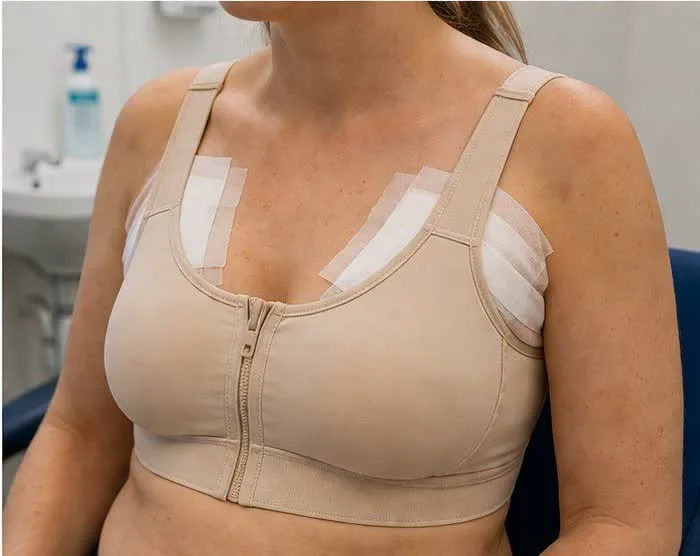
Specially designed bras and soft bras for women after mastectomy allow comfortable wear of an external prosthesis, or comfortable wear without a prosthesis. Some women choose to wear nothing — this is also a fully valid choice.
Medical areola tattooing is offered only after breast volume reconstruction — it does not apply to flat closure. However, some women choose a decorative tattoo on their scar, which is entirely a personal choice.
It is a real choice, fully valid in its own right. There is no hierarchy between reconstruction techniques — each woman has different priorities, a different relationship with her body, and different life circumstances. Flat closure is offered, explained and respected on equal terms with all other options.
What matters is how the surgeon performs the closure. A good flat closure requires a specific surgical intention — excess skin removal, careful scar placement, chest symmetry. It is not less surgery.
Positive, empowered choice Offered on equal terms with other techniquesMastectomy with flat closure is covered by French health insurance (Assurance Maladie) on the standard tariff within the ALD long-term illness framework for breast cancer, or in a prophylactic setting (BRCA).
Dr Zeitoun practices in sector 2 (non-OPTAM) — additional fees apply, including for patients with ALD status. A detailed, transparent quote is provided at consultation before any procedure. Your supplementary insurance (mutuelle) may cover part or all of the additional fees.
External breast prostheses are covered separately by French health insurance (renewed every 18 months).
Covered on standard SS tariff (ALD) Additional fees — sector 2 non-OPTAM External prosthesis covered separatelyYes, absolutely. In the context of prophylactic mastectomy for BRCA1 or BRCA2 mutation, flat closure is a fully valid option — offered and respected on equal terms with implant reconstruction or autologous tissue reconstruction.
Women who choose this option in a prophylactic setting often have a clear sense of their relationship with their body and their priorities. This choice is fully coherent and deserves to be supported.
Offered in prophylactic BRCA setting Respected on equal terms with other techniquesYes. Flat closure is not irreversible. Secondary reconstruction by implant or autologous tissue remains possible later on, if skin and oncological conditions allow it.
It is never too late. Delayed reconstruction is discussed at consultation whenever you feel ready — months or years after mastectomy. The timing is entirely yours to decide.
Secondary reconstruction always possible Never too late to reconsiderAfter total mastectomy, there is no longer any glandular tissue to monitor on the operated side — mammography is reserved for the contralateral breast. There is no prosthesis MRI required as there is no implant.
Oncological follow-up continues unchanged — regular oncology consultations, contralateral mammography, and any investigations prescribed by your team. Flat closure does not alter your cancer surveillance in any way.
No prosthesis MRI needed Oncological surveillance unchanged Contralateral mammography maintainedTwo possible situations, two adapted approaches. Choose the one that best matches your journey.
A second opinion at the practice before your mastectomy: we assess together whether flat closure matches your project, review the surgical technique and skin marking.
Request a second opinion →Video teleconsultation from home: assessment of the current chest (dog-ears, scar), feasibility of surgical revision or lipofilling if needed, and option of a secondary breast reconstruction if you wish.
Video teleconsultation →Unsure or prefer talking? Request a callback from the secretary — Coralie will guide you to the right slot.
Dr Zeitoun practices in sector 2 (non-OPTAM) and charges additional fees for all consultations and procedures. French health insurance (Assurance Maladie) reimburses on the basis of the standard SS tariff — this reimbursement is enhanced in cases of breast cancer (ALD 30) but does not cover additional fees. Your supplementary insurance (mutuelle) may cover part or all of these fees depending on your contract.