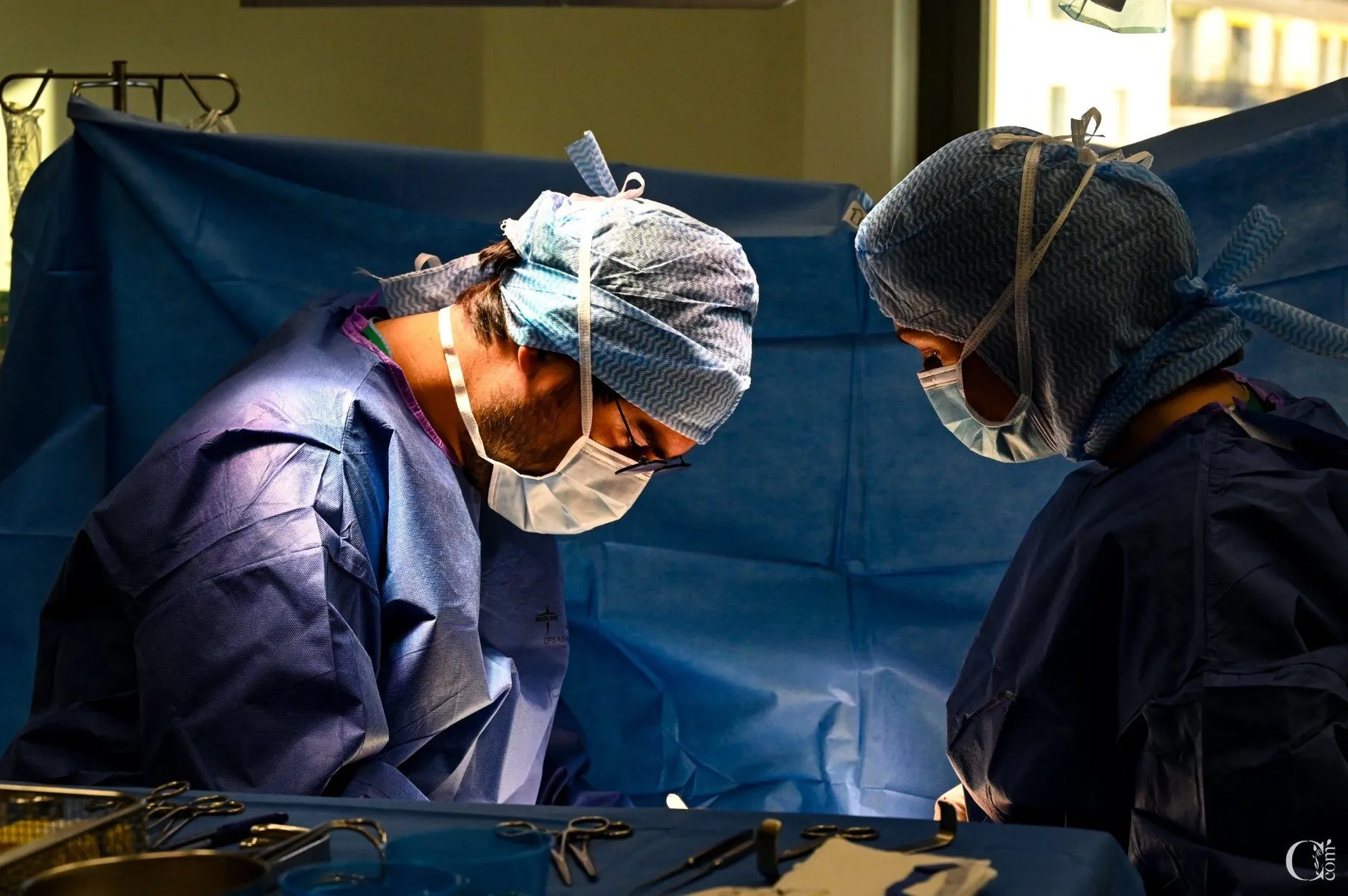
BRCA mutation or very high breast cancer risk. Immediate reconstruction possible in the same procedure.
Prophylactic mastectomy reduces the risk of breast cancer by 90 to 95% in women with very high genetic risk. It can be discussed and offered in the following situations.
Do you have a genetic workup revealing a predisposition, or significant family history of cancers (breast, ovary)? Dr Zeitoun will see you for a dedicated consultation to analyse your situation, discuss options and answer all your questions — without pressure or commitment.
Prophylactic mastectomy is never an urgent decision. Dr Zeitoun will see you to analyse your situation, explain the available options and answer all your questions — before any surgical decision.
Each case is discussed in a multidisciplinary team meeting (MDT). The surgical technique and reconstruction are chosen together, during a dedicated consultation, taking into account your morphology, medical history and wishes.
Prophylactic mastectomy is not the only option. Intensive surveillance is a medically validated alternative. Both approaches are discussed together, without judgement, taking into account your mutation, age and wishes.
Surveillance must begin with breast MRI, followed by mammography with or without ultrasound within 2 months, at the same centre. The protocol recommended by SénoriF 2025-2026 is as follows:
Age 20-25: annual clinical examination only. No systematic imaging.
Age 25-30: breast MRI optional (to be discussed according to family history), six-monthly clinical examination. Mammography not recommended at this age.
Age 30-65: annual breast MRI + mammography 1 view (lateral oblique) + optional ultrasound at radiologist's discretion + six-monthly clinical examination.
After age 65 (disease-free): MRI to be discussed (especially if high breast density) + mammography 2 views + six-monthly clinical examination.
This surveillance does not eliminate the risk but allows detection at a very early stage. According to SénoriF 2025-2026, the benefit/risk ratio of prophylactic mastectomy is debatable before age 30, favourable between 30 and 65, and low after 65. The residual cancer risk after prophylactic mastectomy is below 2%.
For rare genetic predispositions, surveillance modalities and surgical indications differ depending on the gene involved and must be validated in a specialised genetic oncology consultation (FAR Curie-Gustave Roussy 2024 and SAR-AP-HP guidelines).
TP53 mutation (Li-Fraumeni syndrome): prophylactic mastectomy may be discussed from age 20, as breast cancer treatment may increase the risk of secondary cancer in these patients.
PHTS syndrome (PTEN mutation): in cases of early severe breast disease with surveillance difficulties, early prophylactic mastectomy may be considered.
CHEK2, ATM, RAD51C, RAD51D variants: no indication for prophylactic mastectomy in the absence of severe family history. To be discussed at MDT if significant family history.
Some women present a very high risk without an identified causal mutation — assessed in genetic oncology consultation using modified Claus or BOADICEA scores. SénoriF 2025-2026 defines the threshold as a risk at least 4 times that of the general population (Canrisk > 30-35% or Claus score > 40%).
In this situation, prophylactic mastectomy may be discussed on a case-by-case basis at MDT. There is no recommendation for prophylactic oophorectomy in the absence of family history of ovarian cancer.
Surveillance or surgery — neither is the universal right answer. Dr Zeitoun reviews your file, mutation, family history and wishes to help you make an informed decision, at your own pace.
After prophylactic mastectomy, reconstruction can be performed immediately during the same procedure. All techniques are available — implant, expander, DIEP, latissimus dorsi, gracilis, lipofilling, flat closure. The choice depends on your morphology, medical history and wishes.
Prophylactic mastectomy is part of a coordinated pathway. Each step is planned with you.
No. It is an option, not an obligation. Intensive surveillance (MRI, mammography, clinical examination) is a medically validated alternative. Prophylactic mastectomy reduces breast cancer risk by over 90% — but the decision belongs entirely to the patient, after full information and without rushing.
According to SénoriF 2025-2026, the benefit/risk ratio of prophylactic mastectomy is debatable before age 30, favourable between 30 and 65, and low after 65. For TP53 mutations, the discussion may begin from age 20 due to the risk of secondary cancer from treatment. Each situation is assessed individually at MDT.
In most cases yes. Nipple-sparing mastectomy is offered when preoperative breast imaging shows no abnormality. It provides the best aesthetic result. If preservation is not possible, the areola can be reconstructed secondarily by 3D medical tattoo or local flap.
Yes, in the context of a confirmed BRCA mutation, prophylactic mastectomy is covered by French Health Insurance (Assurance Maladie). Dr Zeitoun practises in Sector 2 with additional fees — a personalised quote is provided at the preoperative consultation. Your supplementary insurance may reimburse part or all of the additional fees.
No. You can consult without a confirmed result if you have significant family history. Dr Zeitoun can refer you to a genetic oncology consultation if needed, and explain the different options according to your risk profile.
BRCA1/BRCA2 patients also have a high risk of ovarian cancer. Bilateral prophylactic salpingo-oophorectomy may be discussed: recommended at age 40 for BRCA1, deferrable to 45 for BRCA2, and offered at menopause (50-55) for PALB2. Both procedures are performed in separate operations.
Consulting rooms: 241 rue du Faubourg Saint-Honoré, Paris 8th · Surgery: Clinique Hartmann, Neuilly-sur-Seine · Former specialist practitioner at Institut Gustave Roussy