

Ovarian Cancer surgery & treatment Dr Jérémie Zeitoun · Gynaecological Surgeon in the 8th arrondissement of Paris
Often diagnosed at an advanced stage. The quality of the initial surgery is the most important prognostic factor.

Ovarian cancer accounts for about 5,348 new cases in 2023 in France (INCa). In nearly 70% of cases it is found at an advanced stage, because symptoms appear late and are non-specific. The operation discussed is cytoreductive surgery. Dr Jérémie Zeitoun sees patients in the 8th arrondissement of Paris and at Clinique Hartmann (Neuilly-sur-Seine), where he operates.
A cancer that can be treated, even at an advanced stage
Being told you have ovarian cancer is overwhelming — especially since it is often discovered late. But treatments have advanced considerably, and durable remissions are now achieved in many cases.
Ovarian cancer represents about 5,348 new cases per year in France (INCa). In nearly 70% of cases, it is discovered at an advanced stage, because symptoms appear late and are non-specific. This is not inevitable: ovarian cytoreductive surgery, performed in an experienced centre, remains the most decisive treatment for prognosis. Advances in the last ten years — PARP inhibitors, better understanding of genetic profiles — have profoundly changed what can be achieved, including at stages III and IV.
The stage is defined according to FIGO classification: stage I — limited to the ovaries; stage II — pelvic extension; stage III — abdominal extension or retroperitoneal lymph nodes (the most frequent at diagnosis); stage IV — distant metastases (pleura, liver, spleen). The stage determines the strategy, but is not the only prognostic factor — the quality of surgical resection and the genetic profile matter just as much.
Reference source: National Cancer Institute — Ovarian Cancer — ESGO 2023 guidelines, Saint-Paul de Vence 2024-2025.
You have just received a diagnosis, or you would like a second opinion? A consultation allows you to take stock of your situation and the available options.
Surgery is the key factor
Personalised treatments
A collaborative decision
Signs that are often subtle, long overlooked
The symptoms of ovarian cancer are generally not very specific at first. They are diffuse signals, easily attributed to something else — which explains the late diagnosis in nearly 70% of cases.
The initial workup and diagnostic laparoscopy
Ovarian cancer is not diagnosed by percutaneous biopsy — a suspicious ovarian tumour is not punctured. The workup includes imaging, blood tests, and most commonly a laparoscopy which confirms the diagnosis and determines the stage. The reference international guidelines are those of ESGO, plus French Saint-Paul de Vence 2024-2025.

CA-125 — the most used in epithelial ovarian cancers.
HE4 — more specific, complements CA-125.
ROMA score — combines CA-125 and HE4 to estimate malignancy risk.
In rarer cases (germ cell tumours, stromal tumours): inhibin B, LDH, βHCG may be requested depending on the context.
Diagnostic laparoscopy
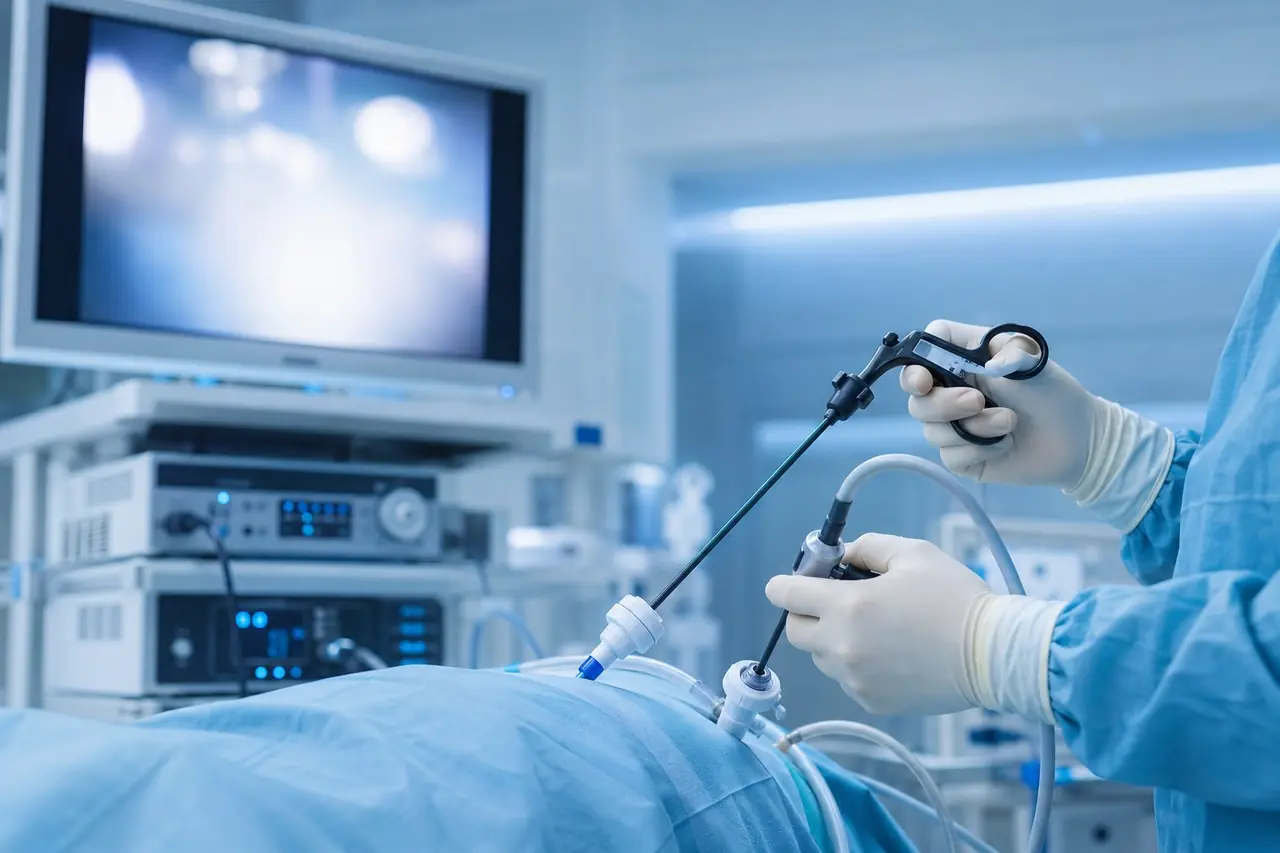
What it is, and why it is necessaryWhat it is for. Diagnostic laparoscopy is a small camera introduced into the abdomen through tiny incisions. It allows visualisation of the extent of disease, sampling for analysis, and most importantly assessment of whether complete resection is feasible upfront.
Why we do not biopsy through the skin. Puncturing a suspicious ovarian mass through the skin would risk disseminating tumour cells in the abdomen. This procedure is contraindicated if surgery is accessible.
What it decides. At the end of the laparoscopy, we know whether to operate directly (upfront surgery) or to start with chemotherapy to reduce disease before operating. This is the most important decision of the pathway — it is taken at the MDT.
The Fagotti laparoscopic score quantifies the extent of peritoneal disease. A PI score above a certain threshold indicates that upfront complete resection is not achievable — chemotherapy first is then the recommended strategy.
Not all ovarian cancers are alike
The histological type — the nature of the cancerous cells analysed under the microscope — sometimes profoundly changes management. Having a high-grade serous carcinoma is not the same as having a borderline tumour.
High-grade serous carcinoma
The most common — accounts for approximately 70% of casesThe most common type. It is often diagnosed at an advanced stage. It is the one that responds best to platinum-based chemotherapy and PARP inhibitors — particularly in case of BRCA mutation or genomic instability.
Complete cytoreductive surgery is the cornerstone of treatment. Prognosis depends mainly on the quality of this resection and on the genetic profile of the tumour.
Mucinous carcinoma
Relatively rare, with distinctive behaviourMucinous ovarian carcinoma is relatively rare. When diagnosed, the first question is to ensure that it is indeed a primary ovarian cancer — and not a metastasis from a digestive or appendiceal cancer that has migrated to the ovary, which would completely change management.
When it is truly primary, it is often diagnosed at an early stage and responds less well to standard chemotherapy than serous carcinoma. Complete surgery is all the more important.
Clear cell carcinoma
Very rare, sometimes associated with endometriosis historyClear cell carcinoma is very rare. It is sometimes found in women with a history of endometriosis — but endometriosis does not cause this cancer, and the vast majority of women with endometriosis will never develop cancer. This is an observed association, not a cause-and-effect relationship.
This tumour type responds less well to standard platinum-based chemotherapy than serous carcinomas. Complete surgery is even more decisive. Clinical trials are seeking to identify better-suited treatments.
Borderline tumours
A category apart — different management, excellent prognosisBorderline tumours occupy an in-between space: they are not benign, but they do not invade neighbouring tissues like a classical cancer. They are often diagnosed in young women, sometimes during a fertility workup. Their prognosis is overall very favourable.
Their management is very different from ovarian cancer: surgery alone in the vast majority of cases, no routine chemotherapy, fertility preservation often possible. But long-term follow-up — at least 10 to 15 years — is essential because recurrences can be late.
Treatments for ovarian cancer
Surgery, chemotherapy, maintenance treatment — each modality has a specific role. Here is what each represents in practice.

Surgery
The most important treatment — its outcome conditions everything elseThe aim is to remove all visible tumour in the abdomen — leaving no residue. This is open abdominal surgery (laparotomy), often long, which may include the uterus, ovaries, fallopian tubes, omentum, portions of peritoneum, bowel or other organs depending on disease extent.
It can be performed upfront if disease is resectable, or after a few cycles of chemotherapy to reduce the tumour before operating. In both cases, the goal remains the same: leave nothing.
It must be performed in an authorised specialised centre — this is a requirement under French regulation, because the quality of this procedure directly impacts prognosis.
Chemotherapy
Before or after surgery — sometimes bothReference chemotherapy combines two drugs: carboplatin and paclitaxel, administered intravenously every 3 weeks for 6 cycles. A third drug, bevacizumab, may be added — it works by cutting off the tumour's blood supply.
Before surgery (neoadjuvant chemotherapy): 3 to 4 cycles to reduce disease and allow complete resection that would not have been possible upfront.
After surgery (adjuvant chemotherapy): to eliminate microscopic residual cells that surgery cannot see.
The most frequent side effects are fatigue, nausea, temporary hair loss, and increased susceptibility to infections. They are managed by the medical team throughout treatment.
Maintenance treatment
To maintain remission after chemotherapyOnce chemotherapy is completed, maintenance treatment is often offered to prolong remission. It does not cure on its own — it prevents or delays disease recurrence.
PARP inhibitors (olaparib, niraparib, rucaparib) are tablets that prevent tumour cells from repairing their damaged DNA. They are particularly effective if the tumour carries a BRCA mutation or genomic instability. They are taken daily for several months to years.
Bevacizumab may also be used in maintenance, as injections every 3 weeks. It is often combined with olaparib or used alone depending on tumour profile.
The choice of maintenance treatment depends on BRCA status, tumour genomic instability, and what was used during chemotherapy. It is decided at the MDT after molecular workup results.
Clinical trials
An option to consider at every stageClinical trials test new drugs or new combinations, often before they are available outside hospital. Participating means accessing innovative treatments while contributing to progress for future patients.
They are offered at every stage: at diagnosis, first line, and especially in case of recurrence. Your team will inform you of trials for which you are eligible. It is never an obligation — it is always an informed choice.
In ovarian cancer, clinical trials have produced the most important advances of the last 20 years — particularly the validation of PARP inhibitors.
Your pathway, step by step
From the first symptom to long-term follow-up. Every decision is made in consultation with you.
Cytoreductive surgery in Paris
Ovarian cancer surgery in Paris must be performed in an authorised B5 centre. The aim is always the same: to leave no visible tumour residue (CC-0). This complete resection is the most powerful prognostic factor.
What exactly is removed?
The extent of surgery depends on disease extensionIn all cases, we remove the uterus, both ovaries and both fallopian tubes, as well as the abdominal omentum (often involved). All visible suspicious lesions are removed at the same time — that's the goal of leaving no residue.
Depending on disease extent, surgery may include: peritoneal resections (the membrane lining the abdomen), part of the bowel, the spleen, lymph nodes along the major vessels. These procedures are decided during the operation according to what is found.
This is open abdominal surgery (laparotomy). Unlike other gynaecological operations performed by laparoscopy with small incisions, ovarian cytoreduction usually requires complete abdominal opening — to allow exploration and treatment of the entire abdomen.
The risk of stoma. If a portion of bowel must be removed and immediate junction is not possible in the safest conditions, a temporary stoma may be necessary — this is an opening of the bowel onto the abdomen to allow healing. It is most often closed a few weeks to months later. This risk is discussed with you before the operation.
Why this is demanding surgery. It is long, technically difficult, and carries non-negligible risks. This is why it must be performed in a B5-authorised centre with specific ovarian cancer experience — this is French regulation.
Upfront surgery or chemotherapy first?
The most important decision — taken after laparoscopyUpfront surgery — if complete resection is judged feasible at the start (stages III-IVA). We operate, then give adjuvant chemotherapy.
Chemotherapy first — if disease is too extensive for upfront complete resection, or if general condition requires it. 3 to 4 cycles of chemotherapy first, then interval surgery if disease responds. For stage IVB (distant metastases), chemotherapy first is systematic.
It is not a compromise. Doing chemotherapy first is not a second-choice option — it is the appropriate strategy when it allows complete resection that would not have been possible otherwise.
HIPEC — hyperthermic intra-peritoneal chemotherapy
An option in certain recurrence casesWhat it is. At the end of surgery, heated chemotherapy is infused directly into the abdomen for 30 to 90 minutes. It aims to eliminate microscopic residual cells that surgery alone cannot reach.
In what cases. HIPEC is mainly discussed in platinum-sensitive recurrence, when complete resection is possible and disease responds to chemotherapy — according to CHIPOR trial criteria. It is not systematic in first line.
It is a specialised technique performed only in centres trained in this procedure.
Do you have a question about the planned surgery, or have you been offered a strategy you don't fully understand? I'll explain everything during the consultation — not just the medical aspects.
BRCA, HRD and PARP inhibitors
In ovarian cancer, BRCA status and HRD are key markers that guide maintenance treatment. These terms can be frightening — here is what they mean in practice and why they sometimes profoundly change management.

If I have a BRCA mutation, what changes?
For you, and for your familyBRCA1 and BRCA2 are genes involved in DNA repair. A mutation in one of these genes increases the risk of ovarian and breast cancer. In ovarian cancer, a BRCA mutation is found in 15–20% of cases.
For your treatment. A BRCA mutation predicts better sensitivity to platinum-based chemotherapy and particularly good response to PARP inhibitors (olaparib as first choice). This opens access to effective maintenance treatment.
For your family. If a somatic BRCA mutation is found in your tumour, a constitutional genetic test will be offered to determine whether this mutation is hereditary. If so, your first-degree relatives (mother, sisters, daughters) can benefit from testing and, if they carry the mutation, enhanced surveillance or preventive measures.
A genetic consultation is systematically organised in this context — you do not have to manage this information alone.
What maintenance treatment based on my profile?
The strategy depends on BRCA/HRD status and treatment receivedBRCA-mutated + HRD positive: olaparib ± bevacizumab. The most effective maintenance combination in this configuration.
HRD positive but BRCA wild-type: niraparib or olaparib + bevacizumab depending on the protocol. PARP inhibitors remain beneficial even without BRCA mutation when HRD is present.
HRD negative (BRCA wild-type, HRD negative): bevacizumab alone if used in induction. PARP inhibitors offer less benefit in this configuration. Clinical trial participation is particularly relevant here.
The GIS (Genomic Instability Score) measures HRD. A positive result — even without BRCA mutation — opens access to PARP inhibitors as maintenance treatment. This test is performed on the tumour at diagnosis.
Pregnancy, ovaries, fertility — what is possible
The question of fertility arises differently depending on age, tumour type and stage. It must be addressed before treatment begins — not afterwards.
Ovarian cancer and fertility preservation
Possible in selected cases — to be discussed at the MDTFor the vast majority of epithelial ovarian cancers (advanced stage, post-menopausal patient or no desire for pregnancy), surgery includes removal of both ovaries, fallopian tubes and uterus. This is not a question of choice — it is the condition for achieving complete resection.
In young women with stage IA well-differentiated cancer or a germ cell tumour, preservation of the uterus and contralateral ovary is sometimes discussed at the multidisciplinary team meeting. This is not the rule — it is a carefully framed exception.
Borderline tumours are a category of their own. They often affect young women, their prognosis is favourable, and fertility preservation is frequently possible. → Read the dedicated page on borderline ovarian tumours
Surgical menopause after the operation
What changes, and the available optionsRemoval of both ovaries causes immediate menopause in pre-menopausal women. Hot flushes, sleep disturbances, vaginal dryness, mood changes — these effects are real and can be significant.
Hormone replacement therapy (HRT) is discussed on a case-by-case basis. It is not contraindicated in principle in non-hormone-dependent ovarian cancers — but the decision belongs to the oncology team. The aim is to find the right balance between quality of life and safety.
This question is addressed during the pre-operative consultation and revisited at follow-up. It deserves to be raised explicitly — don't wait for it to come up.
Before treatment begins, an oncofertility consultation can be organised at short notice to discuss oocyte or embryo cryopreservation if relevant.
Life after treatment
Ovarian cancer treatment is long — between surgery, chemotherapy and maintenance treatment, we often talk about 12 to 18 months of active treatment. Here is what you can concretely expect afterwards — follow-up, possible recurrence, recovery times — so you can prepare for it.
Hospital stay for surgery
Follow-up after treatment
Return to activity
Recurrence after 6 months
Recurrence before 6 months
Surgical menopause
Questions about follow-up, suspected recurrence, or would you like a second opinion? I answer practical questions as well as medical ones.
Frequently asked questions about ovarian cancer
Ovarian cancer requires expert surgical management at an authorised B5 centre with specific experience in gynaecological oncology. In Paris, Dr Jérémie Zeitoun manages ovarian cancers at Clinique Hartmann (Neuilly-sur-Seine) He sees patients in Paris 8th and at Clinique Hartmann (Neuilly-sur-Seine), where he operates. Every case is presented at a multidisciplinary meeting before any surgical decision.
Hysterectomy in ovarian cancer surgery
In ovarian cancer, hysterectomy is part of complete cytoreductive surgery, alongside bilateral salpingo-oophorectomy, omentectomy and additional procedures based on disease extent. The goal is no residual disease at the end of surgery.
- → Hysterectomy + bilateral salpingo-oophorectomy systematic
- → Omentectomy and additional procedures based on extent
- → Pelvic and para-aortic lymphadenectomy in early stages
- → Surgical principles, complications, full pathway
Surgical procedures associated with ovarian cancer
Book an appointment
Come with your questions, your results, your concerns. We take the time to discuss everything together.
Transparent pricing
Dr Zeitoun practises as a private specialist (Sector 2). French national health insurance reimburses on the basis of the standard rate — improved for cancer patients (ALD 30). Complementary health insurance may cover additional fees.
Ovarian cancer can be hereditary
In 15 to 20% of cases, ovarian cancer is linked to an inherited genetic mutation — BRCA1, BRCA2 or other genes. If family members have had breast or ovarian cancer, assessing your profile may be useful.
The Eisinger Score, recommended by the French National Cancer Institute (INCa), identifies in 6 questions whether your family history warrants discussion with a doctor. No data recorded — 100% confidential.
Whether your family history is suggestive of a hereditary predisposition
Whether a genetic oncology consultation could be useful for you or your family
Whether close relatives (sisters, daughters) should benefit from enhanced screening
The vast majority of ovarian masses are not cancers. To understand benign cysts, how their risk is assessed (IOTA, O-RADS) and when surgery is needed, see our dedicated article: Ovarian cyst: do you need surgery, and how?.
Patient guideOvarian cyst: do you need surgery, and how?
Functional or organic cyst, dermoid, endometrioma: which to monitor, which to operate on. Surgical criteria (O-RADS, IOTA), laparoscopy and fertility preservation.
Read also