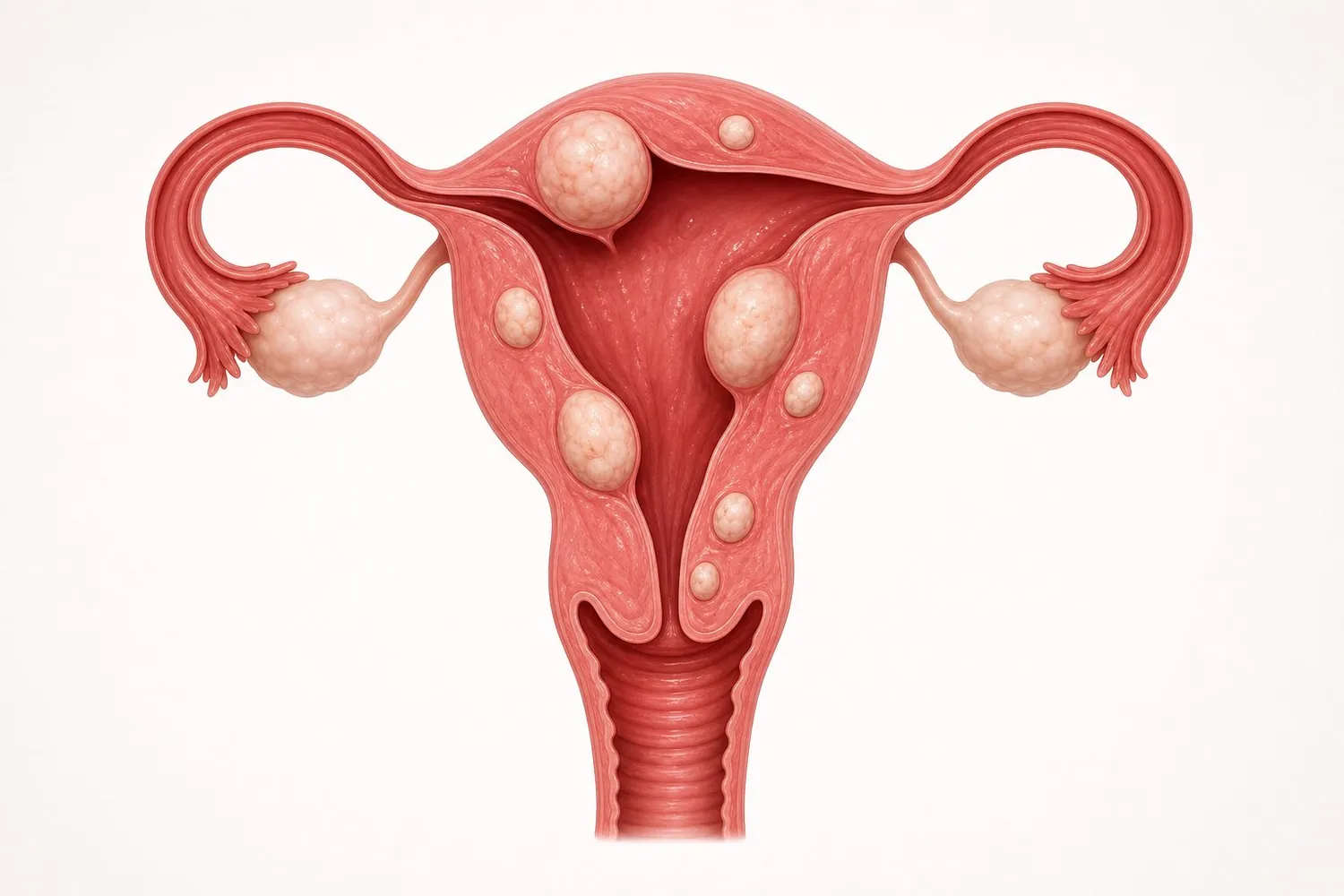
Heavy periods, pain, infertility — uterine problems are common. Most procedures are now performed as day surgery.
Fibroid and myoma are the same thing — a benign growth that forms in the muscle of the uterus. Very common, it only causes problems when it produces symptoms.
Depending on its position, three types are distinguished. Fibroids that grow into the uterine cavity — endometrium (FIGO 0-1-2) — the most disruptive for periods and fertility. Those that remain within the muscle wall (FIGO 3-4-5). And those that grow outward, on the surface. This position determines the operation proposed — which is why an ultrasound or MRI is always requested before any decision is made.
For which fibroids. Submucosal fibroids (FIGO 0, 1 and 2) — those projecting into the uterine cavity. These are the fibroids most responsible for heavy bleeding and fertility problems.
How it works. A small camera is introduced through the cervix — no incision. The fibroid is removed using a surgical instrument under direct vision. Day surgery, under general or local anaesthesia. You go home the same day.
Fertility. Hysteroscopy preserves the uterus. Pregnancy is possible immediately afterwards. It is the reference procedure for fibroids causing fertility problems.
For which fibroids. Intramural fibroids (within the muscle, FIGO 3-4-5) or subserosal fibroids (on the outer surface) that are symptomatic or large. Laparoscopy allows removal of the fibroid while preserving the uterus.
How it works. 3 to 4 small incisions on the abdomen (less than 1 cm each). The fibroid is removed and the muscle is sutured. Day surgery or 1 night depending on the size and number of fibroids.
Fertility. Laparoscopic myomectomy preserves the uterus and fertility. A caesarean section may be recommended for subsequent pregnancies depending on the extent of muscle repair.
When it is indicated. For very large fibroids (generally above 10 cm) or very numerous fibroids where laparoscopy would not allow safe complete removal. Laparotomy (open surgery via a lower abdominal incision) allows more extensive access.
Hospitalisation. 2 to 4 days. Return to work in 4 to 6 weeks.
When there are multiple fibroids, the decision is more complex. The objective is to remove the symptomatic fibroids — those responsible for bleeding, pain or infertility — without necessarily removing all of them. The risk of recurrence after myomectomy is real: approximately 20 to 30% at 5 years. This is discussed before the operation to choose the most appropriate strategy.
When myomectomy is no longer the best option — because of the number, size or after recurrence — hysterectomy may be discussed if there is no further desire for pregnancy.
Very heavy periods, anaemia or fibroid discovered on ultrasound? A consultation allows the indication to be established and the right technique to be chosen.
A uterine polyp is a small benign growth that forms inside the uterine cavity. Often discovered incidentally on ultrasound, it can cause more or less heavy bleeding during periods — menorrhagia — or between periods — metrorrhagia. It is systematically removed when it causes symptoms or before an assisted reproduction attempt.
The reference procedure. Operative hysteroscopy removes the polyp under direct vision, without any incision. A camera is introduced through the cervix — no abdominal incision. Day surgery, under general or local anaesthesia. You go home the same day or within a few hours.
The specimen is sent for analysis. Even if a polyp is almost always benign, the specimen is systematically analysed by a pathologist to exclude an atypical endometrial hyperplasia or a rare endometrial cancer in the polyp.
After the procedure. Light bleeding for a few days. Resume normal activities the next day. No restrictions on sex for 2 to 3 weeks. A follow-up ultrasound is arranged at 3 months.
Two different conditions, one treatment. Synechia are adhesions that form after trauma to the uterine lining — the walls stick together and reduce the cavity. A uterine septum is present from birth: it is an internal wall that divides the uterus into two compartments. One is acquired, the other is congenital — but in both cases, they disrupt the uterine cavity, impair implantation and can cause infertility or recurrent miscarriages. And in both cases, the treatment is the same: a small camera introduced through the cervix, which cuts the adhesions or septum under direct vision, without incision, as day surgery.
For synechia. The adhesions are sectioned under hysteroscopic vision using small scissors or electrical energy. The cavity is then restored to its normal configuration. Post-operative oestrogen treatment promotes re-epithelialisation.
For uterine septum. The septum is sectioned at its base using scissors or a resectoscope, under direct vision. The procedure is performed in day surgery. Fertility improves significantly after sectioning — the rate of miscarriage decreases considerably.
Monitoring. A control hysteroscopy or 3D ultrasound is arranged at 2 to 3 months to verify the result.
Periods that have disappeared after a uterine procedure? Recurrent miscarriages? A consultation allows the diagnosis to be established.
Adenomyosis occurs when the lining of the uterine cavity (endometrium) infiltrates the muscle. The result: very painful, very heavy periods, and a uterus that enlarges. It is different from endometriosis, which affects the organs around the uterus.
Medical treatment is the first-line approach for adenomyosis: progestogens, levonorgestrel IUD (Mirena), GnRH analogue. These treatments reduce symptoms significantly in many women. Surgery is only considered when medical treatment has failed or is contraindicated.
Endometrectomy (destruction of the endometrium) or thermal ablation can be proposed when medical treatment has failed, when adenomyosis is mainly superficial, and when there is no desire for pregnancy. Day surgery under general anaesthesia. Periods are significantly reduced or disappear in 70 to 80% of cases.
When all other treatments have failed and there is no further desire for pregnancy, hysterectomy is the definitive solution. It cures adenomyosis. It is performed laparoscopically in the majority of cases — 2 to 3 days of hospitalisation.
Hysterectomy is the surgical removal of the uterus. It is proposed when medical treatments and conservative procedures have been insufficient, and when there is no further desire for pregnancy. It is the definitive solution for refractory benign uterine conditions.
Surgical approaches (laparoscopy, vaginal route, laparotomy), total or subtotal, salpingectomy, complications: everything is detailed on the dedicated page.
To go further on hysterectomy — total or subtotal, detailed surgical approaches, procedures on adnexa, surgical principles, approach-specific complication rates, alternatives — Dr Zeitoun has dedicated a complete page to this essential subject.
Come with your questions, your results, your concerns. We take the time to discuss everything together.
Dr Zeitoun practises as a private specialist (Sector 2). French national health insurance reimburses on the basis of the standard rate. Complementary health insurance may cover additional fees.