Ovarian cysts, endometrioma, adnexal torsion, hydrosalpinx. Minimally invasive, fertility-preserving.
Ovarian cysts, endometrioma, adnexal torsion, hydrosalpinx — none of these conditions necessarily requires surgery. The surgical decision depends on symptoms, how the condition evolves over time, and your fertility goals. Each situation is evaluated individually.
The discovery of a cyst or ovarian mass on ultrasound does not mean surgery is necessary. Diagnosis relies on structured imaging, today codified by the O-RADS classification.
O-RADS classification — what your score means
| 1 | Normal ovary |
| 2 | Almost certainly benign — monitoring or no action |
| 3 | Low risk — MRI recommended |
| 4 | Intermediate risk — surgical opinion required |
| 5 | High risk — specialist oncological management |
An O-RADS score of 4 or 5 does not necessarily mean cancer — it indicates that specialist management is needed.
You have a pelvic ultrasound or MRI showing a cyst or ovarian mass? Come with your results — we review them together in the consultation.
Certain symptoms should prompt a rapid consultation. A pelvic ultrasound can often clarify the situation within minutes. If your report mentions an O-RADS score of 3, 4 or 5, or a suspicious adnexal mass, a surgical opinion is recommended.
Not to be confused
PCOS (polycystic ovary syndrome) — PCOS is often confused with ovarian cysts. It is a hormonal disorder that causes the appearance of many small follicles on the ovaries — these are not true cysts. It manifests as irregular cycles, acne, and can lead to difficulties conceiving. Its management is medical, not surgical in the vast majority of cases.
You want prompt management or an opinion on your pelvic ultrasound or MRI results? Book a consultation.
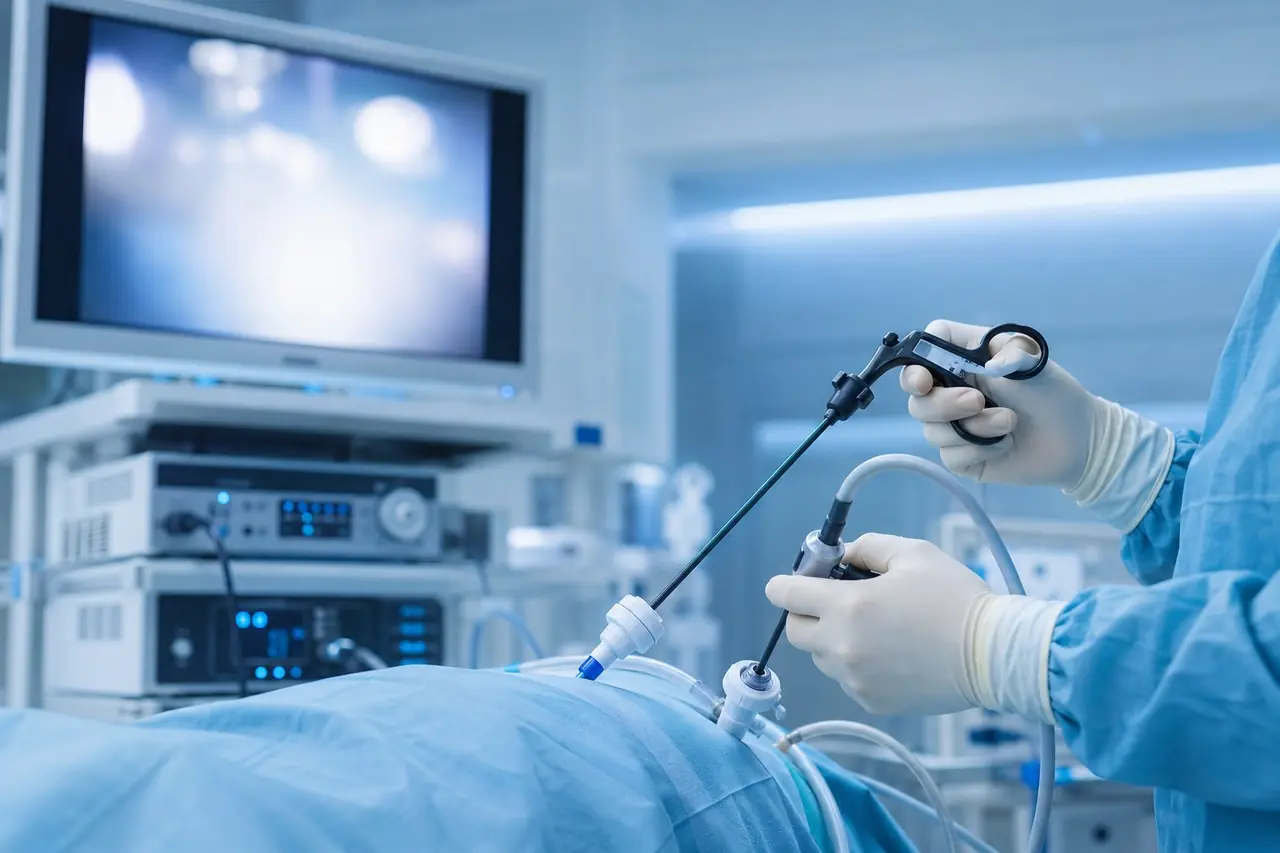
Almost all these procedures are performed by laparoscopy — 3 to 4 small incisions on the abdomen, without opening it. Fast recovery, short hospitalisation, discreet scars.
What it is. Cystectomy involves removing the cyst by dissecting it from the healthy ovarian tissue. The ovary is preserved. This is the reference procedure for benign cysts in women of reproductive age.
In the case of an endometrioma. Classic surgery (cystectomy) is increasingly avoided because it always removes some healthy ovarian tissue, which can reduce chances of pregnancy — especially if the procedure is repeated or both ovaries are affected. In specialised centres, ovary-sparing techniques are preferred: plasma energy vaporisation, which destroys the inner wall of the cyst without touching the surrounding tissue, and ultrasound-guided alcoholisation (ethanol sclerotherapy), particularly useful when the cyst returns after a first operation or when the egg reserve is already fragile. Cystectomy retains its place for very large cysts or when there is doubt about the nature of the cyst.
When is the ovary removed? Adnexectomy (removal of the ovary and fallopian tube) is reserved for specific situations: suspicious cyst, non-conservable ovary, or post-menopausal woman. It is not the default decision.
Recovery. Return home the next day or the same day depending on the case. Return to light activity within 1 week, sport after 3 to 4 weeks.
An absolute emergency. In case of adnexal torsion, every hour counts. The faster the intervention, the higher the chances of preserving the ovary. Emergency laparoscopy allows the adnexa to be untwisted and blood supply restored.
Is the ovary always preserved? The goal is to preserve it, even if the ovary appears necrotic to the naked eye — it often recovers after detorsion. Adnexectomy is only performed if the ovary is definitively non-viable.
And afterwards? If a cyst was the cause of the torsion, it will be treated during the same operation or in a subsequent procedure depending on the situation.
Why operate? A hydrosalpinx reduces the chances of success in IVF — the fluid from the tube refluxes into the uterus and impairs embryo implantation. Salpingectomy (removal of the tube) significantly improves IVF success rates.
The contralateral tube. Removal of one tube does not prevent natural pregnancy if the opposite tube is healthy. In the case of planned IVF, salpingectomy is discussed with your fertility team before stimulation. In bilateral hydrosalpinx, IVF becomes the route to conception.
Recovery. Short procedure, often as day surgery. Return to normal activity within 5 to 7 days.
Laparoscopy allows rapid recovery. Timelines vary depending on the extent of the surgical procedure.
A word on fertility
Any ovarian surgery can impact the ovarian reserve, especially in cases of endometrioma or repeated surgery. If you have a desire for pregnancy, this point is discussed before the operation at Clinique Hartmann (Neuilly-sur-Seine) or at the Paris 8th practice — and an ovarian reserve assessment (AMH) can be proposed in advance.
Come with your results, your questions, your concerns. We take the time to discuss everything together.