Key figures — Deep contraceptive implant removal
Medical statistics for quick understanding.
Your implant can no longer be felt? Dr Zeitoun relies on an X-ray and ultrasound of the arm to plan its removal.
REQUEST A CALLBACKBOOK ON DOCTOLIB →The subcutaneous contraceptive implant (Nexplanon) is inserted in the arm in a few minutes at the GP practice. In some cases, however, it gradually migrates into deeper tissue and becomes impossible to feel — or to remove — by simple means. This situation, which affects approximately 1 to 2% of patients with an implant, requires specialist surgical management.
For full information on the surgical procedure, see our dedicated page on deep implant removal.
How does an implant end up too deep?
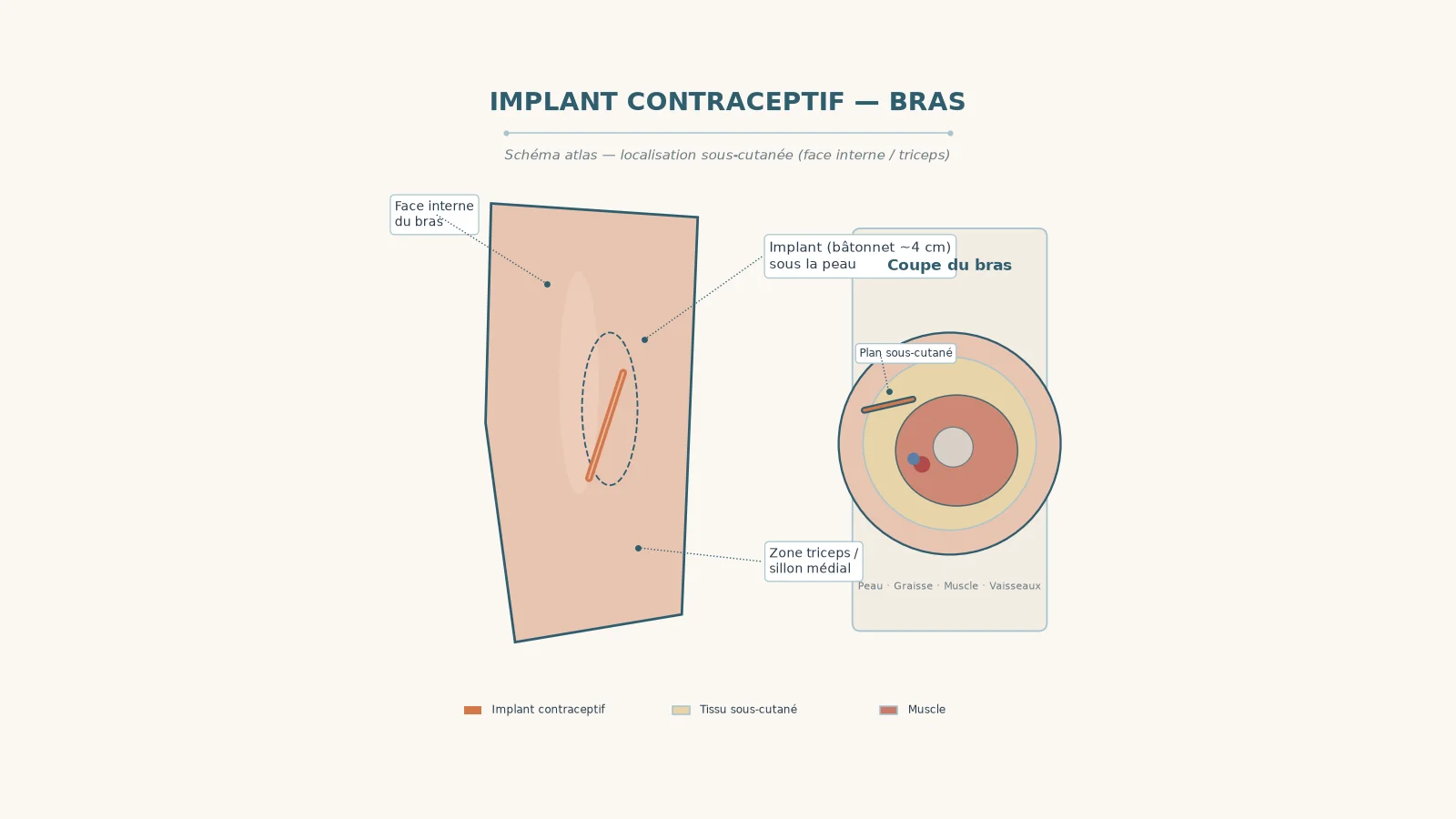
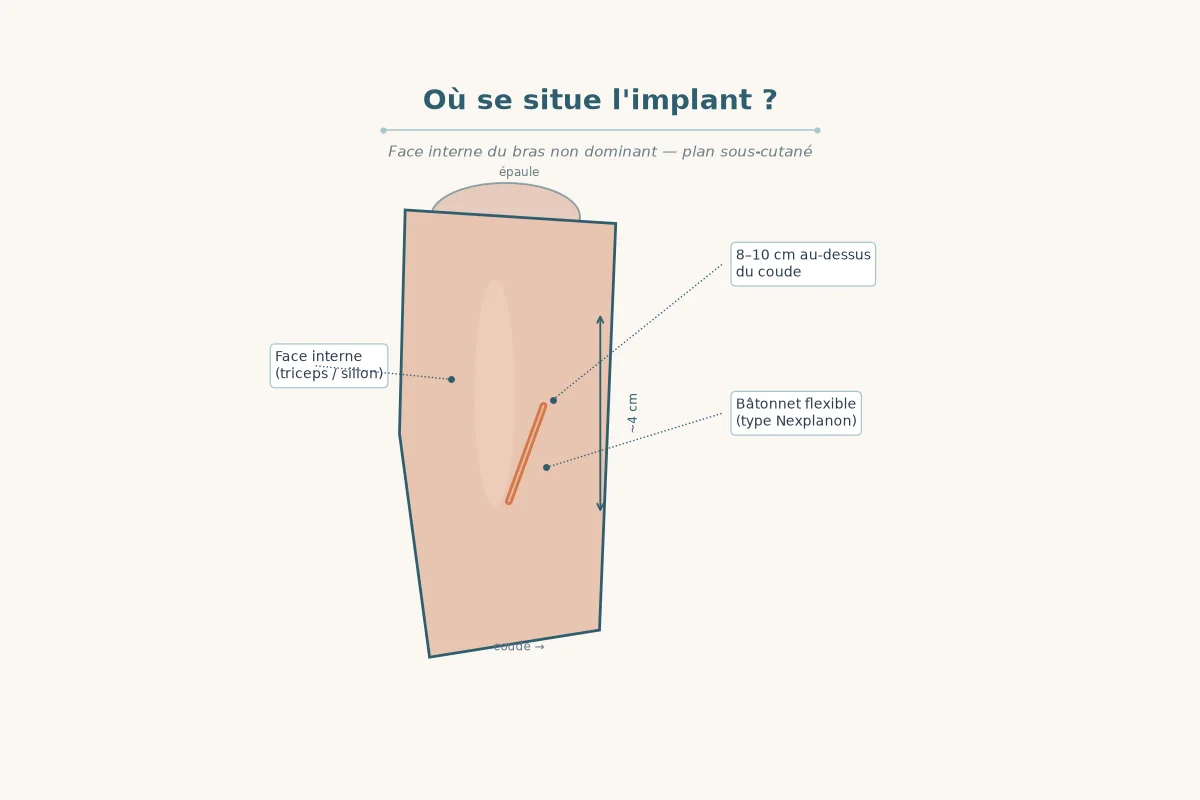
The implant should normally sit just below the skin, in the superficial subcutaneous tissue of the inner arm. Several mechanisms can lead to deep migration:
- Placement too deep at the time of insertion — the main cause
- Spontaneous migration through the connective tissue over time
- Progressive fibrosis trapping the implant within a fibrous sheath
- Significant weight gain after insertion
Important: in rare cases, migrations towards the thorax (subclavian vessels, lung) have been reported in the literature. This is exceptional, but it is why a full imaging workup is essential before any removal attempt.
Symptoms of a deep implant
- Implant no longer palpable at the insertion site
- Persistent pain or discomfort in the arm
- Previous failed removal attempt at the GP practice
- Sensory changes in the arm (tingling, numbness)
- Unexpected return of fertility — suggesting the implant has lost its hormonal efficacy
If the implant is no longer palpable, do not attempt removal at the GP practice. Prior imaging is essential.
Pre-operative workup: X-ray and ultrasound
Before any intervention, two investigations are required to precisely locate the implant:
- X-ray of the arm (front and side views) — the implant is radio-opaque and visible on plain X-ray. This confirms it is still in the arm and rules out thoracic migration.
- Ultrasound — identifies the exact depth of the implant, its relationship to surrounding neurovascular structures (basilic vein, median nerve, brachial vessels), and guides the surgical approach.
These are prescribed at the pre-operative consultation and allow the surgeon to plan the procedure safely.
Who can perform the removal?
Once imaging is available, it is analysed before any decision. In the vast majority of cases, the implant remains accessible to an experienced gynaecological surgeon. In rare situations — deep intramuscular migration, proximity to vascular structures — collaboration with an orthopaedic or vascular surgeon is arranged.
The key risk is injury to the basilic vein, the median nerve, or the brachial vessels during dissection. Only a surgeon trained in fine tissue dissection, in a fully equipped operating theatre, can perform this safely. This pre-operative assessment is precisely what ensures your safety.
The surgical removal procedure
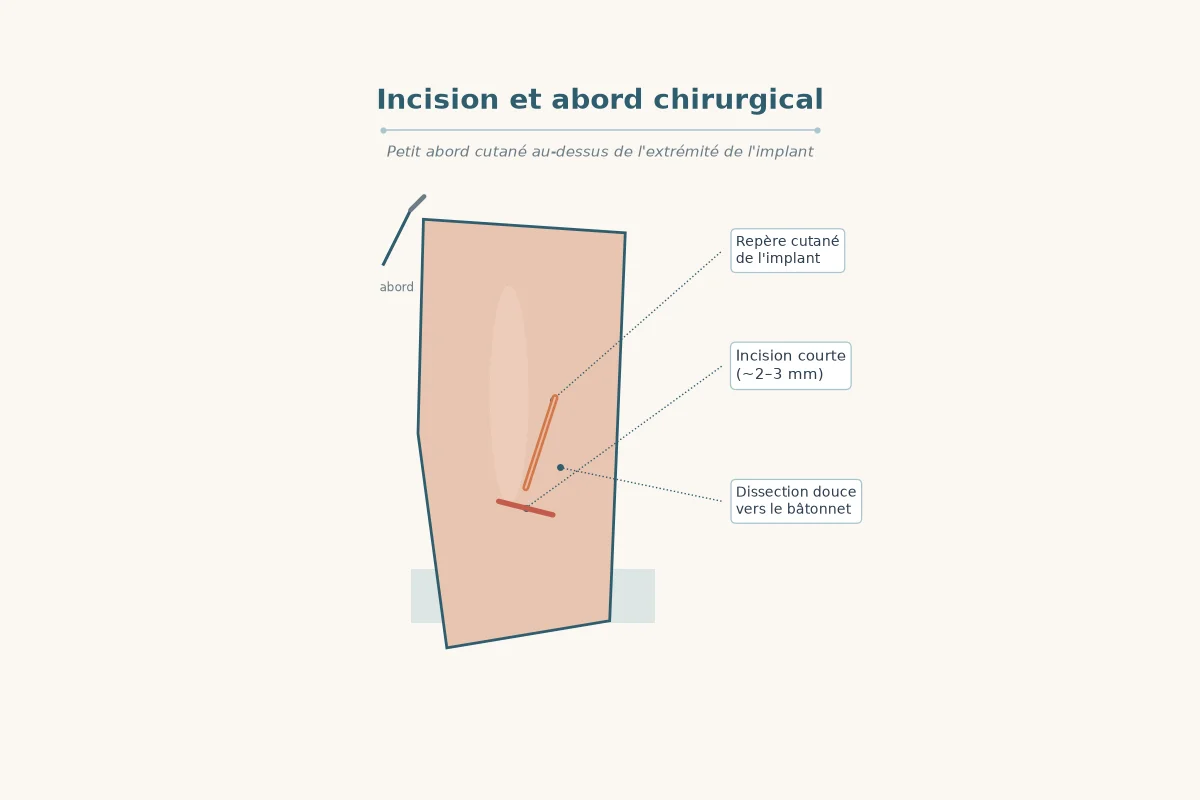
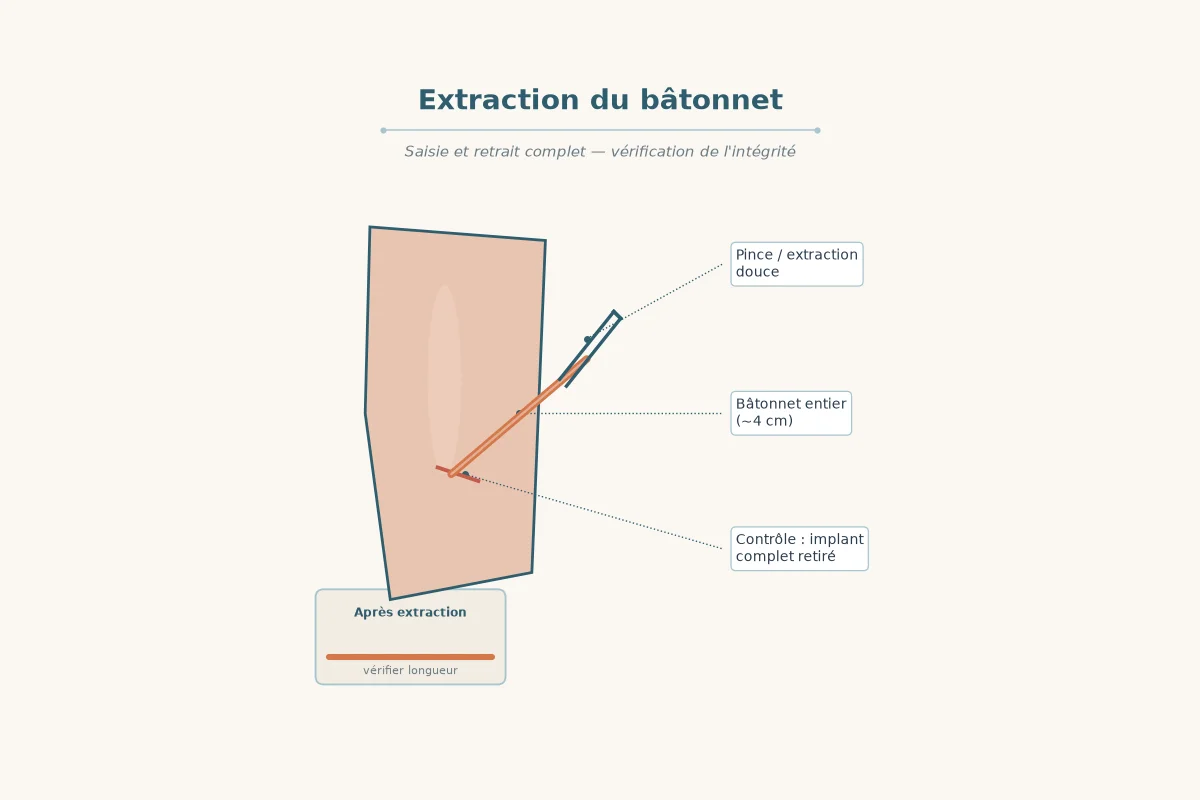
Removal is performed in the operating theatre under local anaesthesia. The patient lies with the arm positioned appropriately. After antiseptic preparation, an incision of approximately 1 to 2 cm is made at the site indicated by ultrasound. Dissection is careful and progressive, respecting the adjacent nerve and vascular structures. The implant is identified, freed from its fibrous sheath if necessary, and extracted. The wound is closed with a few absorbable sutures or steri-strips.
Dr Zeitoun removes the implant in the operating theatre under local anaesthesia, at the spot located by ultrasound.
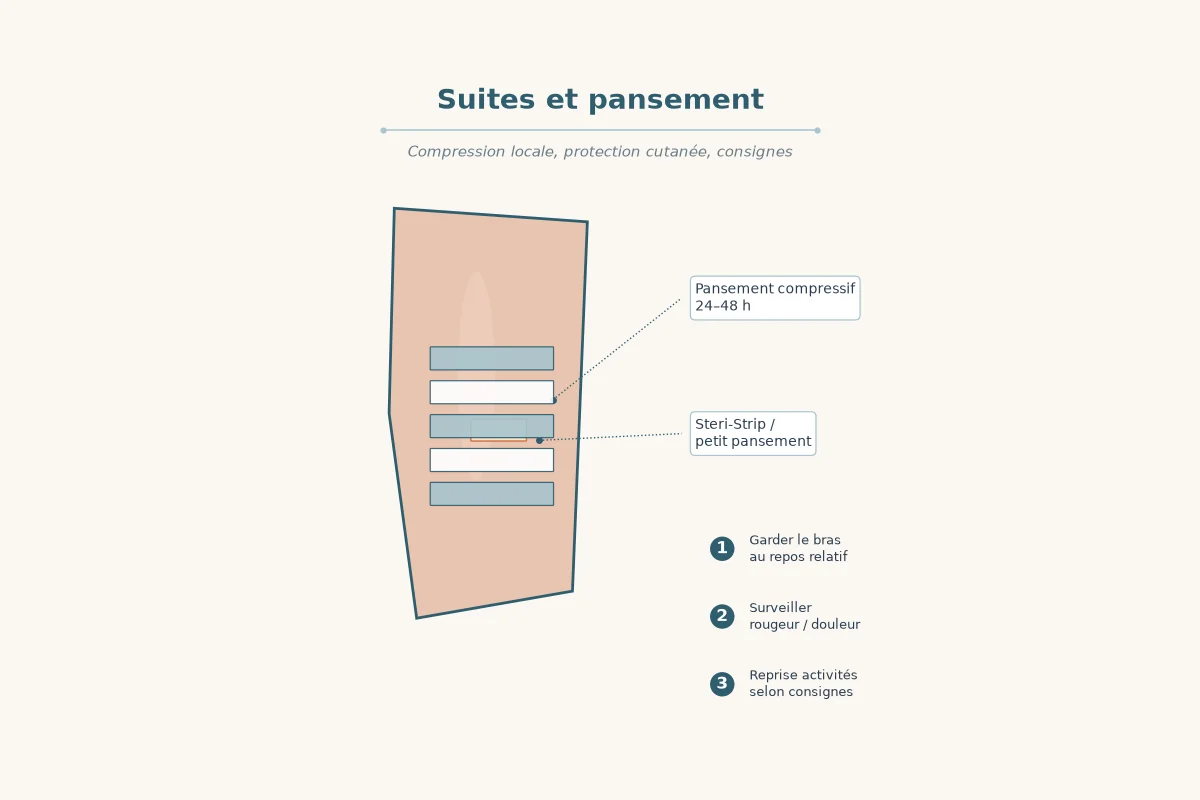
REQUEST A CALLBACKBOOK ON DOCTOLIB →The procedure takes 10 to 20 minutes. The patient goes home the same day. Recovery is straightforward: dressing to be kept for 48 hours, no heavy lifting for one week.
Why a surgeon rather than a GP?
Removal of a superficial implant can be performed by any practitioner trained in insertion. But once the implant is deep — located below the muscular fascia or near neurovascular structures — the situation changes entirely. Only a surgeon trained in fine dissection, in a fully equipped theatre, can perform this safely.
Dr Zeitoun, gynaecological surgeon trained at Institut Gustave Roussy, performs this procedure at Clinique Hartmann (Neuilly-sur-Seine), which has full surgical facilities.
Reimbursement
Surgical removal of a deep contraceptive implant is reimbursed by the French health system (Assurance Maladie) on the basis of the standard tariff. Dr Zeitoun practises in Sector 2 (non-OPTAM) — additional fees apply. A detailed quote is provided at the pre-operative consultation. Your complementary health insurance may cover part or all of the additional fees depending on your plan.
Frequently asked questions

Dr Zeitoun gives you a detailed quote at the pre-operative consultation, alongside the review of your imaging.
REQUEST A CALLBACKBOOK ON DOCTOLIB →Which localisation technique?
The choice depends on implant depth and local anatomy.
| Implant | Localisation technique | Indication | Timeline | Anaesthesia |
|---|---|---|---|---|
| Palpable | None needed | Superficial implant | Immediate | Local |
| Non-palpable | High-frequency ultrasound | Depth < 1 cm | 1-2 weeks | Local or general |
| Migrated | Dedicated MRI | Depth > 1 cm | 2-4 weeks | General |
| Fragmented | US + MRI combined | Broken implant | 2-4 weeks | General |
Source: HAS, CNGOF, ACOG, ESMO, NICE guidelines.
Scientific bibliography
This article draws on guidelines from learned societies (HAS, CNGOF, ACOG, NICE, ESMO) and on recent peer-reviewed literature.
- Power J, French RS, Cowan FM. Subdermal implantable contraceptives versus other forms of reversible contraceptives. Cochrane Database Syst Rev. 2007;(3):CD001326. PubMed 17636662.
- Mansour D, Korver T, Marintcheva-Petrova M, Fraser IS. The effects of Implanon on menstrual bleeding patterns. Eur J Contracept Reprod Health Care. 2008;13(suppl 1):13-28. PubMed 18330814.
- Iwanaga J, Fox MC, Rekers H, et al. Localization techniques for guided removal of non-palpable Implanon. Contraception. 2017;95(2):144-149. PubMed 27741393.
- Reed SD, Zhou X, Ichikawa L, et al. Removal of nonpalpable etonogestrel implants. Obstet Gynecol. 2019;133(2):343-350. PubMed 30633134.
- FSRH. Progestogen-only Implant guideline. Faculty of Sexual & Reproductive Healthcare. fsrh.org.
- Haute Autorité de Santé (HAS). Contraception : prescriptions et conseils aux femmes. has-sante.fr.
- CNGOF. Recommandations pour la pratique clinique : contraception. cngof.fr.
- Mansour D, Korver T, Marintcheva-Petrova M, Fraser IS. The effects of Implanon on menstrual bleeding patterns. Eur J Contracept Reprod Health Care. 2008;13(suppl 1):13-28. PMID: 18330814.
- Iwanaga J, Fox MC, Rekers H, et al. Localization techniques for guided removal of non-palpable Implanon. Contraception. 2017;95(2):144-149. PMID: 27741393.
- Reed SD, Zhou X, Ichikawa L, et al. Removal of nonpalpable etonogestrel implants. Obstet Gynecol. 2019;133(2):343-350. PMID: 30633134.
This article is for information only and does not replace an individual medical consultation.
Quick answers
Why does an implant become deep?
Poor insertion technique, progressive migration, significant weight gain, local trauma. Affects <1% of implants.
How do I know if my implant is deep?
If not palpable on clinical exam. Confirmed by ultrasound or MRI. 5% of implants are difficult to palpate.
Is OR removal painful?
No: local or short general anaesthesia. Intra-operative ultrasound localization. 30-60 min.
How long to recover?
1-3 days rest from physical activity. Immediate resumption of daily activity. Dressing 5-7 days.
Risk of complications?
<1% major complications: infection, hematoma, vascular/nerve injury. Very well tolerated with adapted technique.