
A cancer detected early in most cases
Being told you have uterine cancer is a shock. This cancer is often diagnosed at an early stage thanks to abnormal bleeding that provides an early warning. Treatment is based on surgery, sometimes supplemented by other treatments depending on the situation.
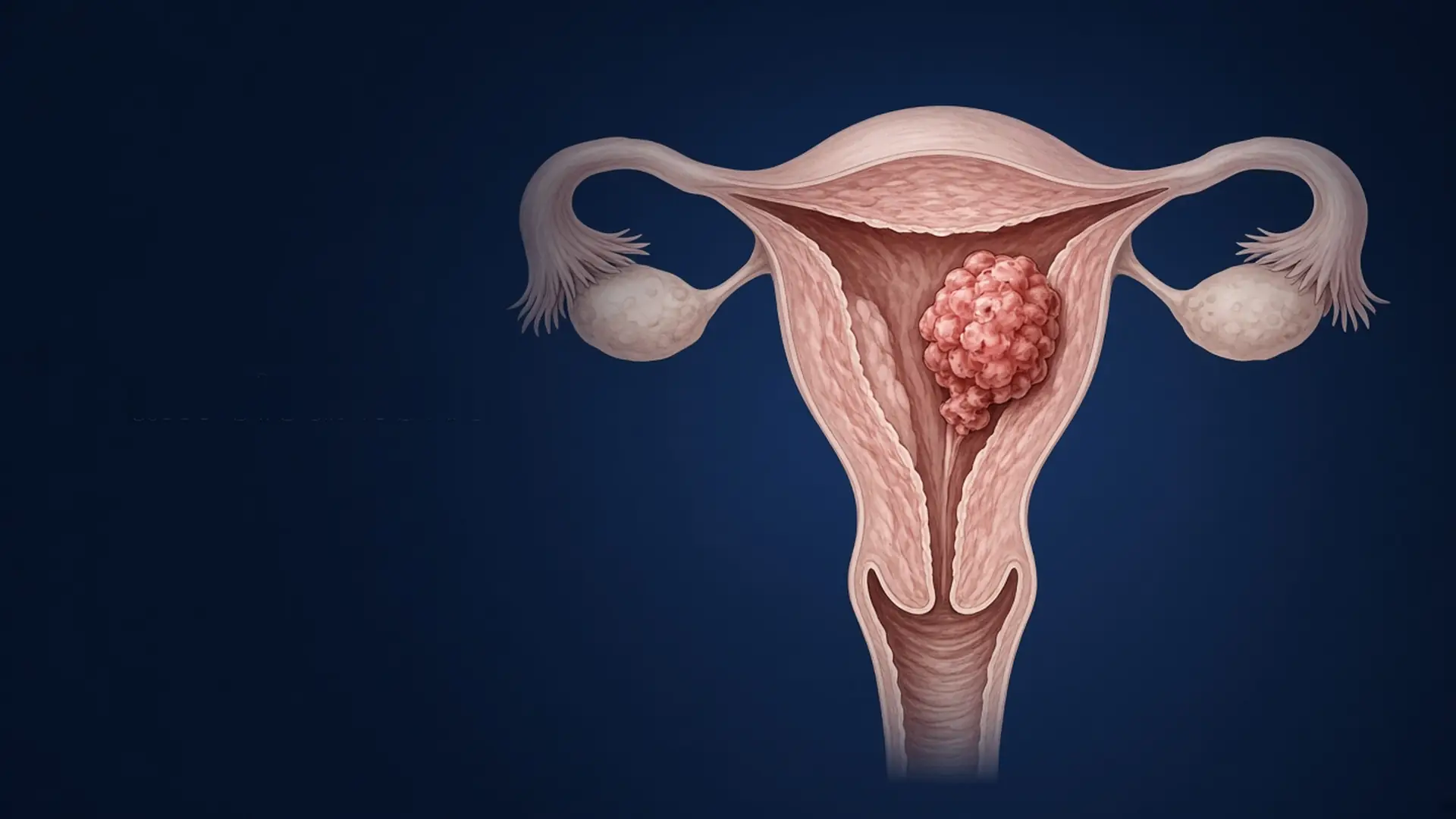
Uterine cancer (also called endometrial cancer) develops in the lining of the uterus — called the endometrium. The most frequent symptom is abnormal vaginal bleeding, particularly after the menopause. It is this alarm signal that often allows detection early, before the cancer has spread.
Have you had bleeding, been offered an endometrial biopsy, or been told about atypical hyperplasia? This is not necessarily cancer. A consultation will help clarify the situation.
What your biopsy tells us
The histological type of cancer — the nature of the cells analysed under the microscope — directly guides treatment and follow-up. Having a low-grade endometrioid carcinoma is not the same as having a serous carcinoma.
The most common type is endometrioid carcinoma (approximately 80% of cases), which generally has a good prognosis when detected early. Other types — serous, clear cell, carcinosarcoma — are rarer but more aggressive, requiring adapted management.
Some uterine cancers are linked to a genetic predisposition: Lynch syndrome (also called HNPCC). If you have a family history of colorectal or endometrial cancer, a genetic consultation may be offered.
Signs that should alert you
Uterine cancer is often detected early, precisely because it causes unusual bleeding. Consult promptly if you have any of these signs.
Your pathway, step by step
From the moment you consult to recovery, here is what happens in practice. Decisions are always made in consultation with you.

The possible operations
The type of operation depends on tumour size, your age, and the multidisciplinary team's decision. Here is what each procedure involves in practice.
Total hysterectomy
The reference operation — removes the entire uterusWhat it is. Total hysterectomy removes the entire uterus (body + cervix). In most cases, the fallopian tubes are also removed (bilateral salpingectomy). The ovaries may or may not be removed depending on the situation.

When it is proposed. In the vast majority of uterine cancers. It is the reference operation regardless of stage, associated with lymph node staging.
How it works. Performed laparoscopically (keyhole surgery) in most cases. 3 to 5 small incisions on the abdomen, each less than 1 cm. The operation lasts 1.5 to 3 hours under general anaesthesia. Hospitalisation: 1 to 3 days at Clinique Hartmann.
And my ovaries? This depends on your age and the type of cancer. In most cases, especially after the menopause, the ovaries are removed at the same time. If you have not yet reached the menopause, the question is discussed — keeping the ovaries avoids sudden surgical menopause.
Sentinel lymph node
A technique that avoids removing too many lymph nodes unnecessarilyWhat it is. The sentinel lymph node is the first lymph node that would receive cancer cells if the cancer spread. A coloured or radioactive tracer injected at the start of the operation migrates to this node. If the sentinel node is clear on analysis, complete lymph node dissection can be avoided — thereby reducing the risk of lymphoedema.
An increasingly standard technique. The sentinel node technique is now the reference approach in early-stage uterine cancer at experienced centres. It reduces operative complications while providing reliable oncological staging information.
→ See the full page on pelvic sentinel lymph node — detailed procedure, indications, recovery, comparison with classic lymphadenectomy.
Lymph node dissection
To check whether cancer has spread to the pelvic lymph nodesWhat it is. Lymph node dissection (pelvic curettage, sometimes para-aortic) involves removing the lymph nodes around the major pelvic vessels. These nodes are analysed to determine whether cancer cells have spread.
When it is performed. When the sentinel node technique is not applicable, or when the tumour characteristics require more extensive staging. The decision is made at the MDT and depends on tumour type and preoperative imaging findings.
→ See the full page on pelvic and para-aortic lymphadenectomy — indications, surgical approaches, complications, recovery.
Minimally invasive surgery (laparoscopy)
The standard approach — small incisions, faster recoveryWhy laparoscopy? Laparoscopic surgery (keyhole surgery) is the reference approach for uterine cancer. It offers the same oncological results as open surgery, with significantly reduced postoperative pain, shorter hospitalisation, and faster return to normal activities.

Robotic surgery. Robotic assistance (da Vinci) may be used in certain complex cases. The technique remains minimally invasive — it is simply a more sophisticated laparoscopic tool.
When open surgery (laparotomy) is needed. In some cases — very advanced tumours, specific anatomical situations — open surgery remains necessary. The decision is always made with the patient's best interests in mind.
A question about the type of operation that applies to you? I explain everything during a consultation.
Do the ovaries always have to be removed?
This is one of the questions most frequently asked in consultation, and it deserves a precise answer.
In most cases, especially after the menopause, the ovaries are removed at the same time as the uterus. This is because certain types of uterine cancer can spread to the ovaries, and removing them eliminates this risk.
If you have not yet reached the menopause and your cancer is low-grade and at an early stage, the question of preserving the ovaries can be discussed at the MDT. Keeping them avoids sudden surgical menopause, which can be difficult to experience.
If the ovaries are removed and you are not yet post-menopausal, hormone replacement therapy (HRT) can be discussed to manage the symptoms of surgical menopause.
Life after treatment
Surgery is not the end of the journey — it is the beginning of recovery. Here is what you can concretely expect in the weeks and months that follow.

Questions about recovery after an operation? I answer practical questions during the consultation — not just medical ones.
Frequently asked questions about uterine cancer
The most common questions asked in consultation. Ask yours at your appointment.
Uterine cancer requires expert surgical management at a centre with specific experience in gynaecological oncology. In Paris, Dr Jérémie Zeitoun manages uterine cancers at Clinique Hartmann (Neuilly-sur-Seine) He sees patients in Paris 8th and at Clinique Hartmann (Neuilly-sur-Seine), where he operates. Every case is presented at a multidisciplinary meeting before any surgical decision.
Hysterectomy, standard of care
In uterine (endometrial) cancer, total hysterectomy with bilateral salpingo-oophorectomy is the surgical standard of care. Depending on stage and grade, pelvic and/or para-aortic lymphadenectomy may be added. The laparoscopic approach is favoured whenever possible.
- → Total hysterectomy + bilateral salpingo-oophorectomy systematic
- → Lymphadenectomy depending on stage and grade
- → Laparoscopy favoured (lower morbidity)
- → Detailed surgical pathway, recovery, complications
Surgical procedures associated with endometrial cancer
Book an appointment
Come with your questions, your results, your concerns. We take the time to discuss everything together.
Transparent pricing
Dr Zeitoun practises as a private specialist (Sector 2) and charges fees above the standard national rate. French national health insurance reimburses on the basis of the standard rate — this is improved for cancer patients (ALD 30). Your complementary health insurance may cover additional fees.
Scientific references
- Mirza MR et al. Dostarlimab for Primary Advanced or Recurrent Endometrial Cancer (RUBY). NEJM. 2023;388:2145-2158. PubMed
- Eskander RN et al. Pembrolizumab plus Chemotherapy in Advanced Endometrial Cancer (NRG-GY018). NEJM. 2023;388:2159-2170. PubMed
- Concin N et al. ESGO/ESTRO/ESP guidelines for the management of patients with endometrial carcinoma. Int J Gynecol Cancer. 2021;31:12-39. PubMed
- Berek JS et al. FIGO staging of endometrial cancer: 2023. Int J Gynaecol Obstet. 2023;162:383-394. PubMed
- Cancer Genome Atlas Research Network. Integrated genomic characterization of endometrial carcinoma. Nature. 2013;497:67-73. PubMed
- Rossi EC et al. A comparison of sentinel lymph node biopsy to lymphadenectomy for endometrial cancer staging (FIRES). Lancet Oncol. 2017;18:384-392. PubMed
- Makker V et al. Lenvatinib plus Pembrolizumab in Advanced Endometrial Cancer (KEYNOTE-775). NEJM. 2022;386:437-448. PubMed
- NCCN Guidelines. Uterine Neoplasms Version 2.2025. National Comprehensive Cancer Network. 2025. PubMed