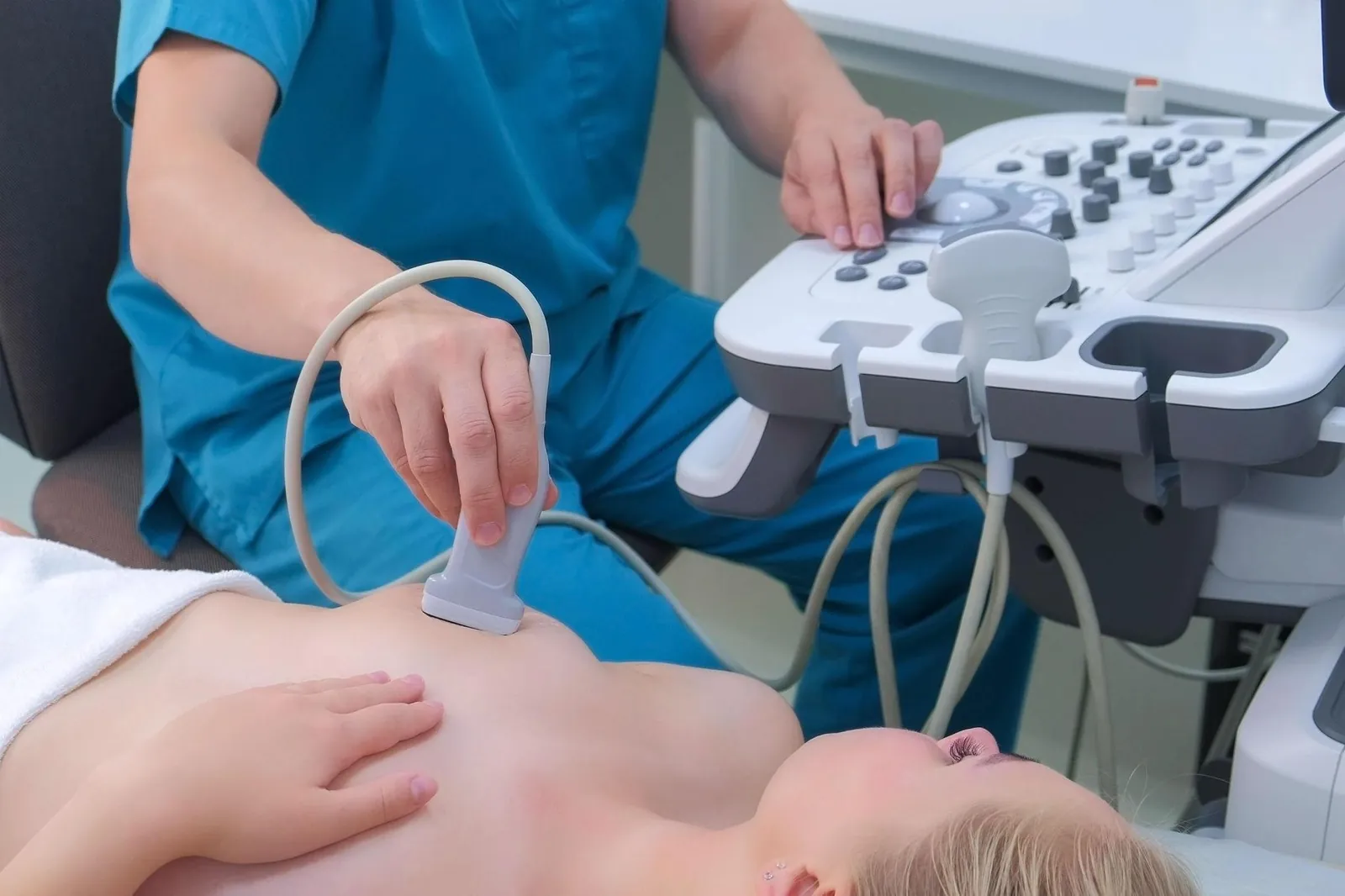
Key figures — Breast biopsy
Medical statistics for quick understanding.

Receiving a positive breast biopsy result is a deeply stressful experience. Whether it follows a fine-needle aspiration, a core biopsy, or a vacuum-assisted biopsy, the moment of reading the result raises immediate questions: is this cancer? What happens now? Do I need surgery urgently? This article answers them, step by step.
For a full overview of surgical management, see our page on breast cancer surgery.
What does a positive biopsy result mean?


A positive result means the pathologist found abnormal cells in the sample. But "positive" does not mean the same thing depending on the type of lesion:
- Benign risk lesion — atypical ductal hyperplasia (ADH), atypical lobular hyperplasia (ALH), lobular carcinoma in situ (LCIS): not a cancer, but a lesion that increases risk and often requires surgical excision for complete analysis.
- Carcinoma in situ (DCIS) — cancer cells present but not invading surrounding tissue. Treatable with excellent outcomes.
- Invasive carcinoma — invasive ductal or lobular carcinoma: a cancer requiring surgery and often additional treatment.
- Phyllodes tumour — a specific fibroepithelial lesion classified as benign, borderline, or malignant. All phyllodes tumours require complete surgical excision with safety margins, due to the risk of local recurrence and, for borderline and malignant forms, of malignant transformation.
Key point: a positive result does not automatically mean advanced cancer or inevitable mastectomy. The vast majority of breast cancers detected at this stage are treatable, often with breast-conserving surgery.
What your report contains
The pathology report describes the exact nature of the lesion (DCIS, ductal carcinoma, lobular carcinoma), its SBR grade, ER/PR receptor status, HER2 status, and Ki-67 index. These elements determine the entire therapeutic strategy.
First steps after the result
1. Consult a breast surgeon
The first step is to see a breast surgeon (senologist) — a specialist who will review your report, order any further investigations needed, and propose a treatment plan. This consultation should ideally take place within 7 to 10 days of the result. For most breast cancers, there is no absolute urgency, but you should not wait.
The breast surgeon reviews your file
The breast surgeon reads your biopsy report, examines your imaging, asks about your medical history, and proposes a personalised plan. This first consultation, ideally within 7 to 10 days, is central.
2. Gather all your documents
Before the consultation, bring:
- The histopathology report from the biopsy
- All imaging (mammogram, ultrasound, MRI if performed) — on CD or USB
- Associated radiology reports
- Your personal and family history of breast or gynaecological cancers
3. Don't delay — but don't panic
Stress is completely understandable. But for most breast cancers, a delay of a few weeks before surgery does not affect prognosis. Taking time to fully understand your options, complete investigations, and make an informed decision is time well spent.
Further investigations you may be asked to have
- Bilateral breast MRI — to determine the extent of the lesion and look for other foci in either breast
- CT scan (chest/abdomen/pelvis) — to look for distant metastases (mainly if invasive cancer)
- Bone scan or PET scan — depending on stage and risk factors
- Blood tests — full blood count, liver function, tumour markers
Not all of these are routine. A small DCIS, for example, does not require a full staging workup. Your surgeon will decide what is appropriate for your case.
Surgical options
Lumpectomy (breast-conserving surgery)
In the vast majority of cases, a lumpectomy — removal of the tumour with a safety margin — is sufficient. The breast is preserved. This is often followed by breast radiotherapy to reduce the risk of local recurrence. Oncoplastic techniques can extend excision margins while maintaining a good cosmetic result.
Mastectomy
Mastectomy — removal of the entire breast — is recommended in certain cases: large tumour relative to breast size, multifocal disease, contraindication to radiotherapy, or patient's personal choice after full information. It can be combined with immediate reconstruction.
When total removal is needed
Mastectomy is proposed for large or multifocal tumours, or when radiotherapy is contraindicated. Immediate or delayed reconstruction can be offered depending on your situation.
Sentinel lymph node biopsy
For invasive cancers, the sentinel node technique allows the first draining axillary lymph node to be analysed. If it is clear, full axillary clearance is avoided in the vast majority of cases — significantly reducing the risk of arm lymphoedema.
The multidisciplinary team (MDT) meeting
MDT: combined expertise
Surgeon, oncologist, radiotherapist, radiologist and pathologist examine your case together. The validated strategy integrates imaging, pathology and your personal situation. The final decision is always yours.
Before any treatment decision, your case must be presented at a multidisciplinary team (MDT) meeting, bringing together surgeons, oncologists, radiotherapists, radiologists, and pathologists. In France, this is a legal requirement for all cancers. The final decision always belongs to you.
Have you received a biopsy result?
Dr Zeitoun offers rapid consultations to review your case. In person in Paris 8th or at Clinique Hartmann (Neuilly-sur-Seine), and by teleconsultation.
Book an appointment →Can I get a second opinion?
A fresh perspective
A second opinion is not distrust — it's a right. It allows you to compare proposed options, clarify doubts and make your decision with confidence, in person or via teleconsultation.
Yes — and it is your right. Seeking a surgical second opinion is not a sign of distrust towards your doctor — it is a normal step, often encouraged, that any serious clinician will support.
Dr Zeitoun offers second opinion consultations on breast biopsy results, in person in Paris 8th and at Clinique Hartmann (Neuilly-sur-Seine), or by teleconsultation. He reviews your histopathology report, imaging, and medical records, and provides an independent opinion on the proposed surgical strategy. Bring your biopsy report, images on CD or USB, and any relevant documentation.

Dr Jérémie Zeitoun
Surgical oncologist, breast and gynaecological surgeon. Former specialist practitioner at Institut Gustave Roussy. Practices at Paris 8th (241 rue du Faubourg Saint-Honoré) and Clinique Hartmann, Neuilly-sur-Seine..
Let's discuss your situation
A consultation allows precise assessment of your options. Dr Zeitoun offers prompt appointments in Paris or Neuilly-sur-Seine.
Molecular profiles and treatments
The treatment strategy depends on the molecular profile defined by the biopsy.
| Profile | HR | HER2 | Strategy |
|---|---|---|---|
| Luminal A | Positive | Negative | Surgery + endocrine therapy |
| Luminal B HER2- | Positive | Negative | Surgery + chemo + endocrine |
| Luminal B HER2+ | Positive | Positive | Chemo + anti-HER2 + surgery + endocrine |
| HER2+ pure | Negative | Positive | Chemo + anti-HER2 + surgery |
| Triple negative | Negative | Negative | Neoadjuvant chemo + surgery |
Source: HAS, CNGOF, ACOG, ESMO, NICE guidelines.
Scientific bibliography
This article draws on guidelines from learned societies (HAS, CNGOF, ACOG, NICE, ESMO) and on recent peer-reviewed literature.
- Bruening W, Fontanarosa J, Tipton K, et al. Systematic review: comparative effectiveness of core-needle and open surgical biopsy. Ann Intern Med. 2010;152(4):238-246. PubMed 20008742.
- Wolff AC, Hammond MEH, Allison KH, et al. HER2 testing in breast cancer: ASCO/CAP guideline update. J Clin Oncol. 2018;36(20):2105-2122. PubMed 29846122.
- Hammond MEH, Hayes DF, Dowsett M, et al. ASCO/CAP guideline recommendations for immunohistochemical testing of estrogen and progesterone receptors. J Clin Oncol. 2010;28(16):2784-2795. PubMed 20404251.
- NCCN. Breast Cancer Guidelines. nccn.org.
- ESMO. Primary Breast Cancer ESMO Clinical Practice Guidelines. Ann Oncol. 2015;26(suppl 5):v8-v30. PubMed 26314782.
- NICE. Early and locally advanced breast cancer (NG101). nice.org.uk.
- ACOG. Practice Bulletin No. 122: Breast cancer screening. Obstet Gynecol. 2017;130(4):e162-e174. PubMed 28832487.
- Houssami N, Ciatto S, Macaskill P, et al. Accuracy and surgical impact of magnetic resonance imaging in breast cancer staging. J Clin Oncol. 2008;26(19):3248-3258. PMID: 18474876.
- Houssami N, Macaskill P, Marinovich ML, et al. Meta-analysis of the impact of surgical margins on local recurrence in women with early-stage invasive breast cancer treated with breast-conserving therapy. Eur J Cancer. 2010;46(18):3219-3232. PMID: 20817513.
- Esserman LJ, Hylton NM, Asare SM, et al. I-SPY 2: Unlocking the Potential of the Platform Trial. Clin Pharmacol Ther. 2021;109(3):646-654. PMID: 33049068.
This article is for information only and does not replace an individual medical consultation.