


"Dense breasts" means a high breast density: the breast contains a large proportion of glandular and fibrous tissue relative to fat. It is a common, ordinary situation — around 28% of women in the screening age range have dense breasts, and nearly 3% have very dense breasts. Density cannot be seen or felt: only a mammogram can assess it.
The radiologist always records your density in the report, as a letter — A, B, C or D (the "ACR density"). Categories C and D correspond to dense breasts. Having dense breasts is not a disease and does not mean you have or will develop cancer.
But this information is useful for two reasons. First, dense tissue appears white on the mammogram — exactly like most cancers: this is the masking effect, which makes the reading harder. Second, high density is an independent risk factor for breast cancer. This article explains what your density means, and when to complement the mammogram with an ultrasound, sometimes an MRI.
A nodule or a suspicious image? An abnormality found on dense breasts?
If a mass or a suspicious image has been found on your mammogram or ultrasound, or if you would like a second opinion on the surgical management of a breast nodule, Dr Zeitoun, breast surgeon, sees patients in consultation at the practice (Paris 8) and at Clinique Hartmann (Neuilly).
Understanding breast density
The breast is made of two main types of tissue: fibroglandular tissue (the milk-producing glands and supporting tissue) and fatty tissue. "Density" measures the share of the former relative to the latter.

White versus black, on the film
On a mammogram, X-rays pass easily through fat, which therefore appears dark, almost black. They are blocked by glandular tissue, which appears white. A "dense" breast is a breast that contains a lot of white.
The problem: most cancers and microcalcifications also appear white. Against a clear background they stand out; against an already white background they can blend in with the surrounding tissue. That is the whole issue with density.
Density has nothing to do with how your breasts feel
It is a common misconception: breast density is not related to the size of your breasts, their firmness, or their appearance. Small breasts can be very dense; large breasts can be almost entirely fatty.
It can neither be seen nor felt. Density is measured only on the mammogram image — which is why you discover it in your report, and not before.
What makes density vary
Density is not fixed: it changes through life, and several factors modulate it.
- Age — breasts generally become less dense after menopause, as the gland is gradually replaced by fat.
- Hormonal status — menopausal hormone therapy can increase density.
- Individual constitution — some women naturally have dense breasts all their lives.
- Equipment and technique — the estimate may vary slightly from one centre to another, and from one radiologist to another.
This is why your density may be classified differently from one exam to the next — without this meaning anything worrying.
The four categories of density
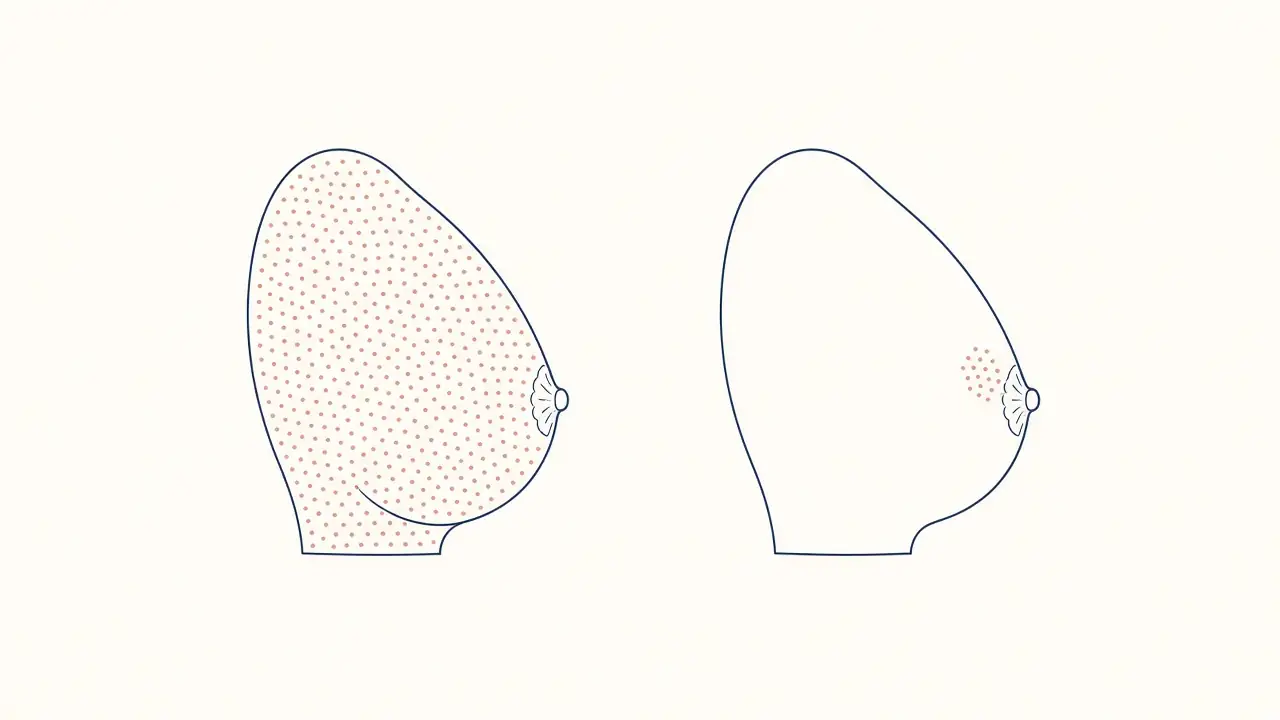
The radiologist classifies density using the international ACR BI-RADS system, in four grades, from A (least dense) to D (most dense). The last two categories — C and D — are the ones grouped under the term "dense breasts".
Almost entirely fatty breast
Less than 25% glandular tissue. The mammogram is easy to read and its sensitivity is excellent.
Scattered areas of density
Around 25 to 50% glandular tissue. Reading is without particular difficulty.
Heterogeneously dense breast
Around 50 to 75% glandular tissue. Reading becomes more difficult; a complementary ultrasound is often useful.
Extremely dense breast
More than 75% glandular tissue. The sensitivity of the mammogram is reduced; ultrasound and, in certain profiles, MRI should be discussed.
👉 Do not confuse density (A to D) with the ACR score of the exam (ACR 0 to 6, which states whether an abnormality is present and its degree of suspicion). These are two distinct pieces of information in the same report: a mammogram can perfectly well be classified ACR 1 or 2 (reassuring) while still reporting a density of C or D.
Key point. If your density is C or D, it is neither an abnormality nor a reason to worry: it is a normal anatomical variation, shared by nearly 4 women in 10. It is simply information that helps tailor screening to your situation.
Why density matters

High density has two distinct effects. The first concerns the reading of the mammogram; the second concerns the risk itself. Both are important — and confusing them often creates needless worry.
The masking effect
Dense tissue is white; so are most cancers. On a very dense breast, a small cancer can be "drowned" in the white background and go unnoticed. This is why the sensitivity of the mammogram decreases as density increases — hence the value of complementary exams.
A risk factor in itself
Independently of the masking effect, high density is associated with an increased risk of developing breast cancer. It is one factor among others (age, family history, lifestyle), to be integrated into an overall assessment — not taken in isolation.
The "interval cancer": what are we talking about?
An interval cancer is a cancer that appears — or becomes symptomatic — between two screening mammograms, after an exam judged normal. These cancers are more frequent in women with very dense breasts, precisely because of the masking effect.
This is the central argument for complementary exams: to look, from the very first mammogram, for what it might miss. A large Dutch trial (DENSE) showed that adding an MRI in women with extremely dense breasts halved the rate of interval cancers.
A breast nodule to assess?
Work-up of a mass or suspicious image, second opinion on the surgical management, overall risk profile: a direct consultation with the breast surgeon.
Complementing the mammogram
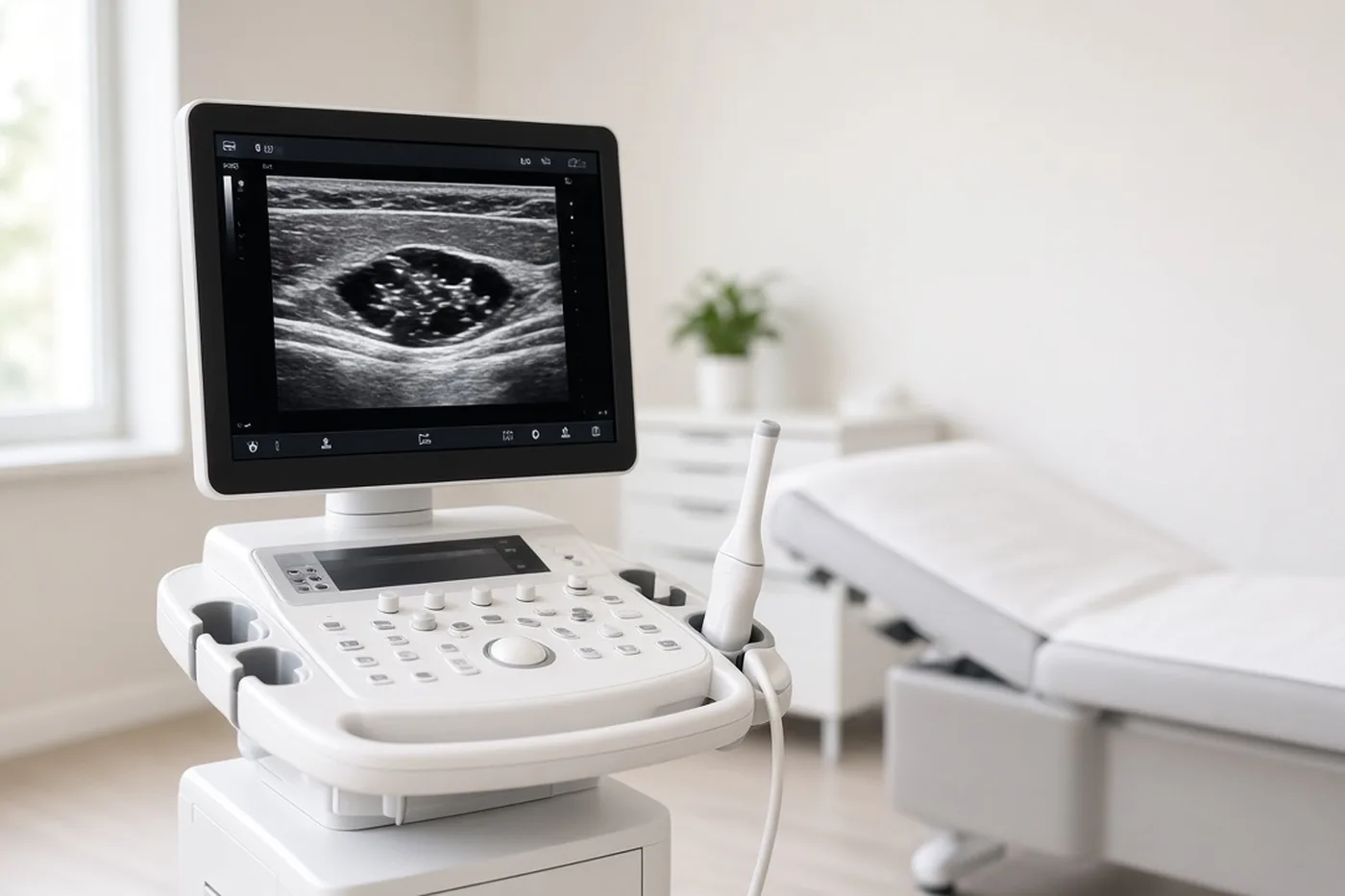


When breasts are dense, several exams can complement the mammogram — without ever replacing it. The choice depends on your density, your age, your history and the context. None is systematic: the decision is personalised.
Breast ultrasound
Painless, without X-rays, it explores the breast using ultrasound waves. It detects cancers not visible on the mammogram of dense breasts, and distinguishes cysts, benign nodules and abnormalities to monitor. In organised screening, the radiologist often performs it right after the mammogram when breasts are dense. The trade-off: a few false alarms. Learn more about breast ultrasound →
Tomosynthesis (3D mammography)
It acquires the breast in thin slices rather than a single compressed image. This improves detection and reduces false alarms, particularly in women with dense breasts. It has become the standard in equipped centres. Learn more about the mammogram →
Breast MRI
It is the most sensitive exam. It is not a routine screening test: it is reserved for high-risk profiles (BRCA mutation, significant family history) and certain situations of doubt. In extremely dense breasts, its value as a complement is the subject of recent recommendations. Learn more about breast MRI →
Contrast mammography (CESM)
A mammogram with injection of a contrast agent, which highlights richly vascularised areas (typically cancers). It is an alternative to MRI in claustrophobic patients, those with a pacemaker, or when MRI is unavailable.
No exam replaces the mammogram. Ultrasound, MRI and contrast mammography come as a complement, to look for what the mammogram might mask — not in its place.
Dense breasts and screening

In France, organised screening is offered to all women aged 50 to 74 with no particular risk factor: a mammogram every 2 years, fully covered, with a double reading of the films by two radiologists — an extra safeguard that few countries apply.
The radiologist who performs your mammogram may, when judged useful, add complementary views or an ultrasound straight away — particularly if your breasts are dense. This does not mean they have seen something abnormal: it is a way of refining their reading.
For women at high risk (BRCA mutation, significant family history), screening is different: it starts earlier, and combines an annual MRI and a mammogram ± ultrasound. This is the setting in which MRI usually finds its place.
What you can do, concretely
- Find your density in the report (the letter A, B, C or D) and keep your reports to compare them over time.
- Ask whether an ultrasound is useful in your case, especially for density C or D.
- Report your family history: it may warrant specific screening, sometimes with MRI.
- Stay alert between two exams: any lump, retraction, skin change or discharge should prompt a consultation, even if the last mammogram was normal.
- Keep taking part in screening: it remains the central tool, and the double reading strengthens its reliability.
To understand your exam in detail, see also the page Understanding your mammogram (tomosynthesis, ACR/BI-RADS classification, reading the report).
Frequently asked questions
The questions that come up most often about dense breasts. If yours is not here, feel free to ask it at your appointment — or to Sophie, the site assistant, at the bottom right.
Is having dense breasts serious?
No. It is not a disease, but a normal and very common anatomical feature (nearly 4 women in 10). It has two consequences: the mammogram is a little harder to read, and high density slightly increases the risk of breast cancer. It is neither an abnormality nor a reason to worry — it is useful information to tailor screening.
How do I know if I have dense breasts?
Only through the mammogram. Density cannot be guessed by touch: it has nothing to do with the size, firmness or appearance of the breasts. The radiologist assesses it on your films and records it in the report as a letter — A, B, C or D. Categories C and D correspond to dense breasts.
Why do dense breasts make the mammogram less reliable?
Because dense tissue appears white on the mammogram — like most cancers. When the breast contains a lot of dense tissue, a small cancer can be masked in this white background: that is the masking effect. The sensitivity of the mammogram therefore decreases as density increases, which often justifies a complementary ultrasound for C or D breasts.
Should I have an ultrasound as well if I have dense breasts?
Often, but not systematically. The decision depends on the density (especially C and D), age, history and the mammogram result. In organised screening, the radiologist frequently performs a complementary ultrasound when breasts are dense. It detects cancers not visible on the mammogram, at the cost of a few false alarms. The decision must remain personalised.
And breast MRI, when is it indicated?
MRI is not a routine screening test. For extremely dense breasts, recent work (the DENSE trial) showed that adding an MRI reduced cancers found between two mammograms. The European Society of Breast Imaging recommends offering it in that case. In France, it remains reserved for precise situations (very high risk, BRCA mutation, persistent doubt), case by case with your radiologist and your surgeon.
Can my breast density change?
Yes. Density changes with age: breasts generally become less dense after menopause. Menopausal hormone therapy, on the contrary, can increase it. Your density may therefore be classified differently from one exam to the next — this is normal.
My breasts are dense and my mammogram is normal: am I in the clear?
A normal mammogram is reassuring, but its reliability is slightly lower when breasts are dense. That is precisely the role of the complementary ultrasound — and, in certain profiles, the MRI: to complement the mammogram. Keep taking part in screening, report any change in your breasts between two exams, and seek advice if in doubt.
A breast nodule, a surgical opinion to seek?
If a mass or a suspicious image has been found on your dense breasts, or if you would like a second opinion on the surgical management of a breast nodule, Dr Jérémie Zeitoun, breast surgeon, sees patients in consultation at the practice in the 8th arrondissement of Paris and at Clinique Hartmann in Neuilly-sur-Seine.