



You have just received a Pap smear result described as abnormal, and the lab report mentions ASC-US, LSIL, or HSIL. It is unsettling — these acronyms mean little to most patients, and the first reflex is often to search "abnormal pap smear cancer" on Google. Here is essential information before going further: an abnormal Pap smear is not a cancer diagnosis.
It is a signal that requires additional examination, within a timeframe that depends on the specific finding. This article explains each possible result and the corresponding next steps — for a broader overview of cervical conditions, a dedicated page is also available.
The five cytology codes
ASC-US
Atypical squamous cells of undetermined significance. Minor finding, most often benign.
The Pap smear: what it looks for, what it doesn't

The Pap smear (cervical cytology, cervical smear) is a screening test, not a diagnostic test. A clinician — gynecologist, midwife, or general practitioner — collects cells from the surface of the cervix using a small brush, and these cells are analyzed under a microscope by a cytopathologist. The pathologist looks for abnormalities in cell shape, nucleus, or organization that could indicate a lesion at risk of progression.
Screening strategies vary across countries

Screening strategies vary across countries. In France, since 2020, screening follows a two-tier approach by age: cytology between 25 and 29 (every 3 years after two normal smears one year apart), then HPV-HR testing between 30 and 65 (every 5 years if negative). This aligns with WHO 2021 recommendations and is similar to the UK NHS cervical screening programme, which uses HPV primary testing from age 25.
The French SFCPCV
The French SFCPCV (Société Française de Colposcopie) updated its management guidelines for abnormal cytology in October 2025, adapting the 2016 INCa framework to the era of primary HPV testing. The overall principle is similar to the ASCCP 2019 Risk-Based Guidelines used in the United States: abnormal cytology leads to further investigation (reflex HPV testing, p16/Ki67 dual staining, or colposcopy), depending on the specific abnormality.
Lab reports use a standardized language — the Bethesda System — to classify results into precise categories. Understanding these categories helps contextualize most situations and ask the right questions.
The possible Pap smear results

The cytology report always begins with the specimen adequacy (satisfactory or unsatisfactory for evaluation), followed by the type of abnormality. Here are the five most common abnormal categories, each with its meaning and corresponding action.
ASC-US
Atypical Squamous Cells of Undetermined Significance.
This is the most frequent and most benign abnormal result. The cytopathologist observed slightly atypical cells but cannot determine whether they reflect a true lesion or merely inflammation, irritation, or a sampling artifact. In most cases, no underlying lesion is present.
Next steps depend on age and context
Next steps depend on age and context. Under 30, a cytology follow-up at 12 months is generally preferred, as transient HPV infections are common at this age and typically regress spontaneously.
From age 30, a reflex HPV test can be performed. In practice, its utility is limited: roughly half of ASC-US smears are associated with a positive HPV result, often transient and without underlying lesion, which can lead to unnecessary colposcopies.
p16/Ki67 dual immunostaining
This is why the SFCPCV 2025 guidelines — and increasingly also ASCCP guidance — offer an interesting alternative: p16/Ki67 dual immunostaining (also known as CINtec PLUS), performed on the same liquid-based sample. This test detects markers of truly at-risk cellular transformation (not merely viral presence), and is considerably more specific than HPV testing for triaging ASC-US.
If negative, a 12-month cytology follow-up is sufficient. If positive, colposcopy is indicated.
Next step
Cytology follow-up at 12 months under 30. After 30: HPV triage test or p16/Ki67 dual staining (more specific).
LSIL
Low-grade Squamous Intraepithelial Lesion.
This category includes condylomas and mild dysplasia (corresponding to CIN 1 on biopsy). It indicates an HPV infection with some cellular changes, but more than half of these lesions regress spontaneously within 1-2 years without any treatment, thanks to the immune system.
Management again depends on age and context
Management again depends on age and context. In younger women, simple cytology surveillance may suffice. In women over 30 or with any doubt, colposcopy with biopsies is generally recommended to verify the lesion's extent.
SFCPCV 2025 guidelines also allow p16/Ki67 dual staining as a triage option for LSIL — if negative, a 12-month cytology follow-up can replace immediate colposcopy.
LSIL is never treated surgically as a first-line approach — even when confirmed as CIN 1 on biopsy, the rule is surveillance, not conization.
Next step
Colposcopy with biopsies, or p16/Ki67 dual staining as an option.
HSIL
High-grade Squamous Intraepithelial Lesion.
This category encompasses moderate dysplasia (CIN 2) and severe dysplasia (CIN 3). These are high-risk lesions — some may regress spontaneously, others may persist, and a proportion may, over a long timeframe (typically 10-15 years) and in the absence of treatment, progress to cervical cancer.
Progression is not inevitable, but the risk is substantial enough to justify treatment. At this stage, it is not yet cancer: abnormal cells remain confined to the epithelium and do not cross the basement membrane.
Colposcopy with biopsies is systematic
Colposcopy with biopsies is systematic, and typically followed by conization (cone-shaped excision of the cervix) if biopsies confirm high-grade disease. The procedure is ambulatory, lasts 15-20 minutes, and preserves fertility in the vast majority of cases.
Next step
Colposcopy with biopsies. Treatment by conization often indicated after histologic confirmation.
ASC-H
Atypical Squamous Cells, cannot exclude HSIL.
An intermediate and rare result. The cytopathologist observed suspicious cells that resemble HSIL but cannot confirm this with certainty.
Approximately 30-40% of patients with ASC-H will indeed have a confirmed high-grade lesion (CIN 2 or CIN 3) on biopsy. The majority do not, but the risk is sufficient to justify colposcopy without delay.
Management is the same as for HSIL
Management is the same as for HSIL: colposcopy with biopsies as a priority, then treatment adapted to the histologic result. The absence of cytologic certainty does not alter the relative urgency of the investigation.
Next step
Colposcopy with biopsies. No watchful waiting.
AGC
Atypical Glandular Cells.
Unlike the previous results, which concern squamous cells (the external epithelium of the cervix), AGC indicates an abnormality of glandular cells — those lining the endocervical canal or originating from the endometrium. This result is more complex to interpret because glandular lesions are rarer, deeper, and can involve either the cervix or the uterine body.
Management is more thorough: colposcopy with directed biopsies, endocervical curettage to explore the canal, and occasionally pelvic ultrasound and endometrial biopsy in women over 45 or with abnormal bleeding. A specific subtype, AIS (adenocarcinoma in situ) or AGC suggesting neoplasia, generally requires diagnostic and therapeutic conization.
Next step
Comprehensive workup (colposcopy + endocervical curettage ± endometrial evaluation). Specialist consultation recommended.
Summary: frequency, significance, and next steps
| Result | Frequency | Risk of high-grade lesion on biopsy | Next step |
|---|---|---|---|
| ASC-US | 1-2% | ≈ 5-10% | 12-month follow-up, HPV test or p16/Ki67 |
| LSIL | ≈ 2% | ≈ 10-15% | Colposcopy or p16/Ki67 option |
| HSIL | ≈ 1% | ≈ 70-80% | Colposcopy with biopsies |
| ASC-H | < 0.5% | ≈ 30-40% | Colposcopy with biopsies |
| AGC | < 0.5% | Variable by subtype | Full workup (colposcopy + endocervical curettage) |
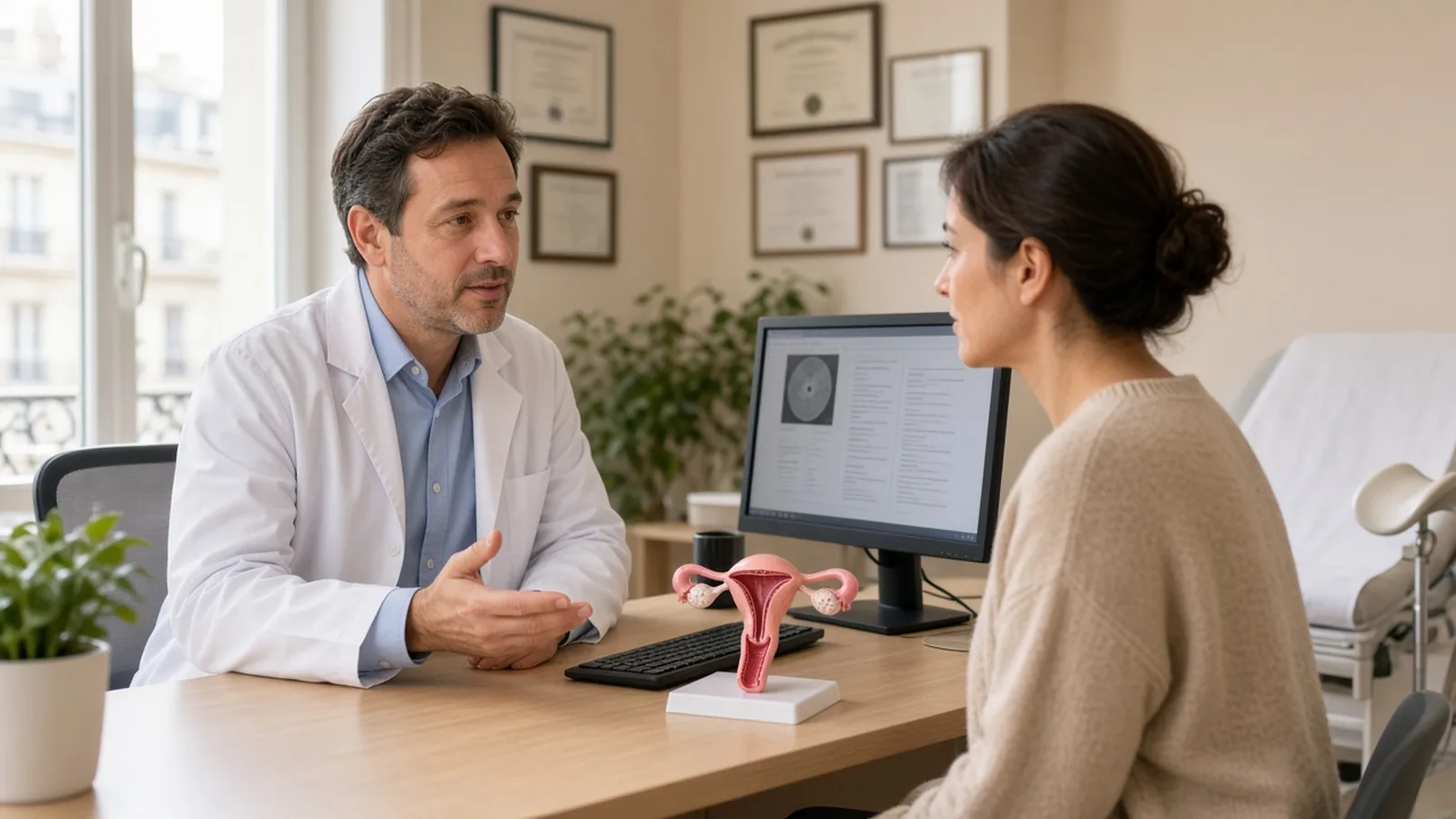
In practice, when colposcopy is indicated, it is typically scheduled within 1 to 3-4 weeks — exact timing depends on the result and clinical context.
The pathway after an abnormal Pap smear

Whatever the result, the following steps follow a clear logic. Here is how the management pathway typically unfolds, from receiving the result to the therapeutic decision.
Offered a colposcopy with biopsies?
Dr Zeitoun explains how it works and what comes next depending on the biopsy results.
Receiving the result and consultation
You receive the lab report. Consult your gynecologist or general practitioner to interpret it and plan next steps. For HSIL, ASC-H, or AGC, specialist consultation is recommended.
HPV test or p16/Ki67 dual staining (if relevant)
For ASC-US and LSIL, these triage tests help target patients who genuinely need colposcopy. The sample is often reusable from the original liquid-based cytology.
Colposcopy with biopsies
Examination of the cervix under magnification after application of acetic acid and Lugol's iodine. Suspicious areas are biopsied. The procedure lasts 10-15 minutes, requires no anesthesia, and is minimally uncomfortable (similar to a Pap smear).
Histologic result
Biopsies are analyzed and classified histologically: CIN 1, CIN 2, CIN 3, adenocarcinoma in situ. Results typically available within 2-3 weeks.
Therapeutic decision
Depending on the result: simple surveillance (CIN 1), surveillance or conization (CIN 2), conization (CIN 3 / AIS). The decision is discussed in consultation considering age, fertility plans, and medical history. For a broader overview of benign cervical conditions and surgical options, see the dedicated page.
HPV self-sampling: an alternative to the Pap smear

Since 2024, cervical screening in France can also be performed using vaginal self-sampling — a kit the patient uses at home or at her physician's office. This option has been integrated into the organized screening programme to better reach women who do not undergo regular Pap smears. Similar programmes exist in the UK (NHS), the Netherlands, Australia, and increasingly in the US.
Self-sampling is offered primarily to women not screened for over 3 years who decline a clinician-performed sample (for reasons of modesty, disability, distance, or anxiety). The kit contains a swab to insert vaginally for a few seconds, which is then mailed to the laboratory.
Self-sampling directly tests for HPV DNA
Self-sampling directly tests for HPV DNA (not cells, unlike conventional cytology). If the test is negative, no further investigation is needed — routine screening resumes.
If positive, a conventional Pap smear is performed on a new clinician-collected sample to complete the analysis. Self-sampling is therefore a gateway to screening, not a diagnostic test.
This approach is not recommended for women already followed regularly or with a history of abnormal smears or cervical lesions — in these cases, conventional cytology or HPV testing with clinician-collected samples remains the reference standard.
Key figures — Abnormal pap smear

Medical statistics for quick understanding.
of pap smears are abnormal
ASC-US regress in 12-24 months
CIN1 progress to CIN2/3
CIN2 regress spontaneously
CIN3 progress to invasive cancer
cervical cancers linked to HPV
HR-HPV
caused by HPV-16/18
screening start age
HPV-test screening interval
conization efficacy for CIN3
recurrence with clear margins
ASC-US, LSIL or HSIL on your report?
Dr Zeitoun explains what the result means and which tests may follow.
Frequently asked questions
Does an abnormal Pap smear mean I have cancer?
No. An abnormal Pap smear indicates cellular abnormalities that need further investigation. Even an HSIL result — the most severe cytologic finding — corresponds to a lesion at risk of progression, not cancer. Progression from HSIL/CIN 3 to invasive cancer is not automatic: some lesions regress spontaneously, others persist without progressing, and only a fraction progress to cancer over a typically long period (several years, sometimes 10-15 years) in the absence of treatment. Screening is designed to detect these lesions in time for treatment before any potential progression.
How soon should I act after an abnormal result?
It depends on the result. For ASC-US or LSIL, there is no urgency — triage by HPV test or p16/Ki67 dual staining, or simple surveillance at 12 months, is generally sufficient. For HSIL, ASC-H, or AGC, colposcopy should be scheduled — in practice, within 1 to 3-4 weeks depending on context. Exact timing depends on your specific situation and should be discussed with your doctor. What matters is completing the pathway — not rushing it.
Should I be worried while waiting for colposcopy?
This waiting period is often the most anxious phase of the pathway — that is completely normal. A few reassurances: you can continue your life normally (work, exercise, sex, travel), no behavior will worsen the situation in such a short timeframe; occasional bleeding after sex or exertion is not necessarily concerning and is common with cervical ectropion; seek prompt care only for heavy recurrent bleeding or marked pelvic pain. If the wait becomes too emotionally heavy, talking to your general practitioner can help — the emotional dimension matters too.
Is an abnormal Pap smear contagious to my partner?
An abnormal smear most often reflects an HPV infection — an extremely common virus affecting nearly 80% of sexually active people during their lifetime. If you have been in a stable relationship for some time, your partner has likely already been exposed to the virus. Condoms reduce but do not eliminate transmission risk (skin-to-skin contact). In men, the infection is typically asymptomatic and without consequence — routine HPV screening is not recommended for men in most countries. A positive HPV test says nothing about fidelity: the virus can remain dormant for years before manifesting, and contamination may date back to any time in your sexual history.
Can I become pregnant with an abnormal Pap smear?
Yes, without restriction. An abnormal Pap smear does not affect fertility or pregnancy. If pregnancy begins during the workup, it can continue: colposcopy and biopsies are possible during pregnancy, and therapeutic decisions (possible conization) are typically deferred until 6-8 weeks postpartum, except in case of suspected invasive lesion. However, if conization is being considered and you have upcoming pregnancy plans, this should be discussed in consultation — the technique can be adapted to preserve the cervix as much as possible.
I was vaccinated against HPV, how can I still have an abnormal Pap smear?
HPV vaccines (bivalent, quadrivalent, nonavalent) protect against the most common HPV types but not all. Gardasil 9 (nonavalent) covers 9 genotypes responsible for approximately 90% of cervical cancers, leaving a residual risk of about 10%. Additionally, vaccine efficacy is maximal when administered before sexual debut: if given after exposure, it cannot eliminate an already-present virus. For both reasons, screening remains recommended for all women aged 25-65, vaccinated or not.
Can I have an abnormal Pap smear after menopause?
Yes, and this situation warrants particular attention. After menopause, the cervical mucosa thins and the transformation zone (where lesions typically develop) recedes into the endocervical canal, which can make interpretation of smears and colposcopy more difficult. Local estrogen therapy for a few weeks before a new examination is sometimes recommended. Persistent or reappearing HPV at menopause (sometimes due to immune-related reactivation) should be taken seriously — the cumulative risk of progression is higher than before age 30.
What's the difference between Pap smear, HPV test, colposcopy, and biopsy?
These are four distinct investigations that follow one another: the Pap smear (cytology) looks for abnormal cells under the microscope; the HPV test directly detects the virus (viral DNA); colposcopy is the visual examination of the cervix under magnification, locating suspicious areas; biopsy samples tissue from a suspicious area for histologic analysis, providing a definitive diagnosis (CIN 1, CIN 2, CIN 3, AIS, cancer). Only biopsy yields a certain diagnosis — all the rest is screening or localization.
Is p16/Ki67 dual staining available in my country?
p16/Ki67 dual immunostaining (commercially known as CINtec PLUS) is available in most high-resource countries with developed cytology laboratories. It is endorsed in French SFCPCV 2025 guidelines, and is used in various contexts in the US (ASCCP guidelines recognize its utility for ASC-US and LSIL triage), UK, Germany, and elsewhere. Coverage by insurance varies. Ask your physician whether this option is available in your setting.
Quick answers
What does an abnormal pap smear mean?
An abnormal pap smear indicates atypical cells on the cervix, most often due to HPV. 5-7% of pap smears are abnormal. It does not mean cancer.
What to do after an abnormal pap smear?
HPV test then, depending on result, colposcopy + targeted biopsy. Management depends on the type of abnormality (ASC-US, LSIL, HSIL) and HPV status.
Does an abnormal pap smear always become cancer?
No. 60-70% of ASC-US regress spontaneously. 20% of CIN1 progress to CIN2/3 without treatment. Only CIN2/3 require treatment (conization).
What is conization?
Cone-shaped excision of the abnormal cervical area, for CIN2/3 treatment. Efficacy 60-80%. Recurrence <5% with clear margins. Strict follow-up afterwards.
What is the recommended screening?
HPV test from age 25 in France, then every 5 years between 30 and 65 if negative. Pap smear every 3 years between 25 and 29.
What is the difference between LSIL, HSIL, ASC-H and AGC?
LSIL: low-grade lesion, spontaneous regression in most cases. HSIL: high-grade lesion; not cancer, but treatment is generally recommended. ASC-H: atypical cells suggesting possible high grade, colposcopy needed. AGC: atypical glandular cells, complete workup recommended.
What are Dr Zeitoun’s fees?
Dr Zeitoun practises in Sector 2 (non-OPTAM) and charges fees above the French Social Security rate for all consultations and procedures. Most international patients are not covered by French Social Security. A detailed quote is given during the consultation, before any procedure. If you are covered, the Assurance Maladie reimburses on the basis of the Social Security rate, and your health insurance may cover all or part of the additional fees, depending on your policy.
When to seek prompt care, even without an abnormal smear
- Recurrent abnormal bleeding after intercourse
- Persistent intermenstrual bleeding
- Foul-smelling or blood-tinged vaginal discharge
- Unexplained chronic pelvic pain
- Any bleeding after menopause, however minor
These signs do not necessarily indicate cancer but warrant consultation — and sometimes a Pap smear or colposcopy, even if the last screening was normal.
If a high-grade lesion is confirmed, Dr Zeitoun discusses conization with you, including your pregnancy plans.
Action by Pap smear result
HAS / CNGOF / ACOG recommendations by Bethesda code.
| Smear result | Meaning | Action |
|---|---|---|
| ASC-US | Atypical squamous cells of undetermined significance | Reflex HPV testing |
| LSIL | Low-grade squamous intraepithelial lesion | Colposcopy |
| HSIL | High-grade squamous intraepithelial lesion | Colposcopy + biopsies |
| ASC-H | Atypical cells, cannot exclude HSIL | Urgent colposcopy |
| AGC | Atypical glandular cells | Colposcopy + endocervical curettage |
| Carcinoma | Cervical cancer | Staging work-up + MDT |
Source: HAS, CNGOF, ACOG, ESMO, NICE guidelines.
Sources
- SFCPCV — Management of abnormal cervical cytology: update to INCa 2016 guidelines following primary HPV testing implementation. French Society of Colposcopy and Cervical-Vaginal Pathology, October 2025.
- ASCCP — 2019 Risk-Based Management Consensus Guidelines for Abnormal Cervical Cancer Screening Tests and Cancer Precursors. American Society for Colposcopy and Cervical Pathology. J Low Genit Tract Dis. 2020;24(2):102-131.
- WHO — Guidelines for the use of thermal ablation for cervical pre-cancer lesions. World Health Organization, 2019. Updated cervical cancer screening and treatment recommendations 2021.
- NHS — Cervical screening programme. National Health Service UK, updated 2025.
- Perkins RB, Guido RS, Castle PE, et al. 2019 ASCCP Risk-Based Management Consensus Guidelines: Updates Through 2023. J Low Genit Tract Dis. 2023;27(4):354-362.
- HAS — Evaluation of HPV testing in primary cervical cancer screening and the place of p16/Ki67 dual immunostaining. French National Authority for Health, July 2019.
- Nayar R, Wilbur DC. The Bethesda System for Reporting Cervical Cytology. 3rd edition. Springer, 2015.
- Arbyn M, Smith SB, Temin S, et al. Detecting cervical precancer and reaching underscreened women by using HPV testing on self samples: updated meta-analyses. BMJ. 2018;363:k4823.
- INCa — Conduite à tenir devant une femme ayant une cytologie cervico-utérine anormale. Institut National du Cancer, décembre 2016. Recommandations et référentiels. e-cancer.fr
- HAS — Dépistage et prévention du cancer du col de l'utérus. Haute Autorité de Santé. Actualisation 2019. has-sante.fr
- SFCPCV — Dépistage du cancer du col de l'utérus chez les personnes immunodéprimées hors personnes vivant avec le VIH. Recommandations du 2 octobre 2025.
- CNGOF — Dépistage du cancer du col de l'utérus. Collège National des Gynécologues et Obstétriciens Français. Fiche d'information patiente. cngof.fr
- Santé publique France — Dépistage organisé du cancer du col de l'utérus : évaluation de la première année de généralisation. 2021.
Guidelines evolve: this content is regularly updated to reflect current recommendations.
Scientific bibliography
This article draws on guidelines from learned societies (HAS, CNGOF, ACOG, NICE, ESMO) and on recent peer-reviewed literature.
- Saslow D, Solomon D, Lawson HW, et al. American Cancer Society, ASCCP, and ASCP screening guidelines for the prevention and early detection of cervical cancer. CA Cancer J Clin. 2012;62(3):147-172. PubMed 22422631.
- Curry SJ, Krist AH, Owens DK, et al. Screening for cervical cancer: US Preventive Services Task Force recommendation statement. JAMA. 2018;320(7):674-686. PubMed 30140884.
- Bedell SL, Goldstein LS, Goldstein AR, Goldstein AT. Cervical cancer screening: past, present, and future. Sex Med Rev. 2020;8(1):28-37. PubMed 31791846.
- Massad LS, Einstein MH, Huh WK, et al. 2012 updated consensus guidelines for the management of abnormal cervical cancer screening tests and cancer precursors. Obstet Gynecol. 2013;121(4):829-846. PubMed 23635684.
- NICE. Cervical screening: programme overview. gov.uk.
- Haute Autorité de Santé (HAS). Évaluation de la recherche du HPV en première intention. has-sante.fr.
- CNGOF. Recommandations dépistage du cancer du col. cngof.fr.
- ACOG Practice Bulletin No. 168. Cervical Cancer Screening and Prevention. Obstet Gynecol. 2016;128(4):e111-e130. PubMed 27661652.
- Ronco G, Dillner J, Elfström KM, et al. Efficacy of HPV-based screening for prevention of invasive cervical cancer. Lancet. 2014;383(9916):524-532. PubMed.
- Schiffman M, Castle PE, Jeronimo J, et al. Human papillomavirus and cervical cancer. Lancet. 2007;370(9590):890-907. PubMed.
- Lehtinen M, Paavonen J, Wheeler CM, et al. Overall efficacy of HPV-16/18 AS04-adjuvanted vaccine. Lancet Oncol. 2012;13(1):89-99. PubMed.
- Joura EA, Giuliano AR, Iversen OE, et al. A 9-valent HPV vaccine against infection and intraepithelial neoplasia. N Engl J Med. 2015;372(8):711-723. PubMed.
This article is for information only and does not replace an individual medical consultation.