
Accueil
Sein & Cancer du sein
Cancer du sein Lésions bénignes du sein Mastectomie prophylactique
Reconstruction mammaire
Toutes les techniques Reconstruction par prothèse Lipofilling mammaire Chirurgie intime
Chirurgie gynécologique bénigne
Utérus Trompes et ovaires Col de l'utérus Vulve et vagin
Cancers gynécologiques
Cancer du col de l'utérus Cancer de l'ovaire Cancer de l'utérus Cancer de la vulve Tumeurs borderline Articles Parcours
Être rappelé par le secrétariat Prendre RDV sur Doctolib →

Author and medical review: Dr Jérémie Zeitoun, surgical oncologist — gynaecologist and breast surgeon — RPPS 10101463296 — trained at Institut Gustave Roussy, Institut Curie and Centre François Baclesse. See full background →

Last updated: · Sources: SFCPCV, INCa, HAS, Carcopino. References at bottom of page.

1 · Principle

What is CO₂ laser ablation of the cervix?

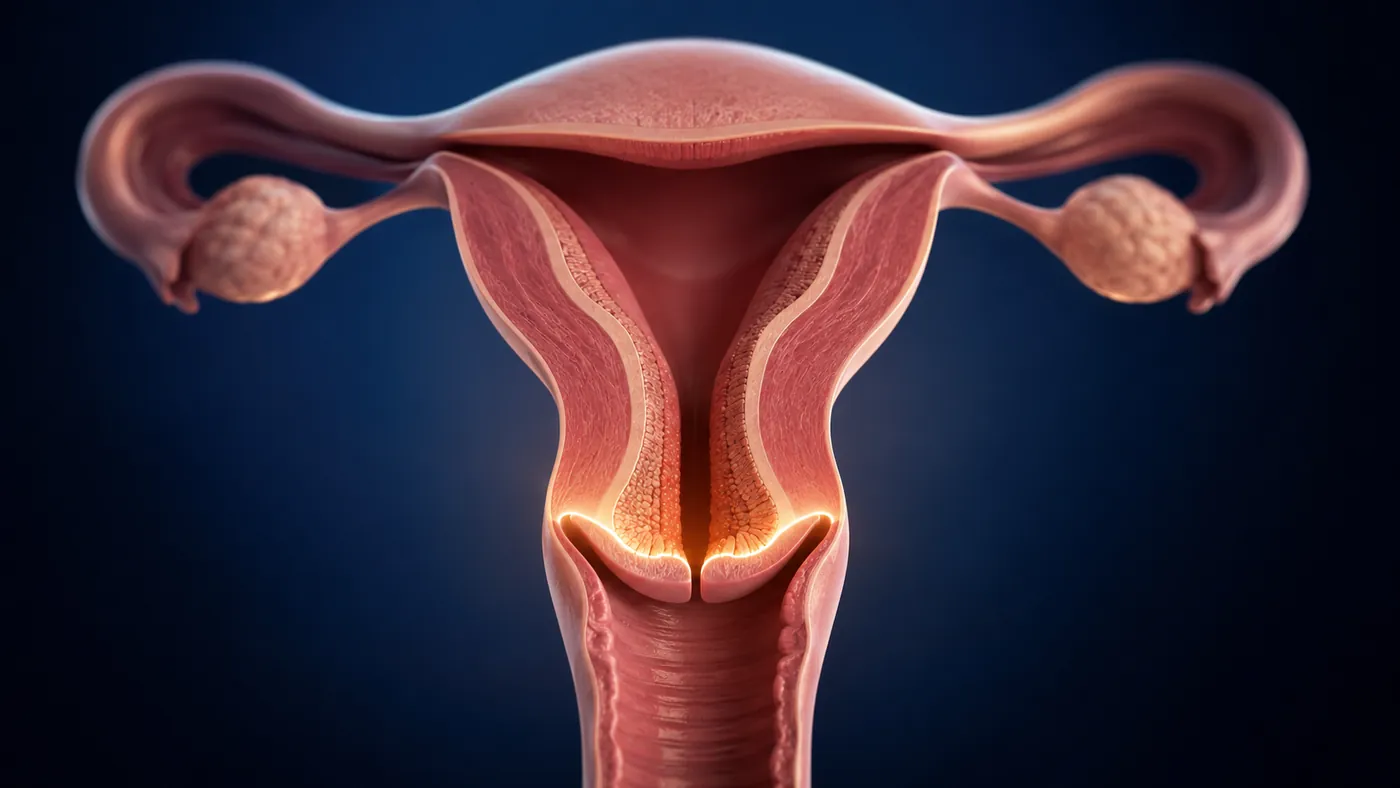
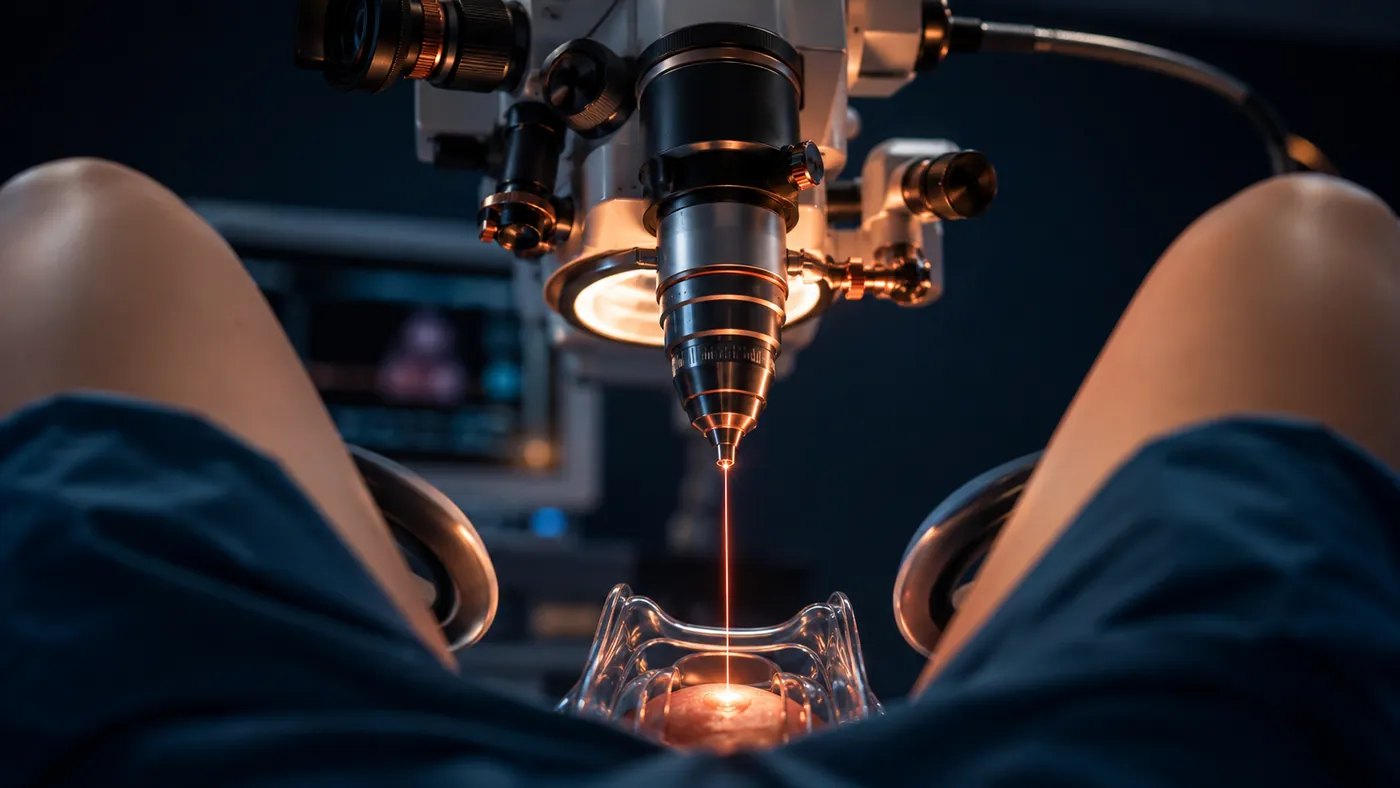
CO₂ laser ablation is a destructive treatment for cervical lesions. A highly focused, precise laser beam instantly vaporises abnormal tissue into vapour, under continuous colposcopic visual control. Unlike conisation which removes an analysable fragment, laser destroys without sampling — meaning there is no histological analysis, which restricts this technique to lesions whose diagnosis is already certain.

The CO₂ laser operates at a power of 10 to 20 Watts. Destruction depth, in accordance with SFCPCV guidelines, must be greater than 5 mm — necessary to reach cervical glands and completely eliminate the transformation zone where lesions develop.

The procedure is performed via the vaginal route — no scar, no incision. It lasts 10 to 20 minutes. Cervical anatomy is preserved — a major advantage over conisation for young women planning pregnancy, as the cervix is not shortened.

Anaesthesia: the comfort choice, always in theatre

CO₂ laser can technically be performed under local or general anaesthesia. Dr Zeitoun offers both, exclusively in the operating theatre at Clinique Hartmann — never in clinic or consultation. Local anaesthesia allows a rapid return home, but can be uncomfortable: the patient's difficulty staying perfectly still sometimes complicates the procedure, and the sensation of heat or small spasms can be unpleasant. Short general anaesthesia guarantees perfect immobility, absolute comfort, and safely ensures the 5 mm depth recommended by SFCPCV. This is the option many patients choose after discussion, for maximum comfort.

2 · Indications

When is CO₂ laser indicated?

Cervical CO₂ laser has precise and limited indications. It applies to lesions where the diagnosis is already established with certainty by colposcopy and biopsy, and where destruction without histological analysis is acceptable. Any lesion suspected of high grade requires conisation, not laser.

Persistent CIN 1

This is the reference indication according to SFCPCV (Carcopino). Low-grade dysplasia (CIN 1) persisting beyond 18 to 24 months in a young woman, without spontaneous regression, may justify laser treatment. This allows treatment of the lesion without shortening the cervix, preserving obstetric future.

Haemorrhagic ectropion

An ectropion is an externalisation of glandular epithelium onto the ectocervix. When haemorrhagic (contact bleeding, post-coital bleeding) or highly symptomatic and not improved by local treatments, CO₂ laser enables its destruction and restoration of healthy squamous epithelium.

Cervical condylomas

Condylomas (HPV-related genital warts) located on the uterine cervix are particularly well suited to laser destruction. Millimetric precision allows destruction of visible lesions while sparing adjacent healthy epithelium — with excellent healing quality.

Multifocal lesions

When several well-defined low-grade exocervical lesion foci coexist at colposcopy, laser allows treatment of each focus with precision without wider resection. Technique of choice for young women planning pregnancy.

CO₂ laser is never indicated for: CIN 2 or CIN 3 (which require histological analysis), adenocarcinoma in situ (AIS), any lesion suspected of endocervical involvement, transformation zone not fully visible at colposcopy, or suspicion of micro-invasion. These situations require conisation. Pregnancy is an absolute contraindication to cervical laser (risk of major bleeding and contractions).

3 · Procedure

How is the procedure performed?

CO₂ laser ablation is a day-surgery procedure performed exclusively in the operating theatre at Clinique Hartmann — never in clinic or consultation. The procedure itself lasts 10 to 20 minutes. Depending on your chosen anaesthesia (local or short general), you arrive in the morning and go home the same day, on average 2 to 4 hours after admission.

1
Pre-operative consultation
Gynaecological examination, screening colposcopy, prescriptions for pre-operative work-up. Detailed explanation of the technique and its limits (absence of histological analysis). Mandatory anaesthesia consultation in the preceding weeks.
2
Morning admission
Arrival at Clinique Hartmann fasting (6h before). Welcome to your room, IV line setup, verification of file and informed consent. Meeting with the anaesthesia team.
3
Laser ablation in theatre
Gynaecological positioning, local or short general anaesthesia as chosen. Speculum placement, application of acetic acid then Lugol's solution to delineate lesions. The CO₂ laser is directed via the colposcope, continuous smoke evacuation ensures visibility. The entire lesion is destroyed to a depth greater than 5 mm.
4
Same-day discharge
Recovery room (30-45 min), return to your room for a light snack, discharge in the afternoon with prescriptions (simple painkillers) and written instructions. Vaginal packing rarely needed. Mandatory accompanying person for the return home.

Local or general anaesthesia: how to choose?

Dr Zeitoun offers both modalities, always in the operating theatre at Clinique Hartmann. Local anaesthesia is quick and allows discharge within the hour — but can be uncomfortable: the patient must remain perfectly still despite a sensation of heat and sometimes small spasms. For small, well-defined lesions in non-anxious patients, it is a good option. Short general anaesthesia guarantees perfect immobility and maximum comfort — particularly indicated for extensive lesions, anxious patients, or when safely ensuring the 5 mm depth recommended by SFCPCV. The choice is made together with you during the pre-operative consultation.

CO₂ laser or conisation: how to choose?

The choice is based on prior histological diagnosis. CO₂ laser destroys without analysis — reserved for lesions where the diagnosis is certain and pure destruction is acceptable (persistent CIN 1, ectropion, condylomas). Conisation removes a fragment analysable under the microscope — essential for high-grade lesions (CIN 2/3, AIS) where margins must be verified and micro-invasion ruled out. These two techniques are not in competition — they are complementary, each with its place in the therapeutic arsenal.

4 · Recovery

The first weeks after CO₂ laser

Recovery after CO₂ laser is remarkably simple. Most patients experience no post-operative pain. Some describe transient discomfort similar to period pain for 2 to 3 days, relieved by paracetamol. Cervical healing is rapid thanks to the particular quality of the laser wound — less inflammatory than with other techniques.

Vaginal discharge

Yellow or pink discharge for 2 to 3 weeks, sometimes more abundant in a moist environment. It indicates healing and should not cause concern. It gradually disappears.

Eschar fall (D+8 to D+10)

Between the 8th and 10th day, the scab falling off may cause a small transient bleeding. This is an expected physiological phenomenon. Stay close to a medical centre for 15 days.

Sexual intercourse

Wait 3 weeks after laser before resuming sexual activity. This rule limits the risk of infection and secondary bleeding from eschar detachment.

Sport & travel

No intense sport for 15 days. Gentle walking allowed from the next day. Avoid long-distance travel the first week.

Intimate hygiene

No baths or swimming for 3 weeks. Showers allowed without restriction. No tampons or menstrual cups for 3 weeks — pads only.

Return to activity

Time off work is not systematic. Recovery is very simple — many patients resume activity the next day for sedentary work. A few days may be useful for physical jobs or after a GA.

If complications arise after the procedure: heavy bleeding (exceeding a period), fever > 38 °C, intense pelvic pain, persistent dizziness or fainting require prompt medical attention. Go to the emergency department at Clinique Hartmann, or to the nearest gynaecological emergency unit.

5 · Fertility & pregnancy

CO₂ laser and pregnancy plans

This is a major advantage of CO₂ laser over conisation. Laser ablation does not compromise fertility and does not modify cervical anatomy. Unlike conisation which removes a fragment that can shorten the cervix, CO₂ laser destroys the surface lesion without removing structural tissue — the cervix retains its length and mechanical competence.

No increase in preterm birth risk

Available obstetric studies show no significant increase in preterm birth risk after isolated laser treatment of the cervix. This is one of the main arguments for laser — when indication allows — in young women with pregnancy plans, compared to conisation which, even calibrated to minimum, carries a slight over-risk of prematurity.

In practice, for a patient planning pregnancy: CO₂ laser is often preferred in young women when histological diagnosis (persistent CIN 1, ectropion, condylomas) allows. Dr Zeitoun systematically discusses this choice in pre-operative consultation, weighing the benefit/risk between laser (no histology but cervical preservation) and conisation (histology but slight obstetric over-risk).

Absolute contraindication during pregnancy

Cervical CO₂ laser is strictly contraindicated during pregnancy. Thermal effect on a cervix hypervascularised by pregnancy can cause major bleeding and trigger uterine contractions — with risk of miscarriage or preterm birth. If a lesion is discovered during pregnancy, the decision is postponed until after delivery and uterine involution. Laser can however be performed on the vulva or vagina during pregnancy, if necessary.

When to conceive after laser?

There is no imposed delay after an uncomplicated laser. Most practitioners recommend waiting 2 to 3 months — time to verify healing by a first check-up and organise post-operative follow-up (smear + HPV test at 3-6 months). A pregnancy starting before this delay is not at particular risk, and will be followed normally.

6 · Follow-up

Follow-up after CO₂ laser

Post-laser follow-up is particularly important for a simple reason: since tissue was destroyed rather than removed, there is no definitive histological analysis. Surveillance by smear and HPV test is therefore the only way to verify that treatment was effective and that there is no residual lesion.

D+15
Post-operative consultation
Check of healing, cervical examination, discussion of personalised follow-up plan. Key moment to ask all questions and plan upcoming check-ups.
M+3 to M+6
First smear + HPV test
First check-up by co-testing (smear + HPV test) at 3-6 months. A follow-up colposcopy may be offered. This early check-up is essential because there was no histological analysis of the destroyed lesion.
M+12
New co-testing
Second co-testing at 1 year. If the first two check-ups are negative, the prognosis is excellent and the recurrence risk becomes very low.
3 years
Long-term surveillance
Then co-testing every 3 years according to INCa guidelines. Follow-up must be maintained long-term: 10-year recurrence risk is approximately 10%, often linked to HPV persistence.

If a check-up is abnormal

If the first check-up at 3-6 months reveals an anomaly (suspicious smear or positive HPV test), a colposcopy with biopsies is immediately performed to characterise the residual or recurrent lesion. Depending on the results, a second treatment may be proposed — new laser if the lesion remains low-grade, or conisation if a high-grade lesion appears. This recurrence possibility justifies the critical importance of close follow-up.

7 · Risks

Risks and possible complications

CO₂ laser is a safe, minimally invasive technique with a very low complication rate. Risks are rare but must be known — Dr Zeitoun explains each risk in pre-operative consultation, this information being both a legal obligation and an essential part of shared decision-making.

Bleeding (eschar fall) — 1 to 2%

Heavy bleeding may occur between the 8th and 10th day, when the healing scab falls. Usually managed by simple compression or vaginal packing. Exceptionally (< 1%), hospitalisation or return to theatre may be required. It is advised to stay close to a medical centre for 15 days.

Cervical stenosis — < 2%

Much rarer than after conisation. Scarring narrowing of the external cervical opening that may cause painful periods or interfere with follow-up. Risk is higher in postmenopausal women. Treatment: simple dilation at the clinic.

Recurrence — approximately 10% at 10 years

Risk of recurrence or new lesion, mainly linked to HPV persistence. Higher in case of insufficient depth of destruction, multifocal lesion, or active smoking. This is why close follow-up is essential, even after an apparently successful procedure.

Infection — < 1%

Rare endometritis or pelvic infection. Presents with fever, pelvic pain, malodorous discharge. Treated with targeted antibiotics after swab. Compliance with post-operative instructions (no baths, no intercourse for 3 weeks) is the best prevention.

The main limitation of CO₂ laser: absence of histological analysis. Unlike conisation, no tissue is sampled for microscopic analysis. This is a choice accepted when the diagnosis is already certain on prior biopsies. But it requires rigorous surveillance afterwards — because if a high-grade lesion had been under-diagnosed before laser, it would only be revealed at post-operative follow-up. This follow-up requirement is a mutual commitment between surgeon and patient.

Smoking: a major risk factor

Smoking significantly increases the risk of healing complications (delayed healing, bleeding) and especially the risk of HPV lesion persistence and recurrence. Stopping smoking 6 to 8 weeks before the procedure improves long-term prognosis. Tabac Info Service (3989) offers free support in France.

Abnormal smear, HPV positive or biopsy results?

Dr Zeitoun reviews your documents
and explains what they mean
at your first consultation.

Paris 8th practice · Clinique Hartmann Neuilly · Sector 2 non-OPTAM

Book an appointment → Request a callback
8 · Frequently asked questions

Your questions answered

The answers below are based on SFCPCV, INCa and HAS guidelines, as well as recent medical literature. Each question is frequently asked in consultation — this section is regularly updated.

Is CO₂ laser painful?

No. Under general anaesthesia, the procedure is entirely painless. Under local anaesthesia, you may feel a sensation of heat and occasional small spasms — uncomfortable but tolerable for small lesions. Recovery, whatever the anaesthesia, is minimally uncomfortable: most patients experience no pain, sometimes transient discomfort similar to period pain for a few days. Paracetamol is sufficient. Yellow or pink discharge for 2 to 3 weeks is normal and indicates healing.

Local or general anaesthesia: how to choose?

Dr Zeitoun offers both modalities, always in the operating theatre at Clinique Hartmann — never in clinic. Local anaesthesia allows rapid discharge and suits small, well-defined lesions in non-anxious patients — but can remain uncomfortable (difficulty staying still, sensation of heat, small spasms). Short general anaesthesia guarantees absolute comfort and perfect immobility — preferred for extensive lesions, anxious patients, or when safely ensuring the 5 mm depth recommended by SFCPCV. The choice is made together with you during the pre-operative consultation.

Can I become pregnant after a laser?

Yes, and this is even a major advantage of laser over conisation. CO₂ laser does not remove structural tissue and therefore does not shorten the cervix — unlike conisation. Obstetric studies show no increase in preterm birth risk after isolated laser treatment. This is why laser is often preferred in young women with pregnancy plans, when the indication allows.

What is the difference between CO₂ laser and conisation?

Laser destroys abnormal tissue by vaporisation — fast, precise, without sampling. No microscopic analysis possible. Indications: persistent CIN 1, ectropion, condylomas. Conisation removes a cone-shaped fragment — histological analysis confirms diagnosis, verifies margins, rules out micro-invasion. Indications: CIN 2, CIN 3, adenocarcinoma in situ. The choice depends on exact lesion grade and pregnancy plans.

💡 Learn more about conisation →

What is the difference between CIN 1, CIN 2 and CIN 3?

These are the three grades of precancerous cervical lesions called dysplasias. CIN 1 (low grade): mild anomaly, spontaneously regressing in ~60% of cases — simple surveillance, then CO₂ laser if persistent beyond 18-24 months. CIN 2 (intermediate grade): treatment discussed based on age, most often conisation. CIN 3 (high grade): severe anomaly systematically requiring conisation.

What is the risk of bleeding after?

Significant bleeding affects 1 to 2% of patients, typically between the 8th and 10th day when the healing eschar falls. Usually controlled by simple compression or vaginal packing at the clinic. Exceptionally (< 1%), return to theatre may be necessary. Stay close to a medical centre for 15 days. Moderate period-like bleeding is however normal and may last 8 to 10 days.

Is time off work needed after a laser?

Time off work is not systematic. Recovery is very simple, and many patients resume activity the next day for sedentary work. A few days of rest may be useful for physical jobs, heavy lifting, or after a GA. Any sick leave is discussed individually in pre-operative consultation and adapted to your situation.

Can I have sexual intercourse afterwards?

Yes, but you need to wait 3 weeks after laser. This rule is essential: during healing, intercourse increases infection risk and can cause eschar-related bleeding. After this period, sexual activity resumes normally, with no impact on pleasure or function — cervical anatomy is fully preserved.

How much does a CO₂ laser cost with Dr Zeitoun?

Dr Zeitoun practises in sector 2 non-OPTAM: additional fees apply, including for ALD (long-term condition) patients. The French National Health Insurance reimbursement base for cervical laser destruction (CCAM code JKND003) is covered, but fees charged are higher. Day surgery costs at Clinique Hartmann and anaesthesia fees are added. A detailed personalised quote is systematically provided after consultation — it allows your complementary health insurance to assess coverage. Out-of-pocket costs depend on your insurance level.

References

Institutional sources and scientific references

This page draws on recommendations from French and international medical societies, and on recent PubMed-indexed studies.

  1. SFCPCV — Destructive methods for intra-epithelial cervical lesions. French Society for Colposcopy and Cervico-Vaginal Pathology. Newsletter 2017. societe-colposcopie.com
  2. Carcopino X. What remains of the indication for laser vaporisation? Gynécologie Obstétrique Pratique. Royal College of Surgeons Ireland, Dublin. "Laser vaporisation is a treatment of choice for low-grade intra-epithelial lesions persistent for more than 18 months in young women."
  3. INCa — Cervical cancer screening. French National Cancer Institute. 2020 guidelines. e-cancer.fr
  4. HAS — Cervical cancer screening and prevention. French National Authority for Health. 2019 update. has-sante.fr
  5. CNGOF — Prevention and screening of cervical lesions. French College of Gynaecologists and Obstetricians. 2020 guidelines. cngof.fr
  6. Santesso N, et al. World Health Organization guidelines: treatment of cervical intraepithelial neoplasia 2-3 and screen-and-treat strategies. Int J Gynaecol Obstet. 2016;132(3):252-8. PMID: 26754822
  7. Di Donato V, et al. Adjuvant HPV vaccination to prevent recurrent cervical dysplasia after surgical treatment: a meta-analysis. Vaccines. 2021;9(5):410. PMID: 33919242
  8. French National Health Insurance — CCAM code JKND003. Destruction of cervical lesions by laser colposcopy. Social security tariff and coverage conditions.

Last review of this page: 18 April 2026 · Next review scheduled: July 2026.

Book an appointment with Dr Zeitoun

Paris 8th practice or Clinique Hartmann Neuilly. Second opinion possible on file.

Book on Doctolib → Request a callback
FREN