Accueil
Sein & Cancer du sein
Cancer du sein Lésions bénignes du sein Mastectomie prophylactique
Reconstruction mammaire
Toutes les techniques Reconstruction par prothèse Lipofilling mammaire Chirurgie intime
Chirurgie gynécologique bénigne
Utérus Trompes et ovaires Col de l'utérus Vulve et vagin
Cancers gynécologiques
Cancer du col de l'utérus Cancer de l'ovaire Cancer de l'utérus Cancer de la vulve Tumeurs borderline Articles Parcours
Être rappelé par le secrétariat Prendre RDV sur Doctolib →
Breast-conserving surgery · Paris 8

The lumpectomy, the gold standard for breast cancer surgery.

Removing the tumor with a margin of healthy tissue, while preserving most of the breast. For the majority of small to moderate-sized breast cancers, breast-conserving surgery combined with radiotherapy offers survival equivalent to mastectomy.

Lumpectomy — breast-conserving surgery, preserving the female body
Section 01 · Principle

Remove the tumor, preserve the breast

Lumpectomy is the gold standard surgery for small to medium-sized breast cancer. It preserves most of the breast, with survival outcomes equivalent to mastectomy.

Lumpectomy removes only the tumor and a margin of healthy tissue around it (1 to 5 mm), preserving most of the breast. This margin is what guarantees the oncological quality of the procedure — its absence exposes the patient to a risk of local recurrence.

The procedure is performed under general anesthesia, lasts 30 minutes to 1h15 depending on tumor size and whether oncoplastic remodeling is performed, and is done as day surgery in the vast majority of cases — you arrive in the morning and go home the same evening.

In most cases, a single simple incision is sufficient — either directly over the tumor, or peri-areolar (around the areola) if the tumor is close to the nipple. The aesthetic result is generally very satisfactory when the volume of tissue removed remains modest relative to breast size.

When remodeling is needed — oncoplastic surgery. When the volume of tissue removed is significant relative to breast size, the remaining glandular tissue can be reshaped at the end of the procedure to restore a harmonious breast contour — this is called oncoplastic surgery. The technique (Round Block, inverted-T, radial mammoplasty, perforator flap, Batwing) is chosen on a case-by-case basis.

Adjuvant radiotherapy is systematic after lumpectomy, except in rare cases. It usually starts 2 to 3 months after surgery, over 1, 3 or 5 weeks depending on the protocol. It is what guarantees the survival equivalence with mastectomy — it is an inseparable part of breast-conserving treatment. This equivalence has been demonstrated by historical randomized trials with 20-year follow-up (Milan 1973, NSABP B-06 1976) and confirmed by the EBCTCG meta-analysis pooling the major comparative studies.

If the final pathology report shows insufficient margins — 10 to 15% of cases — a re-excision is organized to complete the resection. This re-excision is generally simpler: either a wider lumpectomy or, more rarely, a mastectomy depending on residual disease extent.

— Section 02 · Who is it for?

The indications

Lumpectomy is preferred whenever breast-conserving treatment can offer good oncological control with a satisfactory aesthetic result.

01

Single, small-sized tumor

Adjusted to breast size. A 2 cm tumor in a large breast leaves more margin than a 2 cm tumor in a small breast — the ratio matters more than the absolute size.

02

Accessible location

Complete excision must be feasible without major aesthetic sequelae. Central or retro-areolar tumors: discussed case by case.

03

No contraindication to radiotherapy

Radiotherapy is inseparable from lumpectomy. Prior chest wall radiotherapy is a formal contraindication.

04

Achievable clear margins

Tumor histology (invasive lobular, multifocal) influences how predictable the margins will be.

— When lumpectomy is not indicated

In these situations, a mastectomy is indicated:

  • Bulky tumor compromising the aesthetic result
  • Multifocality or multicentricity (multiple tumor foci in the same breast)
  • Extensive ductal carcinoma in situ (DCIS)
  • Contraindication to radiotherapy (history of chest wall radiotherapy)
  • BRCA1/BRCA2 mutation with discussion of contralateral prophylactic mastectomy
  • Local recurrence after prior conservative surgery and radiotherapy
Lumpectomy — preserving the woman, preserving the breast
"Preserve the breast,
preserve the woman."
Section 03 · How it works

The step-by-step process

  1. 01

    Pre-operative consultation

    Review of imaging and biopsy results, clinical examination, presentation of the available surgical techniques with anatomical models, and shared decision on the surgical plan. Time for reflection is always preserved.

  2. 02

    Multidisciplinary tumor board (MDT) & anesthesia consultation

    The treatment plan is validated at a multidisciplinary tumor board (medical oncologist, radiation oncologist, pathologist, surgeon). Anesthesia consultation at least 48 hours before surgery.

  3. 03

    The morning of surgery

    For non-palpable lesions: preoperative radiological localization, with timing depending on the marker — wire (harpoon) localization (the morning of surgery or the day before), Magseed or Sirius clip (up to several weeks before, no time constraint). Sentinel lymph node tracer injection on the day of surgery. Standing surgical marking by the surgeon if oncoplastic remodeling is planned. Operating theatre.

  4. 04

    The procedure

    General anesthesia. Lumpectomy with clear margins (1 to 5 mm), intraoperative margin assessment when feasible, and sentinel lymph node biopsy if invasive cancer. If oncoplastic remodeling is associated: glandular reshaping ± contralateral symmetrization. Duration 30 min to 1h15. Compression dressing. Clinique Hartmann or American Hospital of Paris.

  5. 05

    Day-15 follow-up consultation

    Wound check. Review of the final pathology report (histological type, grade, margins, lymph nodes). Presentation of the adjuvant treatment plan validated at the MDT: radiotherapy, chemotherapy, hormone therapy depending on tumor profile.

Section 04 · After surgery

Recovery and aftercare

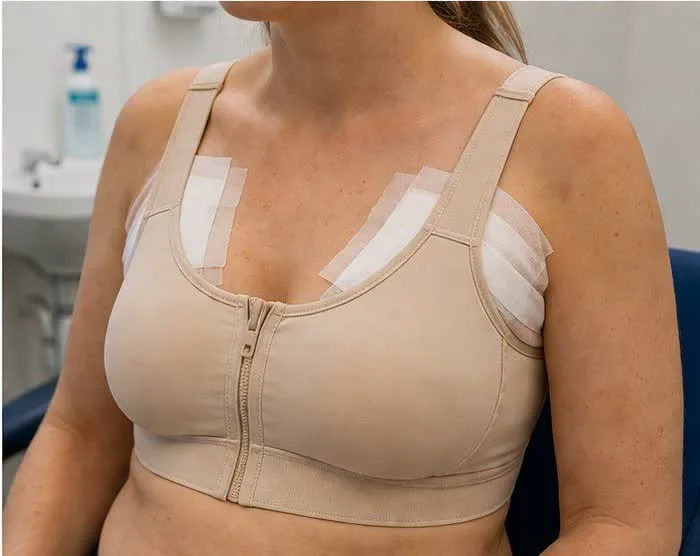
In the vast majority of cases, recovery is straightforward and only mildly painful. A moderate tension-like discomfort, relieved by simple analgesics (paracetamol ± anti-inflammatories), may persist for a few days. A compression dressing shaped like a sports bra is applied and kept in place for 24 to 48 hours.

Sutures are generally absorbable — no removal needed. A nurse phones the patient the day after surgery to check for any complications. A support bra is recommended for 1 month.

Bruising is common and resolves within a few weeks. If blue dye was used for sentinel lymph node mapping, the skin may remain colored for several months — this is harmless.

Bathing and sports activities are not allowed for 1 month. All everyday activities are permitted. Adjuvant radiotherapy usually starts 2 to 3 months after surgery, over 1, 3 or 5 weeks depending on the protocol.

Section 05 · Possible complications

Possible complications

Lumpectomy is a well-standardized surgery, with rare complications. It remains a surgical procedure that carries a low but real risk. The main complications are listed below:

Section 06 · Your questions

Detailed FAQ

How long does a lumpectomy take?+

30 minutes to 1h15 depending on tumor size and whether oncoplastic remodeling is performed. Always under general anesthesia. Add 30 to 45 minutes if a sentinel lymph node biopsy or axillary dissection is associated.

Is lumpectomy performed as day surgery?+

Yes, in most cases. Simple lumpectomy is almost always performed as day surgery — same-day discharge. Only complex oncoplastic lumpectomies (inverted-T with symmetrization, perforator flap) may require a 1 to 2 night hospital stay.

Will I need radiotherapy after lumpectomy?+

Yes, systematically. Whenever breast-conserving surgery is performed, adjuvant radiotherapy follows. It usually starts 2 to 3 months after surgery, over 1, 3 or 5 weeks depending on the protocol. This radiotherapy is what guarantees local control and provides survival equivalent to mastectomy.

What will my scar look like?+

In most cases, a simple incision is sufficient — either directly over the tumor or peri-areolar (around the areola). The aesthetic result is generally very satisfactory when the volume of tissue removed remains modest relative to breast size. If oncoplastic remodeling is associated, the scar pattern depends on the technique chosen (Round Block, inverted-T, radial mammoplasty, perforator flap, Batwing).

What is the risk of re-excision?+

10 to 15% of patients require re-excision if the final pathology report (available at day 15) shows insufficient margins. This re-excision is generally simpler — either a wider lumpectomy or, more rarely, a mastectomy depending on residual disease extent.

Lumpectomy or mastectomy — which to choose?+

The historical randomized trials — Milan 1973 (Veronesi et al.) and NSABP B-06 1976 (Fisher et al.) — showed no long-term survival difference (20-year follow-up) between lumpectomy followed by radiotherapy and mastectomy. The EBCTCG meta-analysis (Early Breast Cancer Trialists' Collaborative Group) confirms this equivalence. The choice therefore depends on tumor characteristics (size, multifocality, achievable margins), anatomy (tumor-to-breast ratio, location) and personal preferences (radiotherapy contraindications). Lumpectomy is preferred whenever feasible. To go further: how to choose between lumpectomy and mastectomy.

Can I have a lumpectomy after neoadjuvant chemotherapy?+

Yes, and it's actually common. Preoperative (neoadjuvant) chemotherapy can shrink the tumor and make breast-conserving surgery feasible when it was not initially. Lumpectomy is then discussed based on treatment response and residual tumor size.

Can I breastfeed after a lumpectomy?+

Breastfeeding remains possible after a lumpectomy, particularly if the surgery was limited. It may be reduced or impossible on the operated side depending on the extent of the procedure. Subsequent radiotherapy significantly reduces lactation capacity on the irradiated side. Discuss this with your surgeon if you have pregnancy plans.

Further reading

To go further

Associated procedure
Oncoplastic breast surgery — when is remodeling needed?
Round Block, inverted-T, radial mammoplasty, perforator flap, Batwing: the 5 oncoplastic techniques associated with lumpectomy.
Read →
Surgical alternative
Mastectomy — total breast removal
Skin-sparing, nipple-sparing, flat closure, endoscopic and robotic approaches. Immediate or delayed reconstruction strategies.
Read →
Associated procedure
Sentinel node or axillary dissection?
Axillary surgery, surgical de-escalation, lymphedema prevention.
Read →
— A question, an opinion

Let's talk about your situation

A consultation to discuss your case, understand the options available to you, or a surgical second opinion — feel free to book an appointment.

Book on Doctolib Request a callback
FREN