Removing the whole breast, yes — but the real question is not how much we remove, it's how we rebuild. Reconstructing right away, later, or choosing flat closure reconstruction. Three possible strategies, a choice always made with you.
Section 01 · Principle
The removal is always total — the strategy, never
Mastectomy is the operation that removes the entire breast. But behind that somewhat blunt word lies a whole family of procedures — and a strategy built with you, not around you.
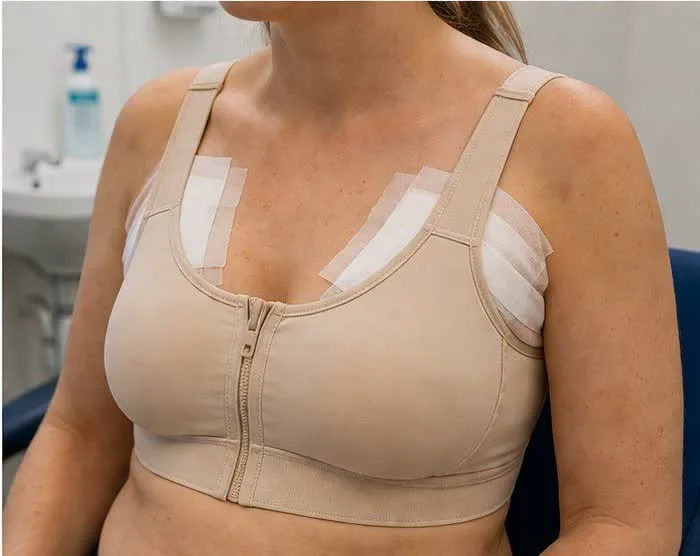
After the breast is removed, the upper chest may stay covered while the wound heals.
In practice, we remove all the breast tissue (the gland). It is the standard procedure when lumpectomy (removing only the tumour and keeping the rest of the breast) is not enough: a tumour too large relative to the size of the breast, several cancer foci, extensive early non-invasive (in-situ) cancer, inability to undergo radiotherapy, BRCA genetic mutation, re-appearance of a previously treated cancer, or inflammatory breast cancer (a particular form that affects the skin of the breast).
One important thing to know: long-term outcomes are identical between breast-conserving surgery (lumpectomy + radiotherapy) and mastectomy, whenever both options are medically feasible. The major international trials (Milan 1973, NSABP B-06 1976) and the EBCTCG meta-analysis demonstrated this with 20-year follow-up. Mastectomy is therefore not a "plus" in terms of cancer control — it is the right answer to a situation where conservation is not appropriate.
The procedure is performed under general anaesthesia. It lasts from 45 minutes to 3.5 hours depending on what is associated (lymph node sampling, immediate reconstruction). The hospital stay is 1 to 5 days, with small drains (soft tubes) in place for 5 to 10 days to remove the natural fluids.
Three questions structure the decision, asked in order: 1) do we need to sample lymph nodes under the arm? 2) would you like breast reconstruction, and if so, which type? 3) if reconstructing: can the nipple and areola be preserved? The next section walks through these steps one by one.
— Section 02 · Decision steps
How your strategy takes shape
Three questions, asked in order. Each answer guides the next. The decision is made together, in consultation, after the workup.
01
— Step 1
Do we need to sample lymph nodes under the arm?
For invasive cancer (one that can spread beyond the breast), we biopsy the sentinel lymph node at the same time as the mastectomy — it is the first lymph node (under the armpit) that "catches" what comes out of the breast. Analysing it tells us whether the disease has started to spread. If we already know before surgery that several lymph nodes are involved, we instead remove a larger group: this is called an axillary lymph node dissection (ALND).
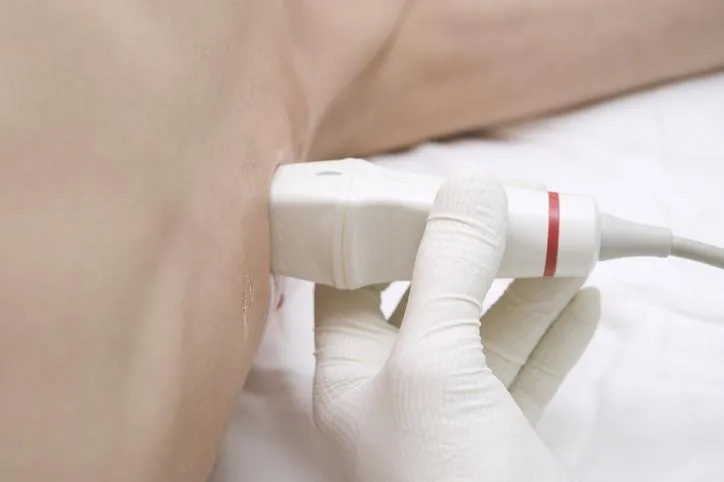
Ultrasound of the armpit, arm raised, to look at the lymph nodes.
A deeply personal choice. Reconstruction is always possible — either right away ("immediate reconstruction") or later ("delayed reconstruction"). And choosing not to reconstruct is also an entirely legitimate choice, and one that is increasingly recognised.
Waiting area: the reconstruction plan is discussed without rushing.
An increasingly recognised and embraced choice ("flat closure"). The surgeon closes the skin with a clean scar, without redundant tissue, for a harmonious and symmetrical chest.
· A single, shorter procedure
· Faster recovery
·External breast prosthesis available secondarily (covered by French Social Security)
— Reconstruction on the same day
Reconstructing at the same time
Reconstruction is performed under the same anaesthesia as the mastectomy: avoiding the period when the chest is "flat" between the two operations. Several techniques to choose from depending on your anatomy:
→ All techniques in detail: breast reconstruction → Also possible as a delayed procedure (on average 6 to 9 months after radiotherapy)
03
— Step 3 · Only if reconstruction
Can we keep the nipple and areola?
This question only arises in case of reconstruction. If you choose flat closure reconstruction, the nipple and areola cannot be preserved (there would be no breast volume to support them).
Preserving the nipple and areola (also called the nipple-areola complex, or NAC) depends on several criteria assessed case by case: the tumour-to-nipple distance (ideally more than 1 cm), no nipple involvement on imaging, the shape and volume of the breast (the natural drop of the breast under gravity, called "ptosis"), the quality of the skin, and smoking (which significantly impairs healing).
— Nipple & areola preserved
The nipple and areola are preserved (nipple-sparing technique). The scar is hidden:
·Under the breast (in the fold under the breast — preferred approach)
·Under the arm (scar hidden in the armpit)
·Around the areola
— Nipple & areola removed
The skin of the breast is preserved, but the nipple and areola have to be removed (skin-sparing technique). The scar is central oblique.
Reconstruction of the nipple and areola in a second step remains possible: 3D tattooing in relief, skin grafting, or a small local flap.
— Minimally invasive approaches
Available only when the nipple and areola are preserved — minimally invasive approaches do not allow removal of the nipple-areola complex.
Endoscopic mastectomy
Inframammary or axillary approach with video optics. Short and discreet scars. Indication: nipple preservation with immediate implant reconstruction.
Robot-assisted mastectomy
da Vinci system. Optimised precision and anatomical access. Longer operating time, but optimised aesthetic outcome. Available in equipped centres.
— A decision to make · We are here to guide you
Three questions, one tailored strategy — we build yours together.
Dr Zeitoun receives each patient to take the time to go through the three questions together — lymph nodes, reconstruction, nipple — based on your file, your anatomy and your life plans.
Paris 8th practice · Clinique Hartmann Neuilly · Second opinions on file welcome
Together we go over the workup results, examine you, and walk through the three questions that structure the decision: axillary surgery, NAC preservation, reconstruction. If you opt for immediate reconstruction, you also meet the associated plastic surgeon. Reflection time is guaranteed — nothing is decided in haste.
Consultation: the operation is discussed seated, with the file open.
02
Multidisciplinary team meeting & anesthesia consultation
Therapeutic plan validation in a multidisciplinary team meeting (medical oncologist, radiation oncologist, pathologist, surgeon). Anesthesia consultation at least 48 hours before surgery.
03
The morning of surgery
Standing surgical marking by the surgeon: incision lines, NAC landmarks, inframammary fold, surgical approach axis. Tracer injection for the sentinel lymph node or axillary dissection. Operating room.
04
The surgery
Under general anesthesia. First step: axillary surgery — sentinel lymph node biopsy or axillary dissection if invasive cancer, or axillary lymph node dissection if multiple nodes are already known to be involved. Second step: mastectomy — complete removal of the gland, with or without NAC preservation, via conventional, endoscopic, or robot-assisted approach depending on the strategy. Third step if immediate reconstruction: implant, expander, DIEP flap, latissimus dorsi flap, or lipofilling. Total duration: 45 min to 3.5 hours depending on associated procedures. Suction drains. Hospital stay 1 to 5 days. Clinique Hartmann (Neuilly-sur-Seine).
05
Day 15 follow-up
Scar examination. Drain removal if still in place. Review of the final pathology report (histologic type, grade, margins, lymph nodes). Presentation of the adjuvant treatment plan validated by the multidisciplinary team: post-mastectomy radiotherapy according to characteristics, chemotherapy, hormone therapy according to profile.
Section 04 · After surgery
Postoperative recovery
The hospital stay is 1 to 5 days, the time needed to monitor the drains, manage pain, and organise discharge home.
Suction drains are kept in place for 5 to 10 days on average, depending on output. They evacuate serous fluid and promote skin adherence. A home-care nurse monitors the drains and removes them. A compression bra is worn for 1 month.
Sutures are absorbable — no need to remove them. Pain is moderate, controlled with simple analgesics (paracetamol ± anti-inflammatories) and rest. Bruising is common and resolves within a few weeks.
Loss of sensation. Loss of skin sensation in the operated breast is constant, including with NAC preservation. The preserved skin and nipple lose their tactile sensitivity. Neurotization techniques (microsurgical reinnervation) may partially restore sensation in some centres.
Baths and sports activities are contraindicated for 1 month. Driving can be resumed after about 15 days. Return to work depends on the type of activity (3 to 6 weeks on average, longer if reconstruction by flap).
No mammography on the operated side — there is no remaining glandular tissue. Surveillance is done by clinical examination and complementary imaging (ultrasound, MRI) according to risk profile. Post-mastectomy radiotherapy may be indicated according to tumour characteristics (lymph node involvement, margins, size).
— A decision this important deserves time
Want to talk it through before deciding? That's exactly what a consultation is for.
A mastectomy is not a decision to make in five minutes. Dr Zeitoun receives you in consultation to go over your complete file, answer your questions, and present the strategy that matches your situation and your priorities.
Paris 8th practice · Clinique Hartmann Neuilly · Second opinions on file welcome
Mastectomy is a standardized surgery, with infrequent complications. It remains a surgical procedure that carries a small but real risk. The main complications are listed below:
Seroma
Accumulation of serous fluid in the mastectomy cavity after drain removal. Common. Most often resolves spontaneously. If large: aspiration in clinic, painless.
Hematoma
Accumulation of blood in the operative area. May require surgical evacuation in the operating room if large or painful.
Skin / NAC necrosis
Vascular compromise of the skin or nipple-areola complex when preserved. Main risk of skin-sparing and nipple-sparing mastectomy. More frequent with smoking, diabetes, thin skin, or skin tension. May require revision surgery.
Infection
Increased risk with implant-based reconstruction. Manifests with redness, warmth, pain, fever. Antibiotic therapy ± revision surgery depending on severity. Implant infection often requires implant removal.
Lymphoedema
Arm swelling related to disrupted lymphatic drainage. Rare with isolated sentinel lymph node biopsy or axillary dissection. More frequent after axillary dissection or axillary radiotherapy. Managed with specialised physical therapy and manual lymphatic drainage.
Shoulder stiffness
Limited shoulder mobility on the operated side. Common postoperatively. Managed with mobilization-focused physical therapy. Progressive recovery over 2 to 3 months.
Chronic pain
Some patients develop persistent neuropathic pain, grouped under the term post-mastectomy pain syndrome: burning, tingling or hypersensitivity of the chest wall, armpit or arm, linked to nerve injury. Dedicated management exists. → understand post-mastectomy pain syndrome.
Residual asymmetry
Difference in volume or shape compared to the preserved contralateral breast. Symmetrization is offered if needed (reduction, lift, or augmentation of the contralateral breast) — it falls within the scope of post-mastectomy reconstruction coverage.
Reconstruction
If immediate reconstruction: technique-specific risks (capsular contracture around implant, flap failure, lipofilling). See the reconstruction page for technique-specific complication details.
Section 06 · Your questions
Detailed FAQ
Mastectomy or lumpectomy: which one to choose?▾
The historical randomized trials — Milan 1973 (Veronesi et al.) and NSABP B-06 1976 (Fisher et al.) — showed no long-term survival difference (20-year follow-up) between lumpectomy followed by radiotherapy and mastectomy. The EBCTCG meta-analysis confirms this equivalence. Mastectomy is indicated for large or multifocal tumours, extensive ductal carcinoma in situ, contraindications to radiotherapy, BRCA1/BRCA2 mutations, and recurrences after conservation. The decision is always shared and discussed in MDT. → To go further: lumpectomy or mastectomy: how to choose?
Can I keep my nipple-areola complex (NAC)?▾
Preservation of the nipple-areola complex — called nipple-sparing mastectomy — depends on several criteria reviewed case by case: distance between the tumour and the nipple (ideally >1 cm), absence of NAC involvement on imaging, degree of breast ptosis, skin quality, and active smoking, which compromises wound healing. When feasible, the scar is hidden (inframammary, axillary, or periareolar) with optimal cosmetic outcome. If the NAC must be sacrificed (skin-sparing), a secondary reconstruction of the areola and nipple remains possible (3D tattoo, graft, or local flap).
What are the possible surgical approaches?▾
If the NAC is preserved: inframammary fold approach (preferred, scar hidden in the fold), axillary approach (scar in the armpit), or periareolar approach. If the NAC is sacrificed: central oblique scar. Minimally invasive approaches possible in equipped centres: endoscopic mastectomy (inframammary or axillary) and robotic mastectomy (da Vinci system) — fewer visible scars, but longer operating time.
Will I have an immediate reconstruction?▾
This is a personal decision, discussed in consultation. Immediate breast reconstruction (IBR) is performed under the same general anesthesia as the mastectomy, with an associated plastic surgeon. It avoids the "flat-chest interval". It is possible with or without NAC preservation — keeping the nipple is not a prerequisite. Formal contraindication: inflammatory breast cancer. Delayed reconstruction (on average 6 to 9 months after radiotherapy) is also an option. Techniques: implant (definitive prosthesis or expander), lipofilling, autologous flaps (DIEP, latissimus dorsi). Reconstruction and contralateral breast symmetrization fall within the scope of post-mastectomy reconstruction coverage.
How long does a mastectomy take?▾
45 min to 1.5 hours for a simple mastectomy without reconstruction. 2 to 3 hours with implant-based reconstruction. Up to 3.5 hours with autologous flap reconstruction (DIEP, latissimus dorsi). General anesthesia. Hospital stay 1 to 5 days depending on the strategy.
Is mastectomy reimbursed?▾
Yes. Mastectomy is covered by the French national health insurance under long-term illness status (ALD 30 — cancer). Breast reconstruction and contralateral breast symmetrization also fall within the scope of post-mastectomy reconstruction coverage, without any specific medical prescription. Out-of-pocket fees may apply in sector 2 practice (Dr Zeitoun practices in sector 2 non-OPTAM; a detailed quote is provided during consultation).
Can I choose mastectomy without reconstruction (flat closure)?▾
Yes — it is a fully legitimate and increasingly recognised choice. Flat closure reconstruction means leaving the chest flat and harmonious after mastectomy. It avoids the complications of reconstruction. An external breast prosthesis can be offered secondarily (reimbursed by national health insurance). Many patients live very well with a flat chest — the key is informed choice. → If you are unsure, see also the breast reconstruction page detailing the available techniques.
Will I lose breast sensation?▾
Yes — loss of skin sensation is consistent after mastectomy, including with NAC preservation. The preserved skin and nipple lose tactile sensitivity. Neurotization techniques (microsurgical reinnervation) are being developed in some centres and may partially restore sensation. Erotic sensitivity of the nipple is permanently lost, even when the NAC is preserved.
What is the follow-up after mastectomy?▾
No mammography on the operated side (no remaining glandular tissue). Regular clinical follow-up by the surgeon and oncologist. Ultrasound ± breast MRI according to profile. If implant-based reconstruction: ultrasound surveillance of the implants (including for BIA-ALCL — breast implant-associated anaplastic large cell lymphoma, exceptional but monitored). Annual mammography + ultrasound/MRI of the preserved contralateral breast.
Who performs mastectomy and how do I choose my surgeon in Paris?▾
A mastectomy should be performed by a surgeon specialised in breast surgical oncology, in a hospital accredited for cancer surgery, with multidisciplinary tumour board review and the option of immediate reconstruction when indicated. Dr Jérémie Zeitoun, an English-speaking breast surgeon in Paris 8, former specialist at Institut Gustave Roussy, performs total, skin-sparing and nipple-sparing mastectomies according to the indication, at Clinique Hartmann (Neuilly-sur-Seine).
— Mastectomy + reconstruction · One surgeon, from beginning to end
A mastectomy is never an ending — it's a step, and we prepare it together.
Dr Zeitoun accompanies you at every stage of your journey: choosing the strategy, surgery, reconstruction, long-term follow-up. Immediate or delayed reconstruction with an implant, with your own tissue (DIEP, latissimus dorsi, lipofilling), or an embraced choice of flat closure reconstruction. You stay with the same surgeon, from diagnosis to the final stage.
Paris 8th practice · Clinique Hartmann Neuilly · Sector 2 non-OPTAM · Second opinions on file welcome