A dip after a lumpectomy?
Dr Jérémie Zeitoun, surgical oncologist and breast surgeon, sees patients at the practice at 241 rue du Faubourg Saint-Honoré (Paris 8e) and at Clinique Hartmann (Neuilly-sur-Seine). He looks at the skin, the missing volume and the possible timetable.
Reconstruction or sequelae after breast cancer?
An opinion on whether fat grafting is indicated in your situation, and when.
Contour defect, a dip after a lumpectomy, irradiated skin, the finishing of a reconstruction: Dr Zeitoun reviews your file, sets the indication at a team meeting and explains the safety, the timetable and the surveillance at the Hartmann Clinic in Neuilly.
Fat grafting is one option among others: the indication and the timing are decided case by case, with the team looking after you.

After a breast cancer, reconstruction is rarely done in a single stage. Fat grafting — also called lipomodelling or lipofilling — is the finishing tool par excellence: it uses your own fat to correct a dip, round out a contour, and soften skin damaged by radiotherapy. This article does not repeat the general technique of breast lipofilling, described on the dedicated page: it focuses on the two questions that come up most in consultation — is it safe from a cancer standpoint, and what result to expect.
The concern is legitimate: reinjecting fat — a living, cell-rich tissue — into a breast that has harboured a tumour, might that not "reawaken" the disease? It is a serious question, long debated. The current answer is reassuring but nuanced, and it deserves to be explained honestly, without excessive promises. Fat grafting is part of the wider journey of breast reconstruction, whose other techniques it often complements.
This text draws on the reference points of the INCa, on the recent meta-analyses and on the position statement of the French Society of Senology and Breast Pathology (SFSPM). It is intended for information and does not replace a consultation: the indication and timing of the fat grafting are a shared decision between you and your surgeon, after a breast work-up — not a decision validated in a multidisciplinary team meeting (MDT); the MDT concerns cancer treatment decisions.
Fat grafting: your own fat as reconstruction material
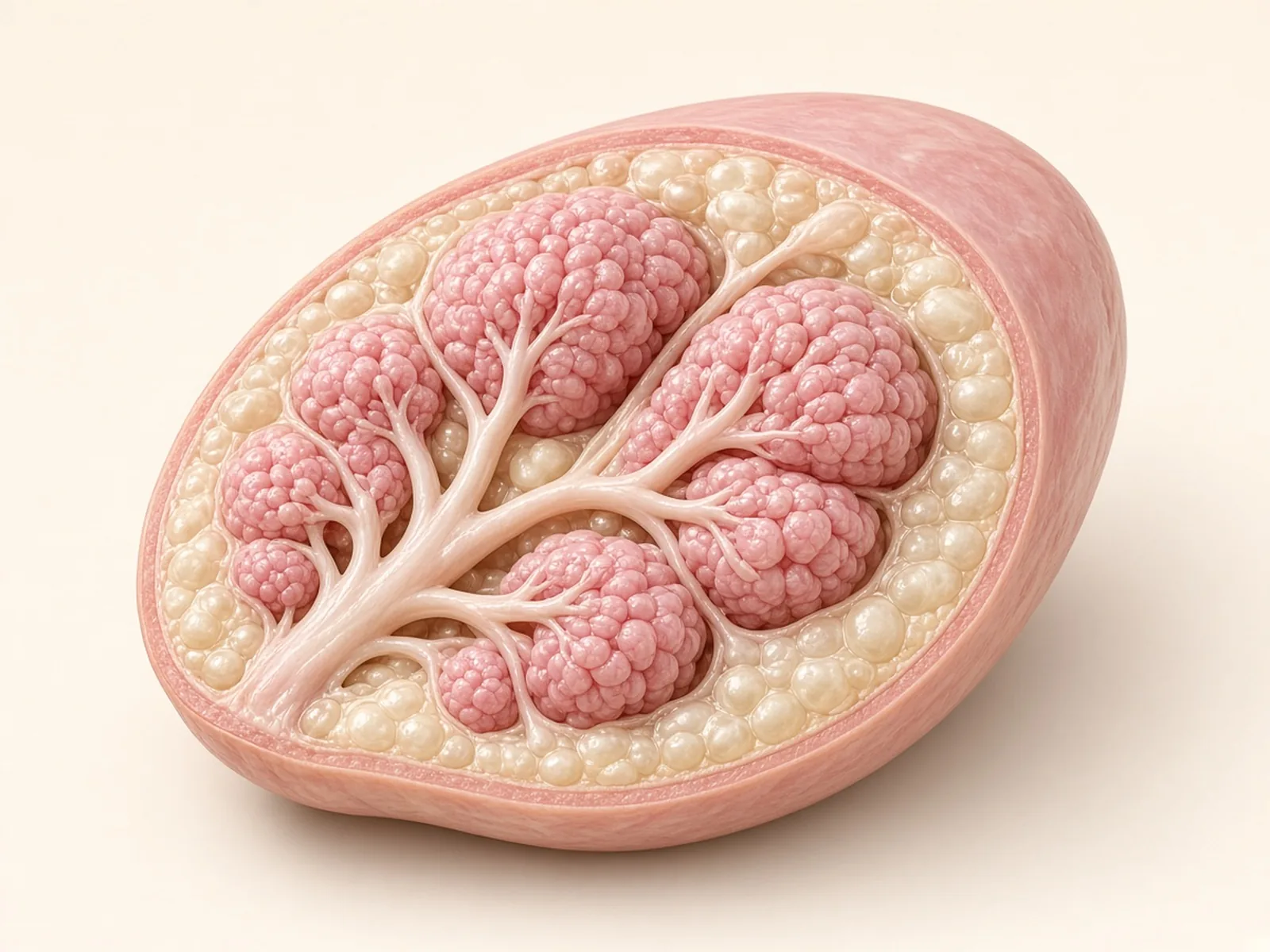
Fat grafting, or lipomodelling, is an autologous fat graft: fat is harvested where you have it, prepared, then reinjected where it is lacking. No implant, no foreign body — the only material is your own.
Harvest, purify, reinject
The fat is gently aspirated from the thighs or the abdomen (liposuction), then purified by decantation or centrifugation to keep only the viable fat cells. It is finally reinjected into the breast or the chest wall using fine micro-cannulas, along many small tracks, so that each droplet of fat finds a blood supply and "takes".
Fat grafting most often comes in addition to another technique: it refines an implant reconstruction, complements a latissimus dorsi flap or a DIEP flap, or remains the only procedure in a patient who has chosen a flat closure but wishes to correct a localised defect. In some patients, repeated over several sessions, it can even rebuild a volume on its own.
What this changes: because it adds neither an implant nor a significant scar, fat grafting is often perceived as "minor". It nonetheless remains a surgical procedure, with its rules, its limits and — after cancer — its own precautions, developed in the rest of this article. For the detail of the technique and the recovery, see the breast lipofilling page.
The indications for fat grafting after breast cancer

After treatment, the reconstructed or conserved breast is never quite as it was before. Fat grafting corrects precisely these imperfections — from a fine touch-up to a complete reconstruction, by way of a more unexpected effect on irradiated skin.
Refining a reconstruction
This is the most frequent use. After an implant or flap reconstruction, there often remains a small dip, a transition that is too marked at the top of the breast, a subtle asymmetry. A few millilitres of fat, well distributed, soften these contours and make the result more natural.
Correcting a defect after breast-conserving surgery
After a lumpectomy (removal of the tumour while conserving the breast), a hollow or a deformity may persist, sometimes accentuated by radiotherapy. Fat grafting fills this localised contour defect without a new visible scar.
Softening damaged skin
This is the least known benefit: the grafted fat has a described regenerative effect on the trophicity and suppleness of irradiated skin. It can soften fibrosed, indurated tissue and improve its quality — a benefit that goes beyond simply correcting volume.
Rebuilding a volume
Repeated over several sessions, fat grafting can, in selected patients, rebuild all or part of the breast volume — an autologous option, without an implant, when the body shape and the available fat allow it.
Beyond appearance: correcting a breast can also relieve the discomfort of a post-mastectomy pain syndrome and help you reclaim your body. Fat grafting is not the only answer, however: depending on the context, surgery of the armpit and of the sentinel lymph node, or other procedures, also come into play.
The indications also concern reconstruction after prophylactic mastectomy in women at high hereditary risk of breast and ovarian cancer (BRCA mutations). In these patients, the strategy is global: it may combine, at different times, breast reconstruction and surgery of the ovaries and tubes to also reduce the risk of ovarian cancer. Fat grafting finds its place there as a finishing step.
Oncological safety: what do the data really say?
This is the heart of the matter. The concern comes from an observation made in the laboratory: fat contains adipose-derived stem cells which, under certain in vitro conditions, appear able to stimulate the proliferation of cancer cells. From this arose the hypothesis that fat grafting might promote a recurrence. The question deserved to be asked seriously — and it was.

Where do things stand today? The available clinical studies are largely retrospective (patients who have had fat grafting are compared, after the fact, with others who have not). With this important caveat, their results converge: they do not show any proven excess risk of recurrence.
| Study (year) | What it shows |
|---|---|
| Goncalves meta-analysis, BMC Cancer (2022) | No significant difference in local recurrence (relative risk around 0.86, 95% confidence interval 0.66–1.12): no excess risk found. |
| Li meta-analysis, Aesthetic Plastic Surgery (2022) | No difference in matched cohorts between patients with and without fat grafting. |
| Experimental data (Valente, 2024) | The theoretical basis — "pro-proliferative" adipose-derived stem cells observed in vitro — is not confirmed in vivo. |
| SFSPM position statement (Moliere, 2023) | No increase in risk in the majority of studies, but limited follow-up and nuances to respect (see below). |
| Historical signal (Petit, 2013) | A possible excess risk raised for intraepithelial neoplasia; this signal has not been confirmed since. |
Indicative summary for information; the figures come from the cited publications and do not prejudge an individual situation.
A reassuring answer, but nuances to respect
The SFSPM position statement (Moliere et al., 2023) sums up the current position well: in the majority of studies, fat grafting does not increase the risk of recurrence. But the learned societies insist on three precautions, precisely because follow-up remains limited and there is no randomised trial.
Observe an interval
Avoid fat grafting that is too early: a safety interval is observed after the end of treatments, so the indication is set at a distance and not in the highest-risk period.
Avoid excess
Avoid excessive volumes in a single stage. Measured, repeated sessions are preferred over massive filling, which is less well tolerated by the tissues and by the graft itself.
Adapt to the risk
Exercise caution in the case of a high risk of relapse. The indication is then discussed all the more carefully, case by case, taking into account the type of cancer and its prognosis.
The wording to remember: the current data, which are largely retrospective, do not show any proven excess risk of recurrence; the learned societies point out that follow-up remains limited and recommend an indication set case by case, at a distance from the treatments, with information and surveillance. The indication and timing of the fat grafting are a shared decision between you and your surgeon, after a breast work-up; this is not a decision validated in a multidisciplinary team meeting (MDT), the MDT concerning cancer treatment decisions.
Unsure about the safety of fat grafting? Let's take the time to talk it through.
Dr Zeitoun reviews your oncology file, gauges your level of risk and explains, without excessive promises, what the data allow us to say — and what they do not yet allow us to assert.
Radiological surveillance after fat grafting
A different, more practical concern: fat grafting changes the appearance of the breast on imaging. Fat that does not "take" can leave benign traces — which must be recognised so they are not mistaken for a recurrence. Well known to radiologists, this issue does not call into question the quality of the follow-up; it adapts it.
Fat necrosis, oil cysts, microcalcifications
When part of the fat does not develop a blood supply, it can progress to fat necrosis, form oil cysts with typical rounded outlines — described as "soap bubbles" — or calcify into fine microcalcifications. These findings are benign and have, to the trained eye, a radiological signature different from that of a recurrence.
That is the whole point: these abnormalities must be recognised as such, without triggering unwarranted anxiety, but without masking a genuine lesion either. This is why follow-up after fat grafting is entrusted to a radiologist familiar with the operated breast.
How the follow-up is organised
Surveillance relies on the usual breast-imaging tools, interpreted with knowledge of the history of fat grafting.
To go further: to decode the terms of your examinations, see understanding your mammogram (density, tomosynthesis, BI-RADS), understanding breast ultrasound and understanding breast MRI; and, if a core biopsy is performed, understanding your pathology report. Telling the radiologist that you have had fat grafting is always useful: this information guides the interpretation.
The procedure: a light operation, but often repeated
Fat grafting is a generally well-tolerated procedure. Its particularity lies less in each session than in their repetition: because part of the fat is resorbed, several stages are often needed to reach the result.
The operation
Most often as a day case (home the same day), under general anaesthesia — sometimes local for small touch-ups. The session usually lasts one to two hours, harvesting and reinjection included.
Resorption
Not all the grafted fat survives: about 30% is resorbed in the first months. This is normal and expected. This is why several sessions are often planned, spaced about three months apart.
Recovery
Bruising and oedema are seen both on the donor area and on the breast. Recovery is generally not very painful and the return to activities is quick, within a few days.
The right timetable: after a cancer, the timing of fat grafting is not left to chance. We wait for the end of treatments, observe the safety interval mentioned above, and plan the sessions around your breast surveillance. This timetable is decided with the team looking after you, not apart from it.
The results: natural, but with honest limits
The main strength of fat grafting is the quality of its result: since it is your own tissue, it has a natural consistency and mobility, very close to those of an unoperated breast. Its limits must also be set out, without glossing over them.
A natural result, achieved in several stages
What you gain: a soft contour, a natural consistency and mobility, and — on irradiated skin — a possible gain in suppleness. The fat that has taken durably remains stable over time, even if it follows weight variations.
What must be accepted: the partial resorption requires iterative sessions; the result depends on the available fat (a very slim patient has little) and on the technique and experience of the surgeon. No quantified success rate can be promised in advance: the result is judged session after session.
And the funding? In France, breast reconstruction after cancer — of which fat grafting is part — is fully covered (100%) under the long-term illness scheme (ALD), according to the INCa. It can be carried out immediately or in a delayed manner. Dr Zeitoun practises in Sector 2 (non-OPTAM) and charges fees above the French Social Security rate for all consultations and procedures. Most international patients are not covered by French Social Security. A detailed quote is given during the consultation, before any procedure. If you are covered, the Assurance Maladie reimburses on the basis of the Social Security rate, and your health insurance may cover all or part of the additional fees, depending on your policy.
Your journey with Dr Zeitoun
A breast surgeon, Dr Zeitoun looks after the breast as a whole — from cancer to benign breast lesions, through to reconstruction and its finishing touches. Fat grafting is part of this continuum.
Setting the indication, together
Dr Zeitoun reviews your complete oncology file — type of cancer, treatments received, level of risk, time elapsed — and carries out a breast work-up. The indication and timing of the fat grafting are a shared decision between you and your surgeon, after this work-up; this is not a decision validated in a multidisciplinary team meeting (MDT), the MDT concerning cancer treatment decisions.
Performing the fat grafting
He performs the fat grafting himself for reconstruction and for sequelae: finishing an implant or a flap, correcting a defect after a lumpectomy, improving irradiated skin, iterative reconstruction with fat.
Free flaps, as a team
He does not himself perform free-flap microsurgery (such as the DIEP): these reconstructions are carried out with a microsurgeon. Fat grafting then complements and refines these reconstructions.
Paris 8th arr. & Hartmann Clinic
He sees patients in Paris 8th and at Clinique Hartmann (Neuilly-sur-Seine), where he operates. Sector 2: fee supplements set out in a quote provided before any procedure.
A second opinion is available if you are already being followed elsewhere and wish to take stock before deciding. You can request a callback from the secretariat or book an appointment directly. To explore other topics, see our patient articles, Dr Zeitoun's training and background page, as well as his management of gynaecological cancers.
Irradiated skin, or the finishing of a reconstruction?
Dr Jérémie Zeitoun, surgical oncologist and breast surgeon, sees patients at the practice at 241 rue du Faubourg Saint-Honoré (Paris 8e) and at Clinique Hartmann (Neuilly-sur-Seine). The consultation sets the indication, the safety and the follow-up.
Frequently asked questions
Does fat grafting increase the risk of breast cancer recurrence?
The current data, which are largely retrospective, do not show any proven excess risk of recurrence. Recent meta-analyses (Goncalves, BMC Cancer 2022; Li, Aesthetic Plastic Surgery 2022) find no significant difference in matched cohorts, and the theoretical basis observed in the laboratory has not been confirmed in humans (Valente 2024). The learned societies (the SFSPM position statement, Moliere 2023) point out that follow-up remains limited, that there is no randomised trial, and recommend that the indication be set case by case, at a distance from the treatments, with information and surveillance.
How many fat grafting sessions are needed?
Part of the grafted fat is resorbed (around 30%). Several sessions are therefore often needed, about three months apart, to achieve a stable contour. The exact number depends on the volume to correct, the quality of the skin and the fat available; it cannot be fixed definitively in advance.
Is the result permanent despite resorption?
The fat that "takes" durably — the fat not resorbed in the first months — in principle remains stable over time; it does, however, follow weight variations. It is because part of it is resorbed that sessions are often repeated: once the result is achieved, it is considered durable.
Does fat grafting interfere with surveillance and mammography?
Fat grafting can create benign findings (fat necrosis, oil cysts described as "soap bubbles", microcalcifications) that must be known so they are not mistaken for a recurrence. Surveillance remains entirely possible: it is carried out by a radiologist familiar with the operated breast, with mammography and ultrasound, MRI if needed, with reading according to the ACR/BI-RADS classification and a core biopsy in case of doubt.
When can fat grafting be performed after treatments?
It is recommended to observe a safety interval after the end of treatments and to avoid fat grafting that is too early. The indication is set at a distance, case by case, taking the risk of relapse into account. The indication and timing are a shared decision between you and your surgeon, after a breast work-up; this is not a decision validated in a multidisciplinary team meeting (MDT), the MDT concerning cancer treatment decisions. The precise timetable is set with the team looking after you.
Is fat grafting after cancer covered?
Yes. Breast reconstruction after cancer, of which fat grafting is part, is fully covered (100%) under the long-term illness scheme (ALD), according to the INCa. Dr Zeitoun practises in Sector 2 (non-OPTAM) and charges fees above the French Social Security rate for all consultations and procedures. Most international patients are not covered by French Social Security. A detailed quote is given during the consultation, before any procedure. If you are covered, the Assurance Maladie reimburses on the basis of the Social Security rate, and your health insurance may cover all or part of the additional fees, depending on your policy.
Can fat grafting improve irradiated skin?
Yes, it is one of its benefits. The grafted fat has a described regenerative effect on the trophicity and suppleness of irradiated skin: it can soften fibrosed tissue and improve its quality, in addition to correcting the contour.
Does Dr Zeitoun perform free flaps (DIEP) himself?
Dr Zeitoun is a breast surgeon: he sets the indication for the fat grafting as a shared decision with you, after a breast work-up (not at a multidisciplinary team meeting, which concerns cancer treatment decisions), and performs fat grafting for reconstruction and for sequelae. He does not himself perform free-flap microsurgery (such as the DIEP), which is carried out with a microsurgeon. A second opinion is available.
What are Dr Zeitoun's fees?
Dr Zeitoun practises in Sector 2 (non-OPTAM) and charges fees above the French Social Security rate for all consultations and procedures. Most international patients are not covered by French Social Security. A detailed quote is given during the consultation, before any procedure. If you are covered, the Assurance Maladie reimburses on the basis of the Social Security rate, and your health insurance may cover all or part of the additional fees, depending on your policy.
Sources & references
This article draws in particular on:
This article is intended for information and does not replace a medical consultation. The data evolve; the indication, the timetable and the surveillance are decided individually, in consultation with the team looking after you.
Further reading
To place fat grafting within the whole breast journey after cancer.
The reference page: principle, full technique, indications and recovery of breast lipomodelling.
All reconstruction techniques: implant, flaps, fat grafting, flat closure — how to choose.
Implant and expander: the technique that fat grafting often refines and complements.
Reconstruction with autologous tissue from the back, frequently finished with one or more fat grafts.
Density, tomosynthesis, ACR/BI-RADS classification: decoding the images of your follow-up.
Risk-reducing surgery and reconstruction in women at hereditary risk (BRCA).
An opinion for your reconstruction and your fat grafting
A sequela after breast cancer, the finishing of a reconstruction, irradiated skin, or simply a need to see clearly on safety: Dr Jérémie Zeitoun sees patients in Paris 8th and at Clinique Hartmann (Neuilly-sur-Seine), where he operates. Bring your reports and your imaging.
This article is intended for information and does not replace a medical consultation; the indication and the surveillance are coordinated with your oncologist, your radiologist and the team looking after you.
Fat grafting is being considered?
The practice arranges the appointment in Paris 8e or at Clinique Hartmann. The procedure takes place at Clinique Hartmann.
Dr Zeitoun practises in Sector 2 (non-OPTAM) and charges fees above the French Social Security rate for all consultations and procedures. Most international patients are not covered by French Social Security. A detailed quote is given during the consultation, before any procedure. If you are covered, the Assurance Maladie reimburses on the basis of the Social Security rate, and your health insurance may cover all or part of the additional fees, depending on your policy.
Sources
References used for this page.
- Goncalves R et al. Oncological safety of autologous fat grafting in breast reconstruction: a systematic review and meta-analysis. BMC Cancer. 2022.
- Li S et al. Oncological safety of fat grafting in breast reconstruction: matched-cohort analysis. Aesthetic Plastic Surgery. 2022.
- Valente et al. Adipose-derived stem cells and breast cancer: in vivo evidence. 2024.
- French Society of Senology and Breast Pathology (SFSPM), Moliere et al. Position statement on the oncological safety of breast fat grafting. 2023. senologie.com.
- Gosset J, Delay E et al. Breast lipomodelling: technique and results. 2008.
- American Society of Plastic Surgeons (ASPS). Post-Mastectomy Fat Graft/Fat Transfer ASPS Guiding Principles. 2009.
- French National Cancer Institute (INCa). e-cancer.fr.