Dr Jérémie Zeitoun · Paris
Lymphoedema prevention after axillary surgery
Lymphoedema prevention after breast cancer surgery (sentinel node, axillary clearance): warning signs, lymphatic drainage, compression sleeve. Dr Zeitoun.
Lymphoedema prevention after breast cancer surgery (sentinel node, axillary clearance): warning signs, lymphatic drainage, compression sleeve. Dr Zeitoun.
Lymphoedema is a chronic swelling of the arm caused by impaired lymphatic drainage. It can occur after axillary surgery (sentinel lymph node or axillary clearance) or after axillary radiotherapy.
Lymph is a fluid circulating through fine vessels, parallel to the blood system, that drains tissues and supports immune defence. In the arm, it flows up to the lymph nodes in the armpit. When these nodes are removed or irradiated, drainage may be slowed, and fluid gradually accumulates in the arm, forearm, or hand.
The risk varies considerably depending on surgery:
— Sentinel node alone: low risk, around 5 to 7%
— Axillary clearance: higher risk, around 20 to 30%
— Axillary clearance + radiotherapy: cumulative risk, up to 30-40%
Lymphoedema may appear a few weeks to several years after surgery. It is neither inevitable nor a sign of recurrence: it is a mechanical complication, that one learns to recognise, prevent, and treat.
The earlier it is spotted, the more effective its management. That is why this page exists: to give you practical landmarks before, during, and after your surgery.

Before your axillary surgery (sentinel lymph node biopsy or axillary dissection), a dedicated second opinion allows us to measure your arm (baseline volumetry), identify your personal risk factors, and put the right habits in place starting today. The earlier we anticipate, the better we protect.
Lymphoedema prevention starts before surgery. A few simple steps reduce the risk or make management easier should it occur.
Routine specialised physiotherapy
For all patients undergoing breast surgery, I prescribe physiotherapy through the French Network of Breast Physiotherapists (Réseau des Kinés du Sein) — a national network of physiotherapists trained specifically in post-breast-surgery care, including manual lymphatic drainage (MLD) and shoulder rehabilitation. You can find a practitioner near you on their website: reseaudeskinesdusein.fr.
This early care, started in the first weeks after surgery, is one of the cornerstones of lymphoedema prevention.
Preparing the operated side
Treat any small wound or skin infection on the arm to be operated: ingrown nail, eczema, fungal infection, infected bite, burn. Healthy skin at the time of surgery reduces post-operative infection risk.
Understanding your surgery
Ask your surgeon: will I have a sentinel lymph node or axillary clearance, or both? This information determines the level of risk and therefore the advice that follows.
During hospitalisation, a few simple steps from staff and patient lay the groundwork for prevention.
Early arm mobilisation
From the day after surgery, the operated arm is gently mobilised. No effort, no maximal range, just slow regular movements (elevation, moderate rotation, opening-closing of the hand). The aim: prevent stiffening and support residual lymphatic flow.
Limb monitoring
The nursing team monitors colour, warmth, volume, and sensation of the arm. Any unusual sign (swelling, redness, pain, fever) is reported immediately.
Resting position
At rest, slightly elevating the arm (on a cushion) supports lymphatic return. Avoid letting the arm hang for hours.
Discharge
Before leaving, ask: do I need a prescription for manual lymphatic drainage (MLD)? Is a prescription needed for a compression sleeve? These elements are specified according to your situation.
This is the most important period for prevention. Good habits adopted on returning home reduce long-term risk.
Manual lymphatic drainage (MLD)
MLD is a specialised physiotherapy that mobilises lymph through gentle manoeuvres. It is generally prescribed after axillary clearance (and sometimes after sentinel node if early signs appear). The first sessions are close together (1 to 2 per week), then spaced out depending on progress. The earlier it is started, the more effective it is.
Self-massage and exercises
Your physiotherapist teaches you movements you can repeat at home: self-drainage, stretches, arm mobilisation. 5 to 10 minutes a day are usually enough.
Daily monitoring
Get into the habit of looking at your arm every day. Compare with the opposite arm. Early swelling is much easier to treat than established lymphoedema.
Skin care
Moisturise the skin of the operated arm daily (simple cream, fragrance-free). Supple skin is less prone to micro-cracks, which are entry points for infection.
Gradual return of the arm
After 2 to 3 weeks, you can resume most daily activities (cooking, light housework, writing). Avoid sudden intense effort. Sport is resumed progressively, in agreement with your surgeon and/or physiotherapist.
Beyond the first weeks, the operated arm remains slightly more fragile, for life. A few simple rules allow a fully normal life.
Compression sleeve
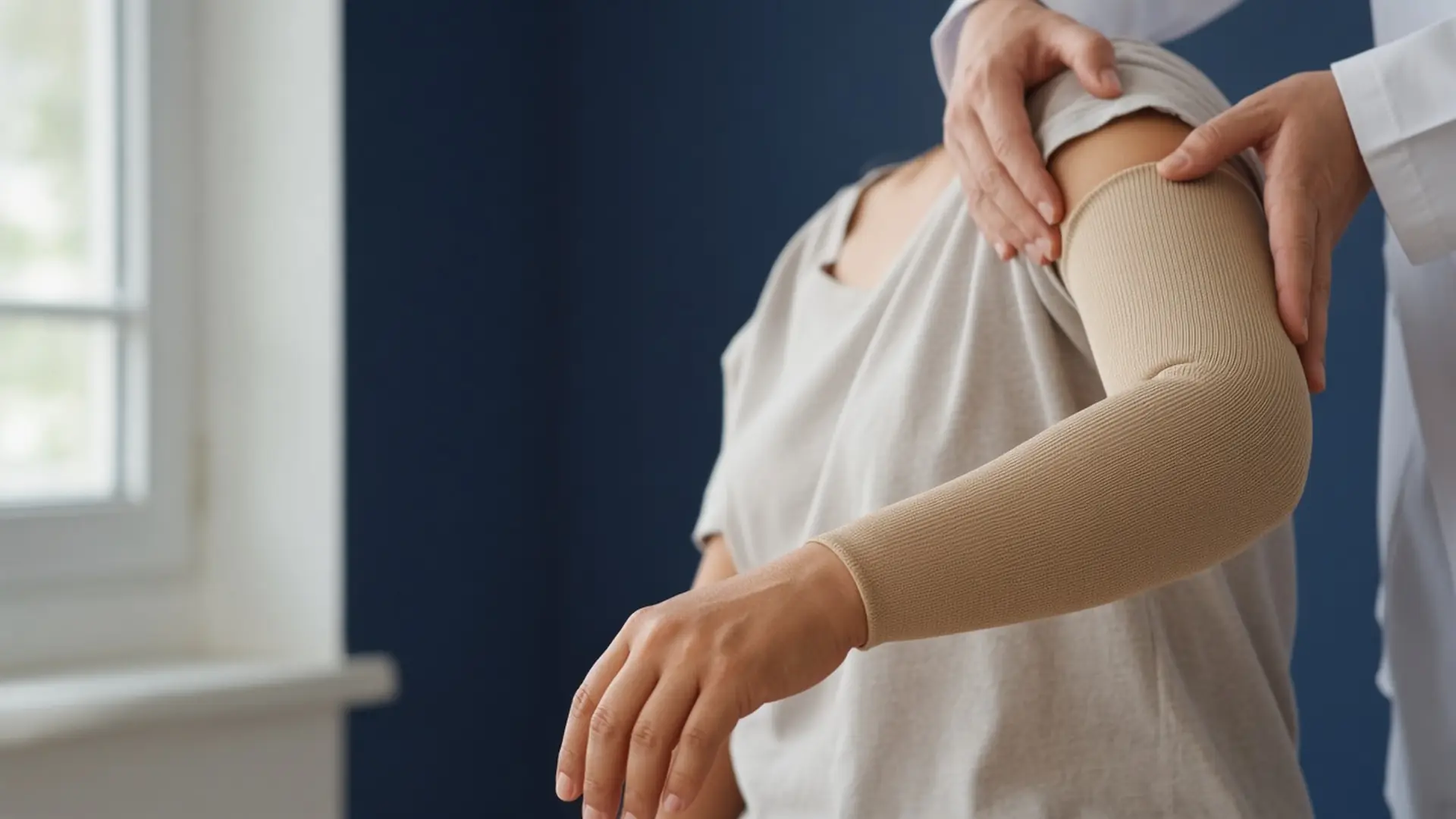
After axillary clearance, I systematically prescribe a compression sleeve as a preventive measure. It is one of the most effective measures to reduce the risk of lymphoedema in the months and years after surgery. The sleeve is custom-fitted by a certified professional and renewed every 6 months or so.
After an isolated sentinel node, the sleeve is not routine but may be recommended in certain risk situations (air travel, intense effort, hot climates).
Sport & activity
No sport is forbidden. Walking, yoga, swimming, cycling are excellent allies. More demanding sports (tennis, golf, weight training, loaded hiking) can be resumed progressively; wearing a sleeve during effort is recommended. Avoid sudden intense effort.
Air travel
Altitude and pressure changes can promote swelling. For long flights (≥ 3 hours), wear your compression sleeve during the flight. Hydrate well, get up regularly, move the arm.
Hot climates
Heat dilates vessels and can promote transient swelling. In sun, beach, sauna, or hammam, be attentive: no prolonged exposure of the arm, no localised heat application.
Long-term monitoring
At your annual post-operative follow-up, the arm circumference is measured and compared. If you notice asymmetry, heaviness, tingling, or redness, mention it to your surgeon without delay — early lymphoedema responds much better.
Specialised reference centre if needed
For established lymphoedema or complex situations, Hôpital Cognacq-Jay (Paris 15th) is the French national reference centre for specialised lymphoedema care — comprehensive assessments, intensive day-hospital drainage sessions, multilayer bandaging, and a dedicated multidisciplinary team. This is the unit to which patients requiring intensive or multidisciplinary management are referred.
When lymphoedema requires intensive management, day-hospital sessions combine prolonged drainage, multilayer bandages applied by a specialised physiotherapist, self-bandaging instruction, and therapeutic education. A few days are often enough to lastingly stabilise the situation.
Noticing a change in volume, a heavy sensation, or simply want to make sure everything is alright? A video teleconsultation with Dr Zeitoun lets us review your photos together, assess early signs, and quickly refer you to a trained physiotherapist if needed.
Teleconsultation from home · Paris 8th practice · Clinique Hartmann Neuilly
Some daily-life situations can trigger or worsen lymphoedema. Knowing them well helps avoid them without becoming anxious.
— Blood draws on the operated side: avoid where possible. Prefer the opposite arm. If unavoidable on the operated side (technical impossibility), it remains possible — but should be the exception.
— Blood pressure cuff: same principle. Prefer the opposite arm. If essential on the operated side, it is feasible but should be flagged.
— Carrying heavy loads with the operated arm: limit heavy bags, bulky suitcases, shopping carried in the operated-side hand. Prefer backpacks or distributed loads.
— Tight bracelets and rings: avoid jewellery that marks the skin. A watch or bracelet: if possible, on the opposite arm.
— Tight clothing on the arm: elasticated sleeves, bra straps that dig in, tight armbands.
— Sunburn and burns: protect your arm (light clothing, sunscreen). Prolonged sunburn can trigger or worsen lymphoedema.
— Insect bites: avoid mosquito-prone areas without protection. If bitten, disinfect immediately.
— Unattended small wounds: torn nail, gardening cut, kitchen micro-cut, animal scratch. Always disinfect quickly.
— Saunas, hammams, very hot baths: not forbidden, but limited, and never during inflammatory flares.
— Untrained massage of the arm: only a physiotherapist trained in MLD should massage an at-risk arm. Avoid “relaxation” massages of the operated arm without medical advice.
Two possible situations, two adapted consultation modes. Choose the one that best matches your journey.
A second opinion at the practice before your lymph node surgery: baseline arm volumetry, risk factor assessment, and putting the right habits in place starting today.
Request a second opinion →Video teleconsultation from home: review of your photos, assessment of the signs, and prompt referral to a trained physiotherapist if needed.
Video teleconsultation →Unsure or prefer talking? Request a callback from the secretary — Coralie will guide you to the right slot.