

Key figures — Borderline ovarian tumour
The essentials before your consultation.
A tumour in its own right
Borderline ovarian tumours — also called tumours of low malignant potential — account for approximately 15 to 20% of ovarian tumours operated on. They frequently occur in young women, sometimes discovered during a fertility work-up or a routine ultrasound. Their prognosis is generally very favourable, but they require surgery and rigorous follow-up.
You have a suspicious ovarian tumour and surgery is being considered? A pre-operative consultation allows us to define the best surgical strategy for your situation together.
Borderline or ovarian cancer — they are not the same
Both involve the ovary, but their behaviour, treatment and prognosis are very different. Here is what distinguishes them.
The tumour does not destroy adjacent tissues. It can form deposits on the peritoneum — known as implants — but these most often remain superficial and non-invasive.
Treatment: surgery alone in the vast majority of cases. No routine chemotherapy.
Fertility: often preserved — fertility-sparing surgery is possible in young women.
Prognosis: very favourable in most cases, including when implants are present.
The tumour invades adjacent tissues and can spread throughout the abdomen. Treatment is heavier and longer.
Treatment: extensive cytoreductive surgery + chemotherapy + maintenance treatment.
Fertility: rarely preserved, except in highly selected cases.
Prognosis: variable depending on stage and type — less favourable than a borderline, especially at advanced stages.
A diagnosis that is often unexpected
In the majority of cases, a borderline tumour does not cause any specific symptom. It is often discovered by chance.
The pre-operative workup
Certainty cannot be reached before surgeryPelvic ultrasound is the first examination. It shows an ovarian mass with suspicious features — internal vegetations, mixed solid and cystic appearance — that suggest a borderline tumour rather than a simple cyst.
Pelvic MRI clarifies the nature of the tumour and assesses possible extension. Thoraco-abdomino-pelvic CT scan looks for distant implants.
The CA-125 marker may be slightly elevated, but it is often normal in borderline tumours — its absence of elevation is therefore not completely reassuring.
Definitive diagnosis is always pathological — it is microscopic analysis of the specimen removed during surgery that confirms the diagnosis. It cannot be reached with certainty before operating.
Types of borderline tumours
Serous and mucinous — the two main formsSerous borderline tumours are the most frequent. They can be bilateral — affecting both ovaries — and accompanied by implants on the peritoneum. These implants are most often non-invasive and have a good prognosis. In rare cases, they may be invasive and require closer surveillance.
Mucinous borderline tumours are generally unilateral and large. When diagnosed, the first question is the same as for mucinous carcinoma: is it a primary ovarian tumour, or a metastasis from a digestive cancer? An appendicectomy is often performed at the same time to rule out an appendiceal tumour.
The micropapillary component is a feature found in some serous borderlines. Its presence indicates higher proliferative potential and increased recurrence risk — it is a term you may encounter in your pathology report. If this is your case, your surgeon will adapt surveillance accordingly.
Are there risk factors?
What we know — and what we don't yetBorderline tumours often occur without an identifiable cause — but certain factors seem associated with higher risk. These are not certain causes, but observed associations.
Hormonal factors — long-term ovulation stimulation, certain hormone replacement therapies — could play a role, although data remain debated.
Family history of ovarian cancer or BRCA mutation — the link is less clear than for invasive cancer, but a familial context warrants discussion of genetic counselling.
Endometriosis may be associated with certain types of borderline tumours, as for clear cell or endometrioid carcinomas. Most women with endometriosis will never develop a borderline tumour.
A suspicious ovarian mass?
Bring your imaging reports (transvaginal ultrasound, pelvic MRI) and your latest blood tests (CA-125). The consultation lasts 30 minutes — a personalised treatment plan is provided.
Surgery — often conservative
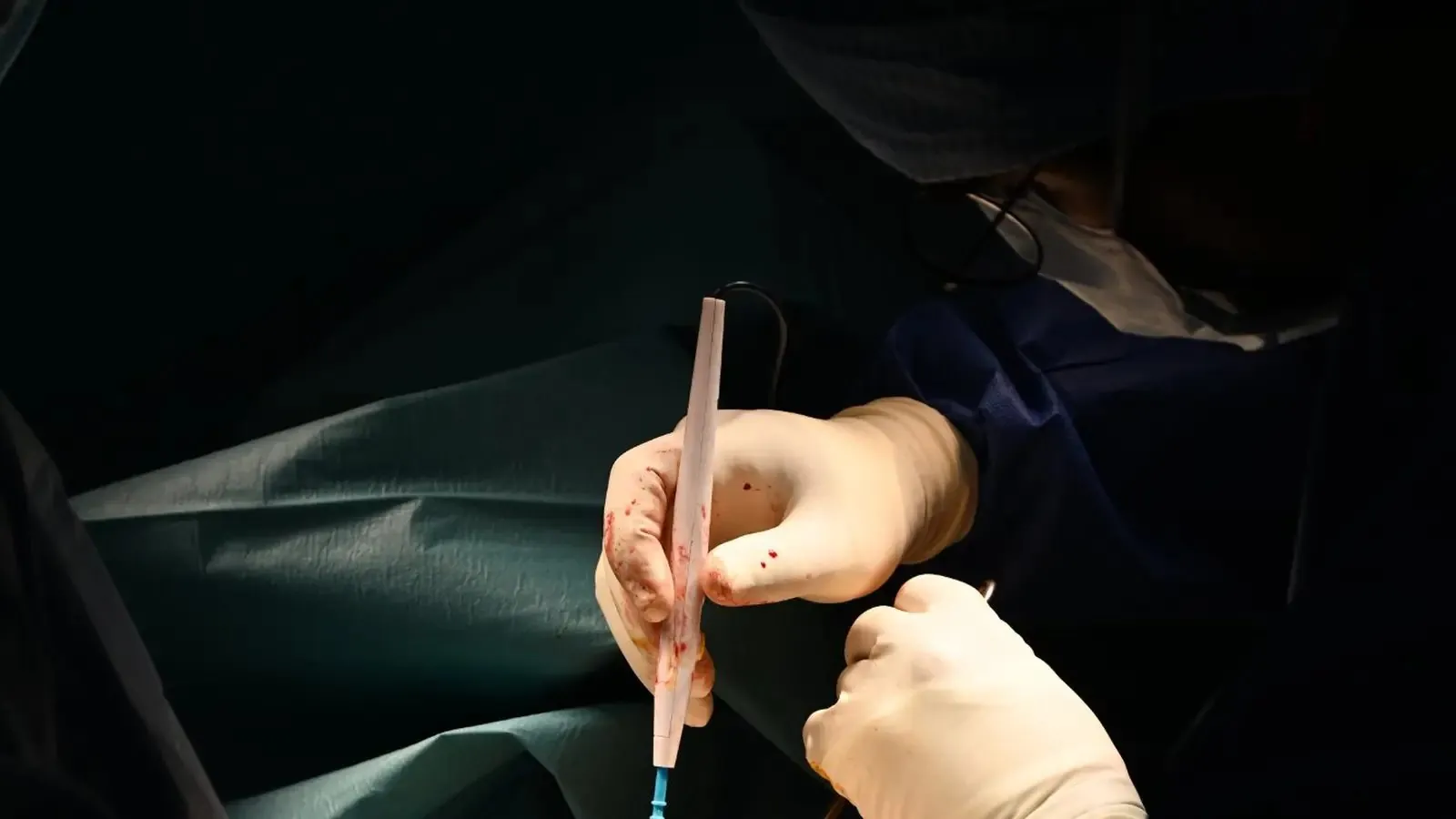
Surgery is the only treatment for borderline tumours. No routine chemotherapy, no radiotherapy. The aim is to completely remove the tumour — preserving, if possible, the uterus and the healthy ovary.
What is removed — and what can be preserved
The strategy depends on your age and your plans for pregnancyIn young women with plans for pregnancy, fertility-sparing surgery is often possible: only the affected ovary is removed (or just the tumour if it is encapsulated), leaving the uterus and the healthy contralateral ovary. This approach allows future pregnancies.
In women without plans for pregnancy or after the menopause, surgery removes both ovaries, fallopian tubes and uterus — to eliminate any risk of recurrence on remaining tissues.
Abdominal exploration is systematic — we look for implants on the peritoneum, the omentum, the liver. These implants are sampled or removed if possible.
The surgical approach is often laparoscopy (small incisions) — unlike ovarian cancer which requires laparotomy. This allows faster recovery.
What if the tumour is discovered on specimen — unexpected diagnosis?
When diagnosis comes after surgery for a cystIt happens that the borderline diagnosis is only made after surgery — we thought we were removing a simple ovarian cyst, and pathology analysis reveals a borderline tumour.
In this case, a multidisciplinary team discussion decides whether re-operation is necessary — to complete exploration or remove residual tissues — or whether surveillance is sufficient based on tumour characteristics and what was removed.
Re-operation is not always necessary. Each situation is assessed individually.
Intraoperative staging
What the surgeon does during the operation — and whyStaging consists of precisely assessing the extent of disease at the time of surgery. It determines subsequent surveillance and, sometimes, the decision to re-operate.
Peritoneal cytology: a fluid sample from the abdomen is taken at the start of the procedure to look for free tumour cells. This is a simple but essential step.
Systematic exploration: the surgeon inspects the entire abdominal cavity — peritoneum, omentum, liver surface, paracolic gutters, diaphragmatic recesses. Any visible implant is sampled for analysis.
Lymph nodes: unlike invasive ovarian cancer, systematic lymphadenectomy is not recommended in borderline tumours. Targeted lymph node biopsies may be performed in case of suspicious nodes on imaging.
Incomplete staging during a first operation — for example when the diagnosis was not suspected before surgery — may justify a re-staging procedure, decided at the multidisciplinary team meeting.
Can one have a child after a borderline tumour?
Yes — in the vast majority of cases. Borderline tumours often affect women of childbearing age, and fertility-sparing surgery is precisely designed to allow future pregnancies.
Pregnancies occur after fertility-sparing surgery for borderline tumours — naturally or with assisted reproductive technology if necessary. The wish for pregnancy must be expressed before the operation so that the surgical strategy is adapted accordingly.
If both ovaries are affected, ovarian stimulation or fertility preservation (oocyte or ovarian cortex cryopreservation) can be discussed before surgery with a specialised team.
How long before trying to get pregnant? There is no rigid recommendation, but a delay of a few months after surgery is generally advised to ensure proper healing and obtain the definitive pathology results. In case of fertility-sparing surgery on a single ovary or bilateral tumour, an oncofertility consultation upstream is strongly recommended to anticipate ART options if necessary.
Is ovarian stimulation for IVF possible? Yes, it is generally feasible after surgery for a borderline — unlike invasive ovarian cancer where the question is more complex. The decision is made jointly between your surgeon and your reproductive medicine team, taking into account tumour type and the surgery performed.
Pregnancy does not appear to increase the risk of recurrence — but follow-up must be maintained during and after pregnancy.
This question deserves more than a paragraph, so we have devoted a full article to it — fertility-sparing surgery, spontaneous pregnancy, assisted reproduction and egg preservation, a tumour found during pregnancy, and deferred completion surgery. Borderline ovarian tumor and fertility: can you still have a child?
You wish to become pregnant and have just learned that you have a borderline tumour? Mention this from the very first consultation — it changes the surgical strategy.
Long-term follow-up — because recurrences can be late
The prognosis of borderline tumours is very favourable — but these tumours can recur several years, even more than a decade after surgery. Follow-up therefore does not stop at 5 years.
The frequency of surveillance
At least 10 to 15 years of regular follow-upThe first two years: consultations every 4 to 6 months with clinical examination, pelvic ultrasound and CA-125 measurement.
From 2 to 5 years: follow-up every 6 months. CT scan may be performed depending on results or symptoms.
After 5 years: the rhythm spaces out to an annual consultation, but follow-up is maintained for at least 10 to 15 years — sometimes for life in case of fertility-sparing surgery, because the remaining ovary can develop a new tumour.
In case of fertility-sparing surgery, the contralateral ovary is carefully monitored at each consultation — it is the most frequent site of recurrence.
In case of recurrence
Often as borderline again — surgically treatableThe vast majority of recurrences occur as borderline again — and are treated surgically, in the same way as the first time. The prognosis remains favourable.
Transformation into invasive carcinoma is possible but exceptional — it mainly concerns cases of invasive implants at initial diagnosis, or multiple recurring forms. In rare cases where peritoneal implants are invasive, the tumour may be reclassified as low-grade serous adenocarcinoma — a distinct entity that then warrants different management, discussed at the MDT. If you have received this diagnosis after slide review, this precisely justifies specialised surgical advice.
This is why follow-up should not be interrupted even when everything has been fine for several years — it is precisely in asymptomatic cases that surveillance allows early detection of treatable recurrence.
Psychological support and life afterwards
Living with a borderline tumour over the long termThe very favourable prognosis of a borderline tumour is good news — but it can coexist with a real mental burden. Knowing that one must be monitored for 10 to 15 years, even for life, is not trivial. The worry before each ultrasound, the fear of recurrence, questions about fertility: all of this is legitimate and deserves to be taken into account.
Do not minimise the diagnosis because it is "not really cancer" — this is a frequent mistake, sometimes made by relatives, sometimes by carers. A borderline tumour requires surgery, surveillance, and can recur. The psychological impact is real.
Psycho-oncology support can be offered at any point in the journey — at diagnosis, before or after the operation, during long-term follow-up. This is a right, not a sign of weakness.
What you really want to know
The most common questions about borderline tumours. Ask me yours during our consultation.
When radical surgery is considered
In certain situations — advanced-stage borderline tumours, recurrence, or after completion of childbearing plans — completion surgery may include a hysterectomy with bilateral salpingo-oophorectomy. A complete dedicated page covers surgical approaches, complications and alternatives.
Discover the hysterectomy page →Book an appointment
Bring your imaging and pathology reports to the consultation — Dr Zeitoun will assess your situation and provide a quote.
Transparency on fees
Dr Zeitoun practises in sector 2 (non-OPTAM) and applies fee supplements across all consultations and procedures. The French national insurance reimburses on the basis of the public-sector tariff — this reimbursement is enhanced in case of cancer (ALD 30), but does not cover the supplements. Your supplementary insurance may cover all or part of these supplements depending on your contract.