
Vulvar cancer Vulvar Cancer Dr Jérémie Zeitoun · Surgeon Paris 8th
A rare tumour treated primarily by surgery when localised. Management depends on tumour size, location and lymph node involvement.

Vulvar cancer: understanding the condition
Vulvar cancer develops in the vulvar region — mainly on the labia majora. In 90% of cases, it is a vulvar squamous cell carcinoma. Persistent itching, a sore that does not heal, or a change in vulvar appearance are the most frequent warning signs.
You have been offered a vulvar biopsy, or have been told about VIN or lichen sclerosus? It is not necessarily cancer. A consultation can help clarify the situation.
Among the risk factors for vulvar cancer: lichen sclerosus, HPV infection (types 16 and 18), smoking, and immunosuppression. The median age at diagnosis is 77 years in France — but this cancer can occur at any age.
Vulvar cancer is staged according to the FIGO classification (International Federation of Gynaecology and Obstetrics), which guides treatment decisions. Stage I: tumour confined to the vulva, no nodal involvement. Stage II: extension to adjacent structures (lower urethra, vagina, anus). Stage III: inguinal nodal involvement. Stage IV: distant or pelvic structure extension. The majority of vulvar cancers are diagnosed at stages I and II.
Would you like a rapid surgical management or a second opinion on your diagnosis or treatment plan?
Prognosis linked to lymph nodes
An early warning symptom
Tailored management
Histology: squamous cell carcinoma, VIN, lichen sclerosus
The histological type of cancer — that is, the nature of cells analysed under the microscope — directly guides treatment and prognosis. In vulvar cancer, squamous cell carcinoma represents the vast majority of cases.
An important particularity: vulvar cancer can be multifocal — several areas of the vulva can be affected simultaneously. This possibility is systematically investigated before any surgical decision, as it directly influences the extent of the operative procedure.
Squamous cell carcinoma
Melanoma & rare types
VIN & lichen sclerosus
Symptoms of vulvar cancer: signs to know
Vulvar cancer is often detected at a localised stage precisely because it causes recognisable signs. Consult promptly if you have any of these signs persisting for several weeks.
Do you have any of these signs, particularly persistent itching or a lesion that won't heal? Don't face this uncertainty alone — a consultation will quickly clarify what you are dealing with.
Management of vulvar cancer in Paris
From the first appointment to the end of treatment, here is what happens in practice. Every decision is discussed at the multidisciplinary team meeting and with you.
-
The initial consultation
You come with your results (biopsy report, pathology results). We take time to read everything together, answer your questions, and explain what was found — without jargon. No decision is made at this stage. -
Imaging assessment
A pelvic MRI is requested to assess the local extent of the vulvar tumour — depth of invasion, relations with the urethra, vagina and anus. A PET-CT may be requested depending on the situation to look for suspicious lymph nodes or distant metastases. These examinations guide the surgical strategy. -
Multidisciplinary team meeting (MDT)
Your case is presented at a meeting with several specialist doctors — surgeon, oncologist, radiotherapist, radiologist. Together, they decide on the best treatment plan for you. This is mandatory in France for all cancers. -
Pre-operative consultation
Before the operation, a consultation with the anaesthetist is organised. We explain exactly what will happen on the day, how to prepare, and what to expect in the recovery room. It is also the time to ask all your questions. -
The operation and immediate recovery
The procedure takes place at Clinique Hartmann (Neuilly-sur-Seine), 10 minutes from Paris. Hospital stay is generally 3 to 5 days depending on the extent of the procedure. A coordinating nurse remains your contact for all practical questions. -
Follow-up
Regular follow-up consultations are scheduled. If other treatments are needed (radiotherapy, chemotherapy), they are coordinated with your specialists. The aim is to support you until you resume your life normally.
A suspicious vulvar lesion or vulvar cancer diagnosed?
Bring your biopsy and imaging reports along with your referring gynaecologist's clinical assessment. The consultation lasts 30 minutes — a personalised treatment plan is provided.
Vulvar cancer surgery: vulvectomy & sentinel node
The type of operation depends on tumour size, location, and the multidisciplinary team's decision. Here is what each procedure involves in practice.
Vulvectomy
The reference operation — removes all or part of the vulvaWhat it is. Vulvectomy removes all or part of the vulva depending on tumour extent and lesion location. It can be partial (wide local excision) or total. It is the reference operation for vulvar cancer. The aim is to obtain healthy surgical margins.
When it is proposed. In the vast majority of invasive vulvar cancer cases, when surgery is feasible. The extent of the procedure is adapted to each situation, preserving function and appearance as much as possible.
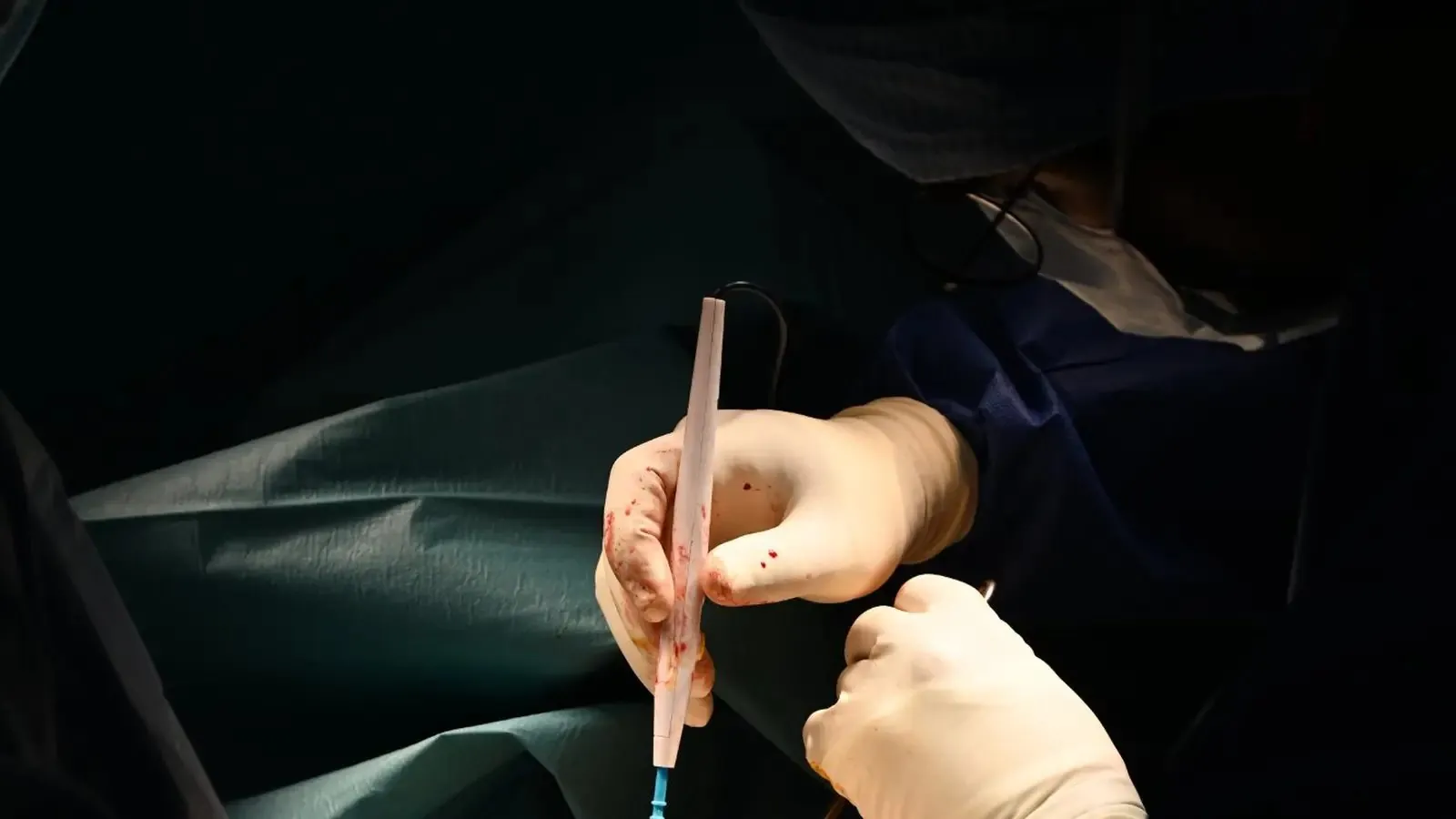
How it works. The operation lasts 1 to 3 hours depending on associated procedures (with or without inguinal lymphadenectomy). It is performed under general anaesthesia. The hospital stay is generally 3 to 5 days at Clinique Hartmann.
And my ovaries? Vulvar surgery does not concern the uterus or the ovaries. You will not enter menopause from this operation.
A surgery that may be mutilating. Vulvectomy is an intervention that often significantly modifies vulvar anatomy. Depending on the extent of the procedure, the consequences on body image and intimate life can be significant. These aspects are addressed during the consultation, before any decision. In cases where the resection is particularly extensive, immediate flap reconstruction may be necessary to cover the skin defect — this possibility is anticipated and planned before the operation.
Healing complications. Vulvar healing is often difficult and prolonged — 4 to 8 weeks on average, sometimes longer. Healing defects (wound dehiscence, partial necrosis, local infection) are common and are among the most frequent complications after vulvectomy. Daily local care is necessary, and home nursing care is systematically organised on discharge.
Inguinal sentinel lymph node
A technique that avoids removing many lymph nodes unnecessarilyWhat it is for. When cancer spreads, it first travels through the lymph nodes in the groin (inguinal nodes). The sentinel node is the first lymph node the cancer would reach if it were spreading. If this node is healthy, complete inguinal lymphadenectomy and its complications can be avoided.
How it is done. Most often by the isotopic method: a radioactive tracer is injected around the tumour the day before or the morning of the operation. This tracer travels to the inguinal sentinel node, detected in the operating theatre using a gamma probe. We remove it for pathological analysis. A blue dye may be used in addition depending on the centre.
If the sentinel node is not identified, a complete inguinal lymphadenectomy is performed.
Saint-Paul de Vence 2025 guidelines. Sentinel lymph node biopsy is now the reference for early-stage vulvar cancer (T1, depth >1 mm, <4 cm, no clinically suspicious nodes). It must be performed by a trained team. Validated by the GROINSS-V trials.
Inguinal lymph node dissection
To check whether the cancer has spread to groin lymph nodesWhat it is. Inguinal lymphadenectomy involves removing the lymph nodes in the groin — on one side or both depending on tumour location. These lymph nodes are analysed to determine whether cancer cells have spread to them.
Why it matters. The result of node analysis determines whether complementary treatment is needed after the operation (radiotherapy). This information sometimes changes the treatment strategy.
Is it always performed? No — the decision depends on cancer type and stage. When sentinel lymph node biopsy is performed, its result guides the decision: if the node is healthy, lymphadenectomy can be avoided; if it is involved, lymphadenectomy is performed.
The main risk. Lymphoedema — swelling of the leg due to disruption of lymphatic circulation. This risk exists but is limited, especially when sentinel lymph node biopsy avoids extensive lymphadenectomy. Specialised physiotherapy helps prevent and treat it.
Radiotherapy & chemotherapy
Complementary treatments according to resultsRadiotherapy. It may be recommended after surgery in case of insufficient surgical margins or lymph node involvement. In some locally advanced tumour situations not initially operable, concurrent radio-chemotherapy may be offered as first-line treatment.
Chemotherapy. It is more rarely used in vulvar cancer. It is reserved for advanced or metastatic forms, often in combination with radiotherapy. It does not concern early stages treated by surgery alone.
The decision is made at the multidisciplinary team meeting, after analysis of the surgical specimen, and is discussed with you during a dedicated consultation.
Vulvar cancer recurrence
What happens if the cancer comes backA reality to anticipate. Vulvar cancer can recur, most often within the first two years after treatment. Recurrence can be local (on the vulva), regional (inguinal nodes) or distant. This is why close surveillance after treatment is essential.
Treatment of recurrence. Each recurrence is discussed at the multidisciplinary team meeting. Depending on its location and extent, additional surgery may be offered — sometimes more extensive than the first operation. Radiotherapy and chemotherapy may also be indicated, alone or in combination.
The importance of follow-up. Regular clinical examination allows early detection of recurrence, when therapeutic options are more numerous. Any unusual sign between two consultations — pain, bleeding, swelling in the groin — should be reported quickly without waiting for the next scheduled appointment.
Surgery in elderly women
A specific assessment before any decisionA cancer that mainly affects elderly women. The median age at diagnosis of vulvar cancer is 77 years in France. Surgery remains the reference treatment, but it must be adapted to the patient's general condition.
Geriatric assessment. For patients over 75 years or with significant comorbidities, an onco-geriatric consultation is systematically offered before the operation. This assessment — particularly the G8 score — helps measure the capacity to tolerate major surgery and to adapt the therapeutic plan if necessary.
Alternatives to surgery. When the general health condition does not allow surgical intervention, other options can be discussed at the multidisciplinary meeting: exclusive radiotherapy, concurrent radio-chemotherapy, or palliative treatment. Age alone is never a contraindication — it is the general condition that matters.
A question about which type of operation concerns you? I'll explain everything during a consultation.
After vulvar surgery: what to expect
Surgery is not the end of the journey. Here is what you can concretely expect in the weeks and months that follow.
Hospitalisation
Return to work
Physical activity
Intimate life
Psychological impact
Follow-up consultations
Do you have questions about recovery after an operation? I answer practical questions during the consultation — not just medical ones.
Frequently asked questions about vulvar cancer
The most common questions asked in consultation. Ask yours at your appointment.
I have a lump or sore on the vulva — should I worry?
What are the risk factors for vulvar cancer?
What are the stages of vulvar cancer?
What is VIN and does it need surgery?
Does HPV cause vulvar cancer?
What is vulvar cancer?
Does persistent vulvar itching necessarily mean cancer?
Does lichen sclerosus always become cancer?
Will surgery affect my ovaries?
Will I enter menopause after the operation?
How long will I be in hospital?
Will I need treatment after the operation?
What is lymphoedema and how to avoid it?
Will I lose my hair?
What happens if vulvar cancer comes back?
Can elderly women be operated on for vulvar cancer?
Can I request a second opinion?
Vulvar cancer is a rare condition that requires expert surgical management at a centre with specific experience in vulvar surgery. In Paris, Dr Jérémie Zeitoun manages vulvar cancers at Clinique Hartmann (Neuilly-sur-Seine) and consults at 241 rue du Faubourg Saint-Honoré, Paris 8th. Every case is presented at a multidisciplinary meeting before any surgical decision.
Surgical procedures associated with vulvar cancer
Book an appointment
Come with your questions, your results, your concerns. We take the time to discuss everything together.
Transparent pricing
Dr Zeitoun practises as a private specialist (Sector 2) and charges fees above the standard national rate. French national health insurance reimburses on the basis of the standard rate — this is improved for cancer patients (ALD 30). Your complementary health insurance may cover additional fees depending on your policy.