The biopsy establishes the diagnosis, surgery refines it. Understanding what your pathology report says — the tumor identity card — to better discuss with your physician and make informed choices.
Pathology is the microscopic analysis of tissue samples. Imaging and clinical exam suggest, pathology decides. It is what establishes the definitive diagnosis and determines the complete identity card of the tumor.
For breast, pathology comes into play at two key moments of your journey:
— First after the biopsy, on a few millimeter-sized fragments collected at the radiology office. This first report identifies the nature of the lesion (benign? at-risk? cancerous?) and, if cancer, gives a first identity card of the tumor. For more on the biopsy itself, see the dedicated breast biopsy page.
— Then, if surgery follows, on the surgical specimen. The operated breast (and any sentinel lymph nodes) is analyzed in its entirety. This second analysis confirms and refines what the biopsy suggested, measures the tumor exactly, verifies the surgical margins, and examines whether lymph nodes are involved.
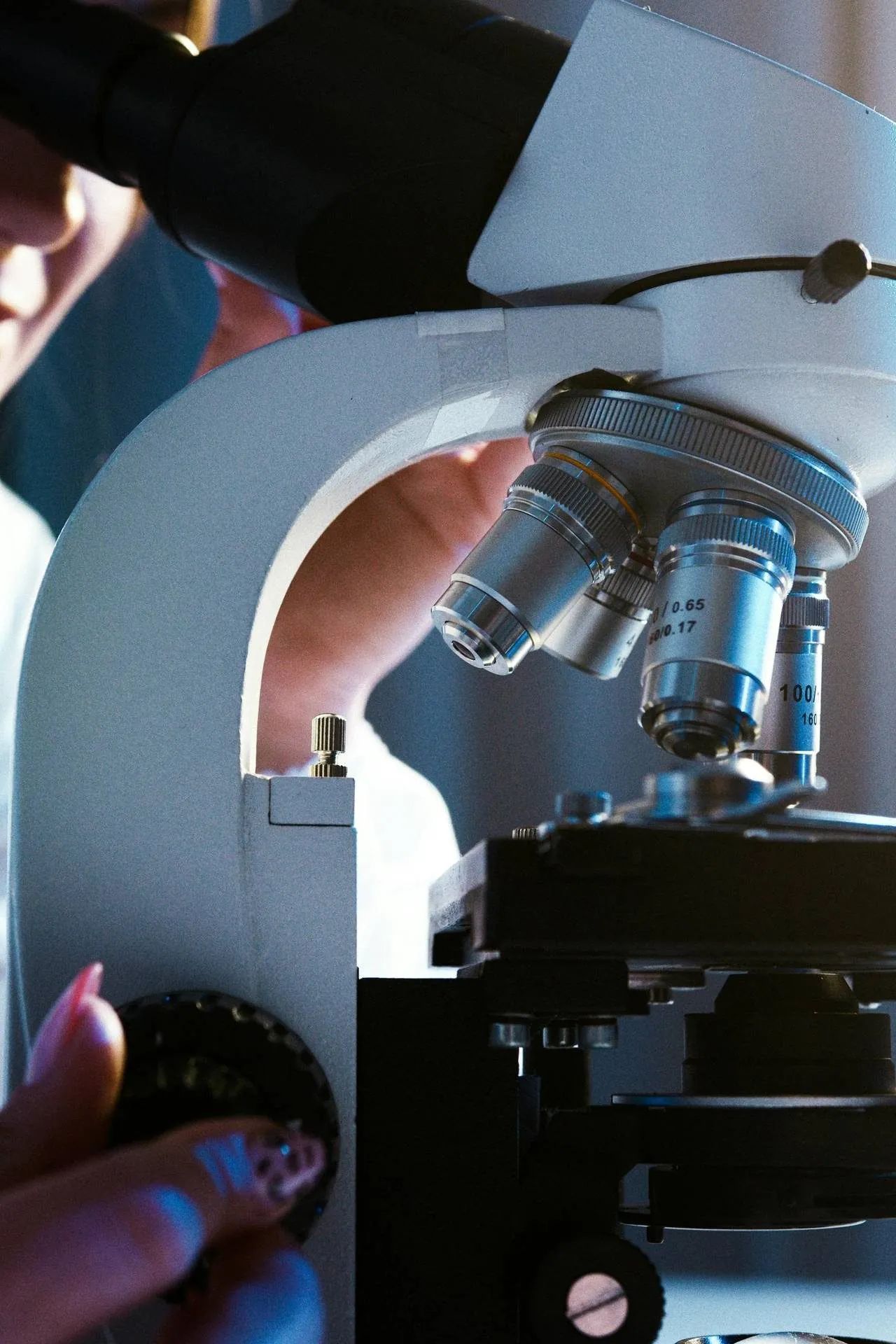
Concretely, the pathologist fixes the tissue, cuts it into very thin sections (a few microns), stains them, then examines them under a microscope. For cancer, additional immunohistochemistry (IHC) analyses are systematic: hormone receptors (ER and PR), HER2, Ki67. Each adds 24 to 48 hours, which explains the 7 to 14 day turnaround between sampling and the final report. More details on breast biopsy results timing.

The biopsy report is the step that establishes the diagnosis. Before it, we speak of "suspicious lesion" or "abnormality"; after, we know precisely what we are dealing with. The entire treatment pathway is decided based on this document.
In practice, two main situations:
The biopsy may reveal a fibroadenoma (very common benign tumor), an intraductal papilloma, or an atypical ductal hyperplasia (ADH) — an at-risk lesion that often justifies surgical excision and enhanced surveillance. These results are reassuring but require a consultation to decide on next steps.
If the biopsy identifies a breast cancer, the report provides a first identity card of the tumor with 6 key parameters detailed below. This identity card is essential: it determines whether chemotherapy could be considered before surgery, and what surgical technique to plan — lumpectomy or mastectomy — as well as the entire treatment strategy.
Important: the biopsy gives only a partial view of the tumor (a few millimeters sampled). Complete definitive analysis is only possible after surgery, on the entire surgical specimen. But this first analysis is sufficient to start making decisions.
When the biopsy identifies a cancer, the report provides six essential pieces of information. Together, they form the identity card of the tumor. You don't need to memorize everything — your physician will go through them with you. The goal here is simply to make the words you'll read familiar.
That's it — these are the items that will appear in your biopsy report if cancer is found. You don't have to interpret them on your own: each line will be reviewed and explained in consultation, with a treatment plan adapted to your situation.
For benign lesions (such as a fibroadenoma) or at-risk lesions (such as atypical ductal hyperplasia), the report follows a different logic — it describes the lesion without addressing these parameters since it is not a cancer.
After surgery, the surgical specimen — the breast tissue that was removed, and any sentinel lymph nodes — is sent to the pathology laboratory for complete analysis. This is what delivers the definitive histology.
Three fundamental differences with the biopsy report:
— The analysis covers the entire tumor, not just a few fragments. It can therefore reveal elements invisible at biopsy: actual extent, multifocality, larger associated in situ component than expected.
— Surgical margins are measured: the distance between the tumor and the edge of the removed tissue. This is what indicates whether the excision was complete or whether re-excision should be considered.
— Sentinel lymph nodes are analyzed for tumor cells. The sentinel lymph node is the first lymphatic drainage station of the breast — its status determines whether axillary dissection is necessary and guides radiotherapy decisions.
This post-operative report typically arrives 10 to 15 days after surgery. It is discussed in MDT (Multidisciplinary Tumor Board) with surgeon, oncologist, radiation oncologist and pathologist to decide on any adjuvant treatments.
The post-operative report includes the six pieces of information from the biopsy (confirming them) and adds elements specific to the analysis of the surgical specimen. Here are the main ones, explained simply.
Again, you don't have to memorize all of this. Each element will be reviewed in consultation, placed in the context of your case, and accompanied by concrete decisions for next steps. This page exists to make the words familiar to you, not to make you do the work of interpretation.
Once the report is available, your case is presented in a team meeting (multidisciplinary tumor board, or MDT) where the surgeon, oncologist, radiation oncologist, and pathologist discuss together the best options for you. This collective discussion is a guarantee of quality — every case is studied in a personalized way.
Following this meeting, a care plan is proposed to you in consultation. Here are the broad orientations possible depending on profiles, knowing that every situation is unique.
For most early-detected breast cancers, treatments are well established and their results excellent. Depending on your profile, they may combine endocrine therapy, radiotherapy, and sometimes chemotherapy. Everything is explained, planned, and adapted to your pace of life.
In some intermediate situations, the usefulness of additional chemotherapy isn't obvious. Genomic tests (Oncotype DX, MammaPrint) can be used to analyze the tumor in detail to better personalize the decision — and sometimes avoid a treatment that wouldn't be useful.
For certain profiles, a path combining several treatments is offered. Recent progress in breast cancer care — particularly targeted therapies and personalized protocols — now allow for very encouraging results, including for situations that would have been more complex a few years ago.
Whatever the profile, breast cancer care has progressed enormously. The vast majority of women treated are cured, and those whose journey is longer benefit today from well-tolerated and increasingly effective treatments. To learn more about surgical options, see the dedicated pages on lumpectomy and mastectomy. If something concerns you when reading your report, don't hesitate to bring it up in consultation or to request a second opinion — it's always possible and always encouraged.
Pathology is the microscopic analysis of tissue samples. It is the exam that establishes the definitive diagnosis and determines the exact nature of a lesion — benign, at-risk, or cancerous.
The pathologist is a specialized physician who examines stained slides under a microscope, supplements as needed with specific analyses (ER, PR, HER2, Ki67), and writes the report.
For breast, two key moments: after the breast biopsy (first diagnosis) and after surgery (definitive analysis on the surgical specimen).
The tissue must be fixed in a special liquid (24h), embedded in paraffin, cut into very thin sections, stained, then examined under a microscope.
For cancer, additional analyses are systematic (ER, PR, HER2, Ki67) — each adds 24 to 48 hours.
Standard turnaround is 7 to 14 days, sometimes 3 weeks if a second opinion is requested. More details on breast biopsy results timing.
Six key pieces of information:
— Histologic type: invasive ductal, invasive lobular, in situ.
— SBR grade: 1, 2 or 3.
— Hormone receptors ER and PR: in percentage.
— HER2: 0, 1+, 2+ or 3+.
— Ki67: percentage of dividing cells.
— Associated in situ component if any.
These six elements help your team personalize the treatment plan that will be offered to you. You don't need to interpret them yourself: everything is explained in consultation.
Yes, that's rather favorable. ER at 90% means the vast majority of tumor cells express the estrogen receptor — the tumor is very hormone-sensitive.
This opens the possibility of endocrine therapy by tablets (Tamoxifen or aromatase inhibitor), which is a well-tolerated treatment particularly effective in this situation.
HER2 is a protein found on the surface of certain tumor cells. The report indicates its expression level:
— HER2 0 or 1+: the tumor is "HER2 negative".
— HER2 2+: an additional test is requested to clarify the level.
— HER2 3+: the tumor is "HER2 positive" and benefits from highly effective targeted treatments designed specifically for this type of tumor (Trastuzumab, for example).
Ki67 reflects how fast the tumor cells divide. A Ki67 of 30% is in an intermediate to high zone.
But this parameter is never read alone: it is the entire report (grade, hormone receptors, size, etc.) that guides decisions. Depending on context, your team may suggest a genomic test (Oncotype DX, MammaPrint) to refine the strategy.
Both are breast cancers, but their origin differs.
— Invasive ductal carcinoma: the most common (about 75%). Arises from milk ducts. Forms a more distinct mass, easier to see on imaging.
— Invasive lobular carcinoma: about 15%. Arises from lobules. Infiltrates tissue more diffusely, sometimes better seen on MRI than on mammography.
Care takes these differences into account and is adapted to your situation. Lobular carcinoma, sometimes multifocal, may more often direct toward a mastectomy, although a lumpectomy remains entirely possible in most cases.
Imaging (mammography, ultrasound, MRI) measures the principal visible lesion.
Microscopic analysis measures the entire tumor on the surgical specimen, including any very fine extensions.
The size measured under the microscope is often slightly different from the imaging size — this is completely normal, and it serves as the definitive reference.
Not systematically. The rule for invasive cancer is that there be healthy tissue around the removed area — even a thin margin can be sufficient.
If a margin is very tight, the decision is made on a case-by-case basis, depending on your overall situation, and discussed in the team meeting. A possible re-excision lumpectomy or, more rarely, a conversion to mastectomy may be offered depending on context. Re-excision is not automatic.
If the decision puzzles you, a second opinion is always possible.
When only a few cells are found in the sentinel lymph node, this is called micro-involvement. Current guidelines no longer routinely recommend a complete axillary dissection in this situation.
Depending on context (tumor size, profile, planned treatment), simple surveillance or axillary radiotherapy may suffice. Everything is discussed in the team meeting. See the dedicated sentinel lymph node page.
"Lymphovascular invasion" refers to tumor cells found in the small blood vessels of the breast. It is a complementary piece of information that adds to the other report data.
This information helps your team refine treatment choices. It is never read in isolation — it's the entire case that guides decisions.
For some tumors, the usefulness of additional chemotherapy is not always obvious. Genomic tests analyze several tumor genes to evaluate its behavior.
They allow for better personalization of the decision and, in many cases, avoiding a chemotherapy that wouldn't be useful. These tests are reimbursed in some indications.
This is called neoadjuvant chemotherapy. Specimen analysis evaluates how the tumor responded to the treatment.
A complete disappearance of the tumor is possible and is an excellent sign. But any response, even partial, is useful information that helps plan the next steps in care.
Good news! The biopsy may reveal a benign lesion:
— Fibroadenoma: very common benign tumor, surveillance or excision depending on context.
— Intraductal papilloma: excision often recommended for full verification.
— Breast cyst: no surgery needed.
Or an at-risk lesion requiring more vigilance:
— Atypical ductal hyperplasia: surgical excision recommended and enhanced surveillance.
In all cases, a consultation is necessary to decide on next steps, even when the result is reassuring.
Yes, and it's even sometimes recommended. For complex diagnoses or rarer lesions, a second reading by another pathologist — often in an expert center — can confirm or refine the initial diagnosis.
Several breast cancer reference centers in France (Institut Curie, Gustave Roussy, Institut Bergonié, Centre François Baclesse) can perform these second reviews. This approach is routine and is never a challenge to the initial pathologist.
If you wish to discuss this, don't hesitate to bring it up in consultation — it's a fully legitimate and frequent request.
An appointment to review your pathology report, understand the options available to you, or get a second opinion — feel free to book a consultation.