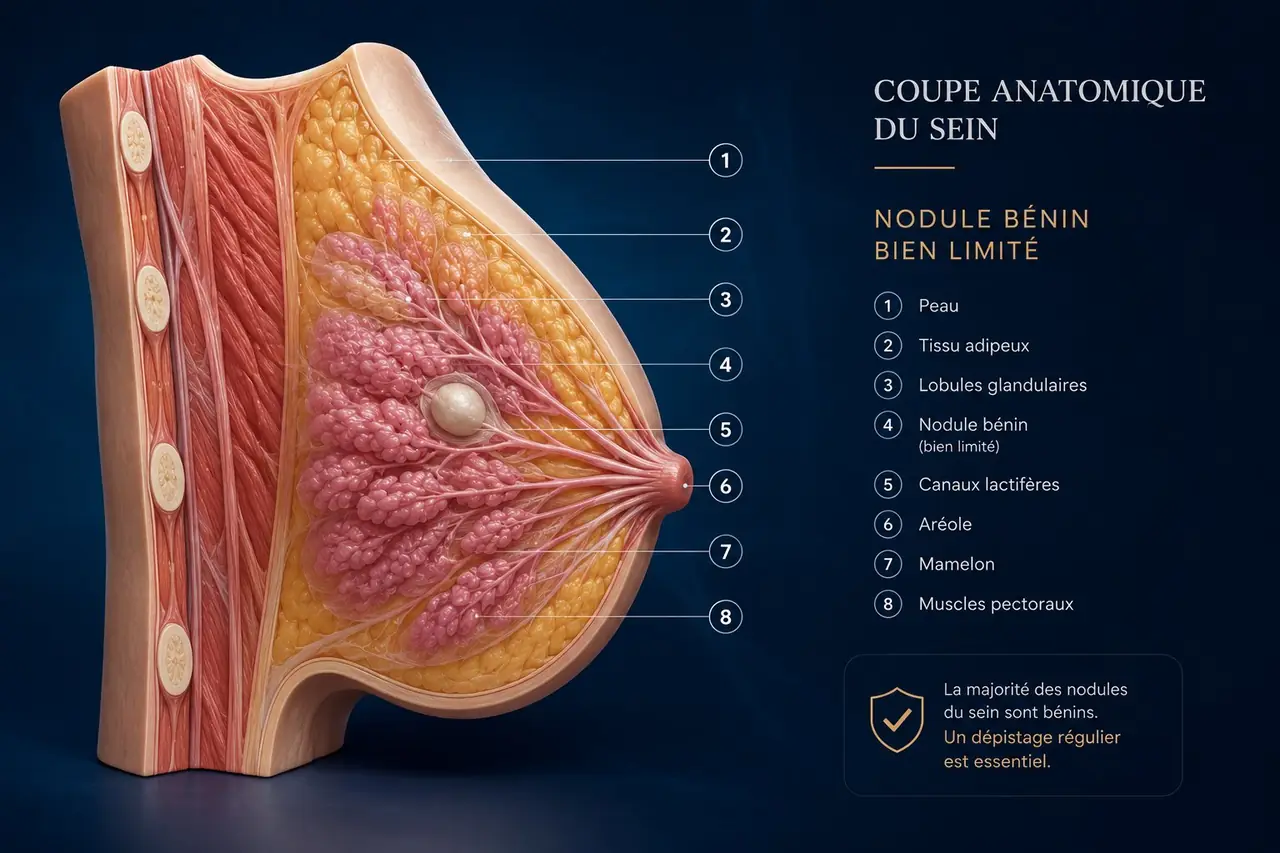

The most common benign breast tumour in young women. Systematic biopsy before any surgery, ultrasound monitoring as default approach.
Author and medical review: Dr Jérémie Zeitoun, cancer surgeon (breast & gynaecology) — RPPS 10101463296 — trained at Institut Gustave Roussy, Institut Curie and Centre François Baclesse. See full background →
Last updated: · Sources: SFSPM, CNGOF, HAS, NICE. References at the bottom of the page.
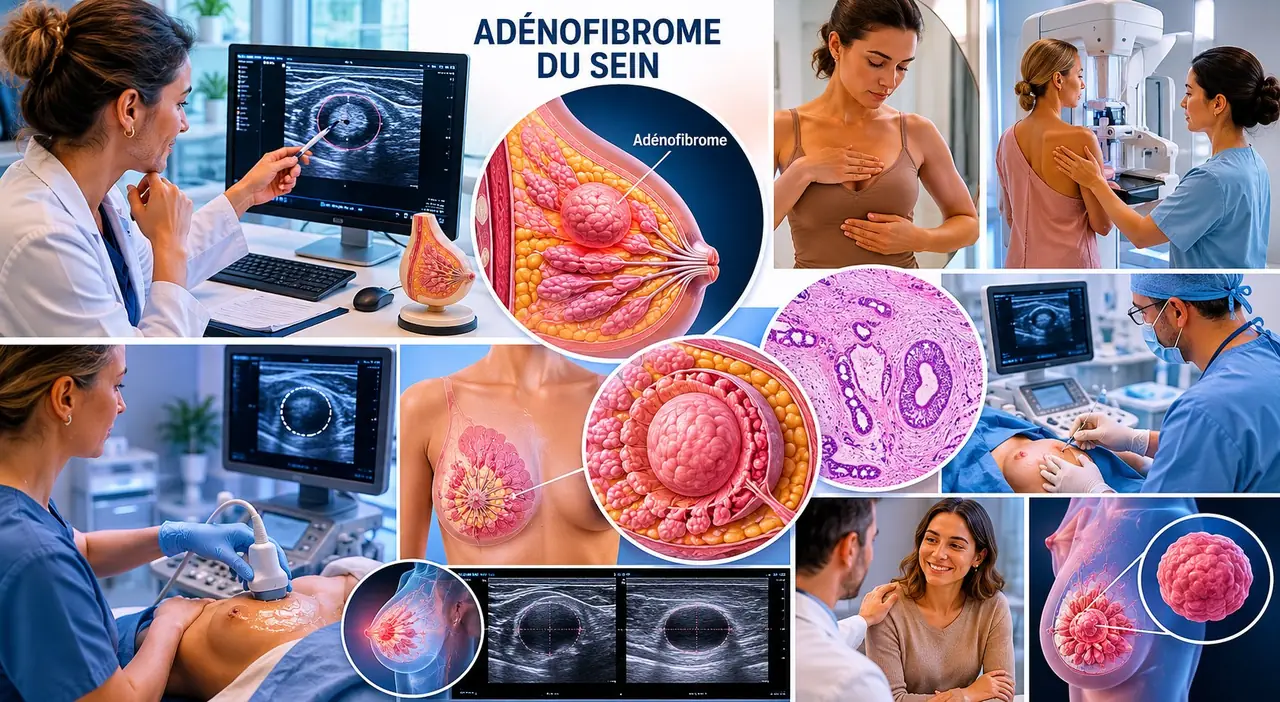
A breast fibroadenoma (also called adenofibroma) is a benign tumour made up of both glandular tissue and fibrous tissue — hence the name. It is the most common benign breast tumour, particularly in young women. Fibroadenomas are, in the overwhelming majority of cases, benign; however, other rarer diagnoses — notably the phyllodes tumour — may present in a similar way, which justifies a percutaneous biopsy before any surgical decision.
A fibroadenoma typically presents as a well-defined, mobile lump under the fingers, firm and elastic, usually painless. On ultrasound, it appears as a well-defined, oval lesion with the long axis parallel to the skin, with sharp contours.
Fibroadenoma is the most common cause of a breast lump in young women, typically aged 15 to 35. It may occur at any age. After menopause, the appearance of a new fibroadenoma is less common and warrants particular attention to rule out a differential diagnosis.
This is the central question. A phyllodes tumour is a rare connective-tissue breast tumour that can look like a fibroadenoma on clinical examination and ultrasound, but whose management is radically different — it requires wider surgical margins, and can be borderline or malignant in about 20 % of cases. It is impossible to formally distinguish a fibroadenoma from a phyllodes tumour without histopathological examination. This is why Dr Zeitoun offers a systematic percutaneous biopsy before any surgery, even when the imaging appearance looks typical.
Fibroadenoma is a hormone-dependent tumour: it develops from normal breast tissue under the influence of oestrogen. It is not a disease in the strict sense, but a specific response of breast tissue to hormonal exposure. Several factors favour its appearance.
Young age (15 to 35), puberty, pregnancy, some hormonal contraceptives — periods of high oestrogen exposure favour the appearance and growth of fibroadenomas. After menopause, they often regress spontaneously.
Some women develop several fibroadenomas during their life, in one or both breasts. This is an individual tendency of breast tissue, with no link to an increased risk of breast cancer.
Important: having one or several fibroadenomas does not increase the risk of breast cancer. Fibroadenoma is not a precancerous lesion. However, it may sometimes coexist with other more significant lesions, which justifies biopsy and appropriate imaging follow-up.
Source: SFSPM · CNGOF 2024
Fibroadenoma is often asymptomatic. It is frequently discovered on palpation — by the patient herself during self-examination, by the GP or gynaecologist during a routine check-up, or by imaging (ultrasound, mammography).
Firm, well-defined, mobile under the fingers — the most common and most characteristic clinical sign.
Many fibroadenomas are discovered on ultrasound during screening or imaging requested for another reason.
Some fibroadenomas become tender pre-menstrually, under the effect of hormonal variations. This sensitivity remains moderate.
Warning signs: rapid growth, a sudden change in shape or consistency, fixation to skin or chest wall, skin changes (redness, retraction, orange-peel appearance), nipple discharge, or a palpable axillary lymph node. These signs require prompt consultation.
Source: SFSPM · HAS
Diagnosis of a fibroadenoma relies on a structured three-step approach: clinical examination, imaging, then systematic percutaneous biopsy before any surgery.
Bilateral palpation of the breasts and lymph node areas. A typical fibroadenoma is firm, well-defined, mobile, not adherent.
The reference examination in young women. Typical appearance: oval, well-defined lesion, long axis parallel to the skin, homogeneous hypoechoic. Mammography added depending on age (generally after 35-40).
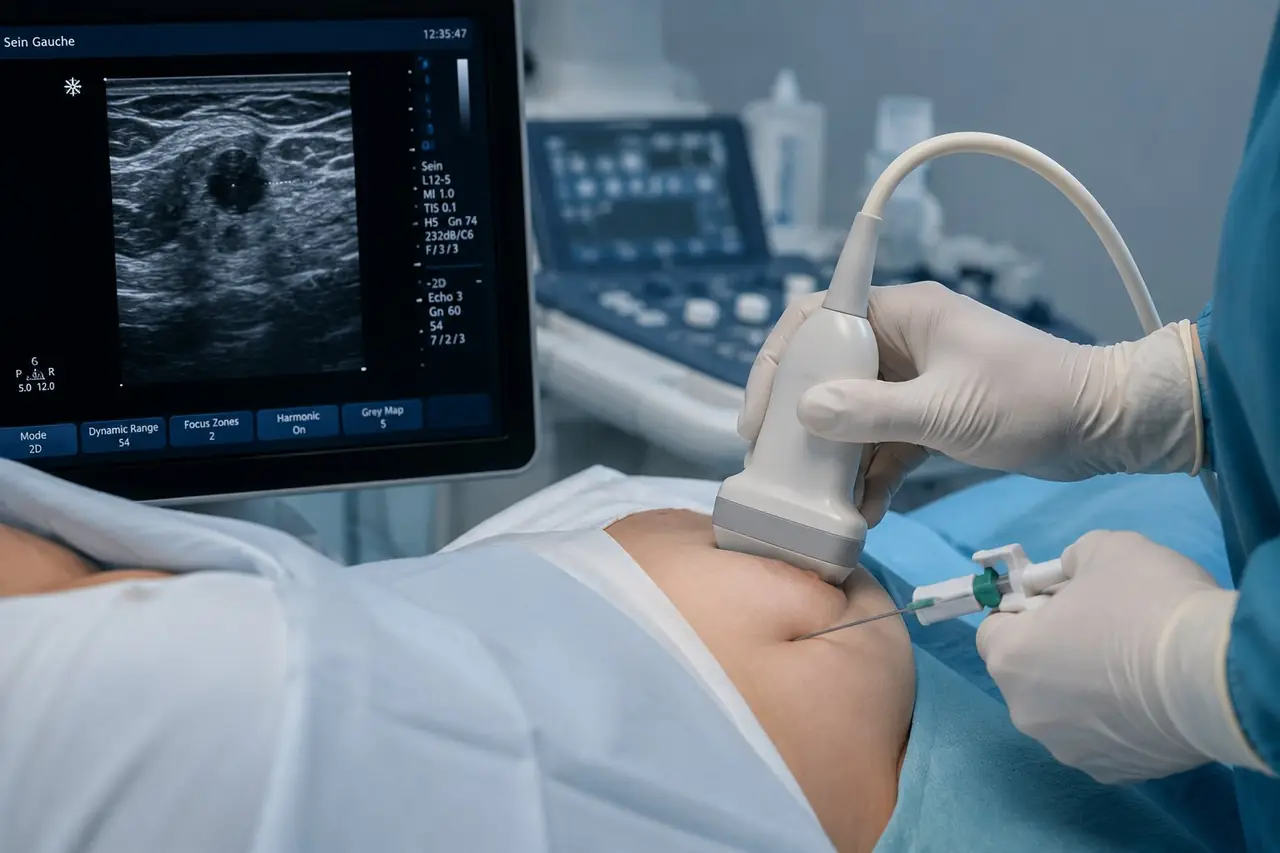
Core biopsy or vacuum-assisted biopsy systematic before any surgery — in clinic, under local anaesthesia, ultrasound-guided. Essential to rule out a phyllodes tumour.
Why systematic biopsy: even when imaging looks typical, no radiological test can formally distinguish a fibroadenoma from a phyllodes tumour. Yet the two require radically different management. In Dr Zeitoun\u0027s practice, percutaneous biopsy is therefore systematic before any fibroadenoma surgery, regardless of the ultrasound appearance.
Source: HAS · SFSPM · CNGOF
Two therapeutic approaches are possible depending on context: ultrasound monitoring (default approach for a biopsy-confirmed typical fibroadenoma) or surgical excision in four specific situations.
First ultrasound check-up at 4 months, then annual follow-up. This monitoring confirms stability of the lesion and allows intervention if changes occur. Alert signs that may change the approach are clearly explained to the patient: significant growth, contour changes, persistent pain, cosmetic concern, significant anxiety.
Excision is offered in four situations:
Surgical details: in the operating theatre, as day surgery. General or local anaesthesia depending on size, location and patient preference. Incision positioned as discreetly as possible — inframammary (in the fold below the breast) or axillary (in the armpit) whenever the topography allows. Systematic histopathological analysis of the specimen.
Source: SFSPM · CNGOF 2024
Recovery after fibroadenoma excision is usually straightforward. The procedure is performed as day surgery, with return home on the same day.
Moderate during the first 48 hours, well relieved by simple analgesics (paracetamol). No severe pain is expected.
3 to 7 days for sedentary work. 10 to 15 days for physical or arm-intensive work.
Light sport at 2-3 weeks. Activities with arms above the head not recommended for 3 to 4 weeks.
Scar in place over 6 to 12 months. Generally favourable evolution — scar massage from 4 weeks onwards.
Report available in 2 to 3 weeks. Follow-up consultation to confirm the benign nature and organise further follow-up.
Systematic ultrasound check-up at 6 months, then return to standard screening rhythm according to age and risk factors.
Source: SFSPM
Fibroadenoma excision is a very safe procedure, with a very low rate of complications. Dr Zeitoun details each risk during the pre-operative consultation — this information is part of shared decision-making and is systematic before any surgery.
The most common post-operative risk. Usually moderate, it resolves spontaneously within a few days. A large haematoma rarely requires re-operation.
Very low risk (< 1 %) thanks to strict theatre asepsis. Warning signs (redness, discharge, fever) should prompt consultation without delay.
Keloid or hypertrophic scar possible depending on individual tendency. Hidden approaches (inframammary, axillary) limit visibility. Scar massage from 4 weeks onwards optimises the result.
The excised fibroadenoma does not recur at its site. However, the patient may develop other fibroadenomas in other parts of the breast — this is an individual tendency, without seriousness, which justifies ultrasound monitoring at 6 months then annually.
Source: SFSPM · CNGOF
Paris 8 practice · Clinique Hartmann Neuilly · Sector 2 non-OPTAM
The answers below are based on the recommendations of CNGOF, HAS and SFSPM, and on daily clinical practice. Each question is frequently asked in consultation — this section is regularly updated.
A fibroadenoma itself does not turn into cancer. Having one or several fibroadenomas does not increase the risk of breast cancer. However, a lesion that looks like a fibroadenoma may sometimes be a phyllodes tumour (benign in about 80 % of cases, borderline or malignant in the remaining 20 %). This is why a percutaneous biopsy is systematically offered before any surgery.
No. The default approach for a biopsy-confirmed fibroadenoma is ultrasound monitoring: first check-up at 4 months, then annual follow-up. Surgical excision is offered in four situations: doubt on biopsy, significant growth over two successive check-ups, bothersome symptoms, or the informed choice of the patient.
Percutaneous biopsy, performed under ultrasound guidance in the clinic, formally confirms the diagnosis of fibroadenoma before any surgery. It rules out phyllodes tumour, which may appear similar clinically and on ultrasound but requires very different surgical management (mandatory wide margins). This step is systematic in Dr Zeitoun\u0027s practice, even when the imaging diagnosis seems obvious.
Excision is performed in the operating theatre, as day surgery. Anaesthesia is general or local depending on size, location and patient preference. The incision is positioned as discreetly as possible — inframammary (in the fold below the breast) or axillary (in the armpit) whenever the topography allows. The specimen is systematically sent for histopathological analysis. An ultrasound check-up is scheduled at 6 months.
Dr Zeitoun favours scars hidden in natural folds: inframammary or axillary incision whenever the topography of the fibroadenoma allows. These scars are usually inconspicuous once healing is complete (6 to 12 months). When the fibroadenoma is too far from either site to allow a hidden approach, other discreet options are discussed during the pre-operative consultation.
Yes. Fibroadenoma is hormone-sensitive breast tissue: it may grow during puberty, pregnancy, or under certain hormonal contraceptives. It often regresses after menopause. The appearance of a new fibroadenoma after menopause is less common and warrants particular attention, especially to rule out a phyllodes tumour which can appear at this stage of life.
Excision is performed as day surgery. Time off work is typically 3 to 7 days for sedentary or office work. For physical work involving heavy lifting or arm use, allow 10 to 15 days. Light sport can be resumed at 2 to 3 weeks; activities with arms above the head are not recommended for 3 to 4 weeks.
A properly excised fibroadenoma does not recur at the surgical site. However, a patient may develop other fibroadenomas elsewhere in the breast, same side or opposite — this reflects an individual tendency of breast tissue to respond to hormones. An ultrasound check-up at 6 months is systematically scheduled after excision, then the follow-up rhythm depends on age and context.
Yes, without any problem. Fibroadenoma does not interfere with fertility or with the course of a pregnancy. However, it may grow during pregnancy under the effect of oestrogen, which is normal and does not justify intervention during this period. Monitoring is simply adjusted. Breastfeeding remains possible whether or not there is a fibroadenoma.
Dr Zeitoun practises in sector 2 non-OPTAM: additional fees apply. Fibroadenoma excision is covered by French Assurance Maladie at the contractual rate. A personalised quote is systematically provided after the consultation. Out-of-pocket expenses depend on your complementary health insurance.
This page relies on recommendations from French and international medical societies, and on recent medical literature indexed in PubMed.
Last reviewed: 20 April 2026 · Next scheduled update: July 2026.
Paris 8th clinic or Clinique Hartmann Neuilly. Second opinion possible on records.