Cyst or solid nodule, ACR/BIRADS classification, color Doppler, elastography, reading the report: a step-by-step guide to understand what we look for, what we find, and what it means for you.
Breast ultrasound is the indispensable complement to mammography — and often the first-line examination in young women, pregnant or breastfeeding patients. Painless, without radiation, it sees what mammography sees poorly and characterizes what mammography has detected.
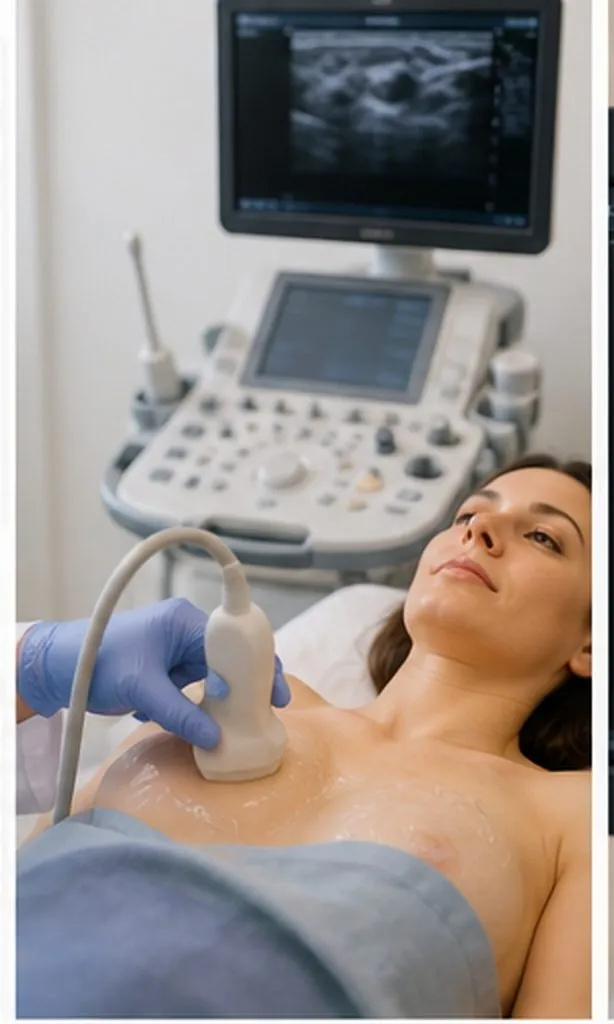
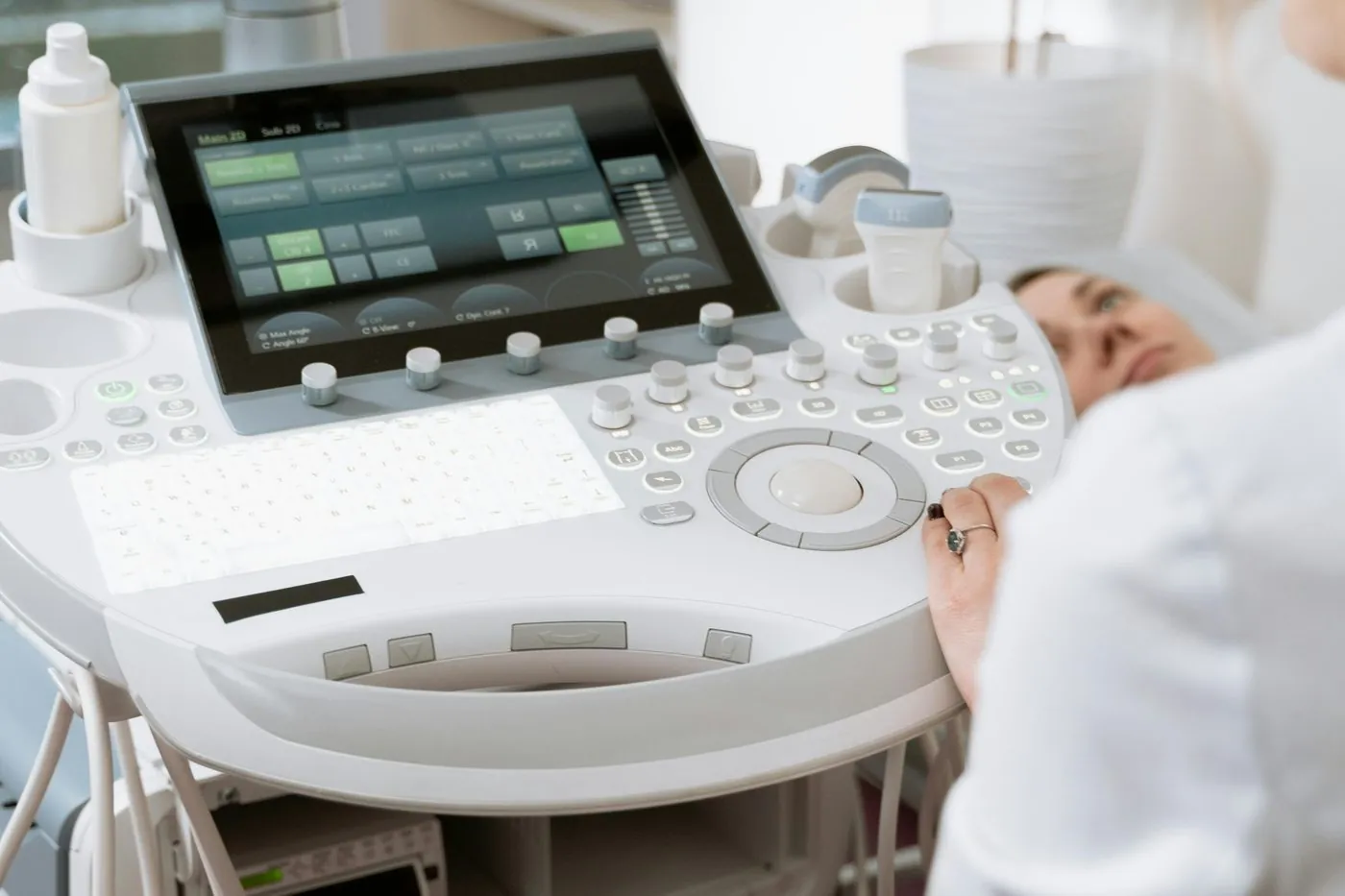
Concretely, ultrasound uses sound waves at high frequency, completely harmless. A high-frequency probe (typically 12 to 18 MHz) is placed on the skin coated with gel, and the image is generated in real time on the screen. The radiologist moves the probe across the entire breast, then systematically explores the axilla looking for lymph nodes.
You lie on your back, with the arm on the side being examined raised behind your head to fully expose the breast tissue. The gel may feel a bit cold at first contact, but the exam is completely painless: no compression, no X-rays. The duration is about 15 to 20 minutes for both breasts.
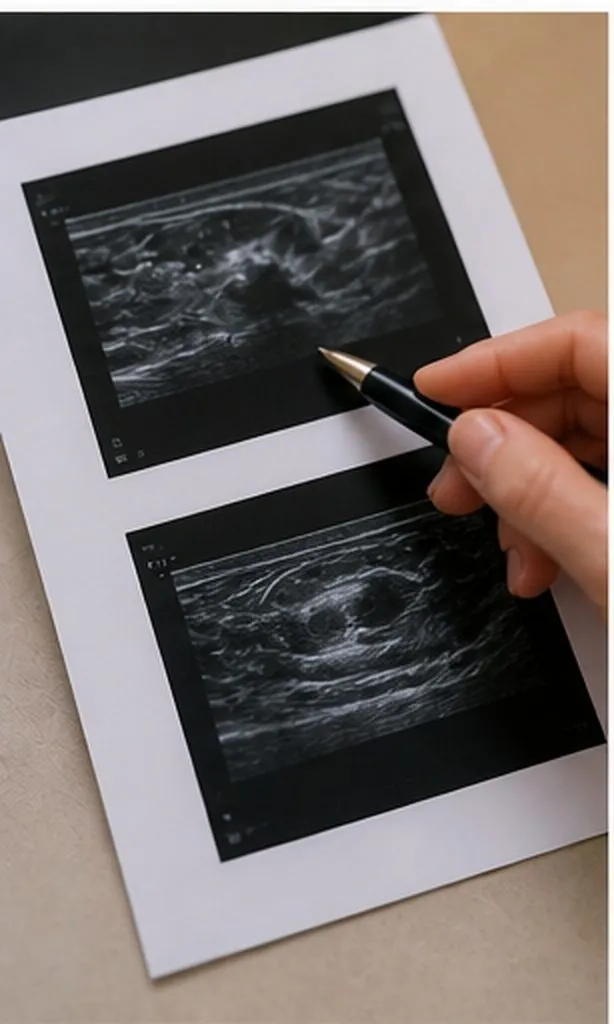
You usually leave with the printed images (snapshots of the main lesions visualized) and the written report from the radiologist, most often available immediately. This is one of ultrasound's great strengths: interpretation is done in real time by the radiologist performing the exam, allowing for direct discussion.
One important particularity: ultrasound is operator-dependent. This means the quality of the exam largely depends on the experience of the radiologist performing it. For a suspicious or ambiguous lesion, it is reasonable to request a second opinion from a radiologist specialized in breast imaging.
Breast ultrasound is not a mass screening exam, but it has specific indications where it is irreplaceable. Three main situations justify it.
1. First-line in young women. Before age 35, and especially in pregnant or breastfeeding women, ultrasound is the first-line examination. The natural density of the young breast makes mammography less effective (white cancer on white background), and the absence of radiation is a major advantage during pregnancy. If a mammogram is later deemed necessary, it can be added — but ultrasound remains the pivotal exam at this age.
2. As a complement to mammography in dense breasts. If your mammogram classifies your breasts as density C or D, complementary ultrasound detects cancers that mammography would have missed. The American ACRIN 6666 trial (2008) and the Japanese J-START study (2016) confirmed a significant diagnostic gain in these patients — at the cost, however, of a higher number of false positives. The discussion is made on a case-by-case basis.
3. To characterize a clinical or radiological abnormality. Any palpable abnormality (nodule, induration, asymmetry), any clinical sign (nipple discharge, skin retraction, focal mastalgia), any lesion detected on mammography requiring further characterization — ultrasound often answers the question, particularly in distinguishing a liquid cyst (essentially benign) from a solid nodule (requiring closer analysis).
A special use: ultrasound for localization and guidance. Beyond diagnosis, ultrasound is the indispensable tool to guide breast biopsies (ultrasound-guided core needle biopsy) and fine-needle aspiration of suspicious axillary lymph nodes. It also enables preoperative localization of non-palpable lesions before lumpectomy, by placing a wire or magnetic seed. It is also the imaging method of choice for early postoperative follow-up: characterization of seroma, hematoma, or lymphocele after surgery.
This is the main contribution of breast ultrasound — what mammography cannot do alone. A nodule visible on mammography may be a cyst (filled with fluid, almost always benign) or a solid mass (requiring closer analysis). Ultrasound resolves this in seconds.
The vocabulary is first that of echogenicity: how tissues reflect ultrasound waves. Tissue that returns no echo appears black (anechoic): typically the content of a cyst filled with pure fluid. Tissue that returns few echoes appears dark gray (hypoechoic): the classic appearance of a solid nodule. Tissue that returns many echoes appears white (hyperechoic): the appearance of fat, for example.
The simple cyst is very common in breast ultrasound — common, benign, never evolving into cancer. Simple surveillance is sufficient. If the cyst is large and painful, an aspiration may be proposed for relief — but it remains optional.
The solid nodule, on the other hand, requires closer analysis. The vast majority of solid nodules are benign — typically fibroadenomas (in young women) or hamartomas. But certain criteria should draw attention: that's exactly what the BIRADS classification applied to ultrasound measures.
To characterize a solid nodule, the radiologist analyzes four families of criteria — the same on every machine, in every country. Knowing these terms helps you understand your report, word by word.
A mass that is oval, wider than tall, is rather reassuring. Conversely, a mass that is taller than wide, appearing to grow vertically, is a warning sign. This is one of the simplest and most useful criteria to guide the radiologist.
Sharp and well-defined margins are reassuring — typical of fibroadenoma or cyst. Blurred, irregular, or pointed ("spiculated") margins, on the other hand, are suggestive of a suspicious lesion.
Homogeneous content is reassuring. Heterogeneous content, with brighter and darker zones mixed together, is more suspicious. Note: ultrasound poorly visualizes microcalcifications — this is one of its limitations, and the reason mammography remains essential after age 40.
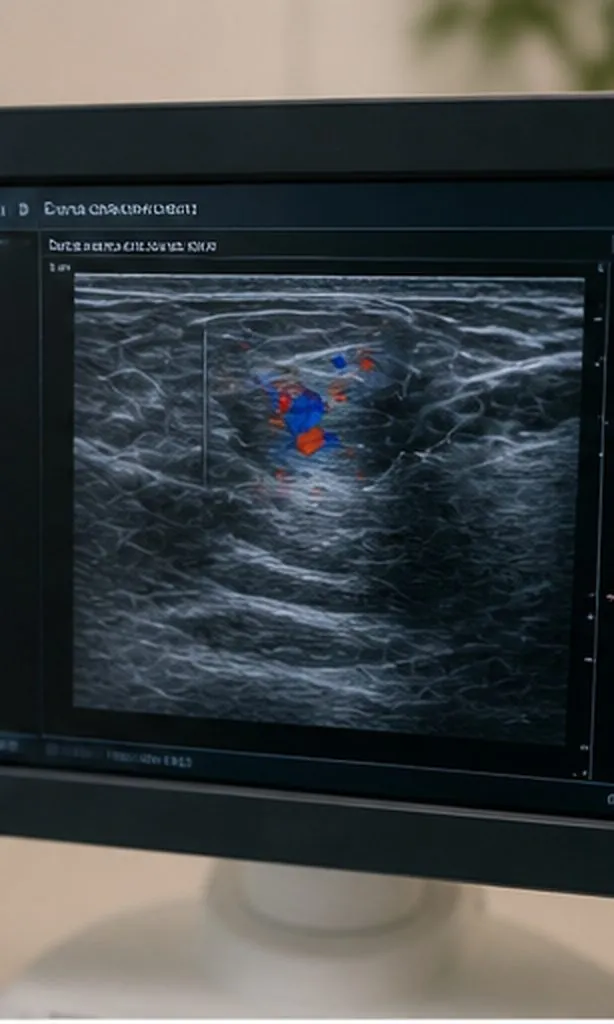
Color Doppler shows whether the lesion is well-supplied by blood vessels. A richly vascularized lesion, with vessels penetrating inside, is a sign to take into account. But beware: this criterion is never used in isolation. A fibroadenoma (benign) can be well vascularized, and some cancers are poorly vascularized.
Other signs may appear in the report: architectural distortion of surrounding tissue, skin thickening, nipple retraction, visible axillary lymph nodes (analyzed by size, cortex and fatty hilum), ductal dilation. No single sign makes the diagnosis on its own — it is their combination that leads to the BIRADS score.
Beyond the standard grayscale image (the "classic" mode), modern breast ultrasound has two complementary tools that provide additional information: color Doppler and elastography.
Color Doppler visualizes blood flow. It reveals whether the lesion is richly supplied or not. A poorly vascularized or non-vascularized lesion is rather reassuring; a highly vascularized lesion calls for special attention. Doppler is never isolated in the decision: a benign fibroadenoma can be well vascularized, and a cancer poorly so. It is one argument among others, complementing the analysis.
Elastography, more recent, measures the stiffness of a lesion. The principle is simple: hard tissues (typically cancers) deform little under gentle pressure; soft tissues (cysts, fibroadenomas) deform more. This criterion is useful for characterizing a nodule in the gray zone, but it does not replace biopsy in case of doubt.
These two tools are mainly useful for characterizing an uncertain nodule, that is, in the gray zone between clearly benign and clearly suspicious. They can help the radiologist guide the decision: should we monitor, or perform a biopsy? The discussion is always made on a case-by-case basis, depending on the overall context.
A word about automated breast ultrasound (ABUS). More recently, some centers use Automated Breast Ultrasound (ABUS), an ultrasound performed by an automatic device that scans the entire breast according to a standardized protocol. Main indication: complementary screening in women with dense breasts, where it offers superior reproducibility compared to manual ultrasound. It is a promising tool, still being deployed, that does not replace targeted ultrasound by an expert radiologist for characterizing a lesion.
The BIRADS classification (Breast Imaging Reporting And Data System), adopted in France under the term ACR, also applies to ultrasound. It uses the same categories as in mammography, and summarizes the level of suspicion and what to do in a score from 0 to 6.
Important: an ACR score on ultrasound is never discussed in isolation. It is always interpreted alongside your mammogram, the clinical exam, your medical history, and the stability or progression of the lesion on prior exams. This is what we call the final BIRADS score — the one that guides decision-making.
Here, by score, are the next steps — and the additional examinations that may be proposed.
No specific action. Continue routine surveillance based on age and risk factors. For a painful cyst, an aspiration can be offered for relief.
Re-imaging at 4 months for a mass (ultrasound), at 6 months for microcalcifications (mammogram). Upfront biopsy possible if the patient is too anxious.
Core needle biopsy under ultrasound guidance, under local anesthesia, most often in the radiologist's office. Placement of a clip marker for later localization. Results in 5 to 10 days.
Depending on the context, additional examinations may be discussed: mammogram (systematic above age 40 to look for associated microcalcifications invisible on ultrasound), breast MRI (for ambiguous lesions, BRCA mutation, cancer staging, or surveillance of dense breasts at high risk), fine-needle aspiration (for suspicious axillary lymph nodes, ultrasound-guided), galactography (for bloody nipple discharge with ductal dilation). The radiologist and your breast surgeon work together to build the most appropriate strategy.
Ultrasound is the first-line examination in young women (under 35), pregnant or breastfeeding. Mammography is less effective at this age (dense tissue), and the absence of radiation is an advantage during pregnancy.
From age 35-40, mammography becomes the primary examination, and ultrasound is used as a complement when: breasts are dense (ACR C or D), a clinical abnormality is palpable, a lesion detected on mammography needs further characterization, or to guide a biopsy.
The two examinations are complementary, never competing.
You lie on your back, with the arm on the side being examined raised behind your head. The radiologist applies gel to the skin (which may feel a bit cold) and moves a high-frequency probe across the entire breast, then explores the axilla looking for lymph nodes.
The exam is painless, without radiation, and lasts about 15 to 20 minutes. You usually leave with images and report available immediately.
Ultrasound is the ideal exam to make this distinction — it is even its main contribution.
A simple cyst appears as an anechoic (completely black) formation, with thin and regular walls, with posterior enhancement (brighter zone behind it). This is a typically benign image (ACR 2).
A solid nodule appears as a hypoechoic (dark gray) mass with homogeneous or heterogeneous internal content. Its nature (benign or suspicious) then depends on several criteria: shape, margins, orientation, vascularization on Doppler, stiffness on elastography.
The ACR/BIRADS ultrasound classification uses the same categories as for mammography. Each exam results in a score:
ACR 1: normal exam. ACR 2: clearly benign abnormality. ACR 3: probably benign abnormality (>98% benign) — surveillance at 6 months. ACR 4: suspicious abnormality — biopsy indicated. ACR 5: highly suggestive of cancer — biopsy required. ACR 0: incomplete exam, additional workup needed. ACR 6: cancer already proven histologically.
Color Doppler visualizes the vascularization of a lesion. A richly vascularized lesion, especially with penetrating or anarchic vessels, is more suspicious than a poorly vascularized one.
Important: a fibroadenoma (benign) can be well vascularized, and a cancer poorly vascularized. Doppler is one argument among others, never used in isolation.
It is particularly useful for characterizing a cyst with mural nodule: the presence of flow within the nodule points to a suspicious lesion requiring biopsy.
Elastography measures the stiffness of a lesion. The principle is simple: under gentle pressure of the probe, hard tissues (typically cancers) deform little, while soft tissues (cysts, fibroadenomas) deform more.
It is a useful complementary tool for characterizing an uncertain nodule, but it does not replace biopsy in case of doubt.
An ACR 3 lesion (probably benign) has less than 2% risk of being a cancer. Three options depending on the context:
— For a mass (round or oval opacity): re-imaging at 4 months by targeted ultrasound.
— For microcalcifications: re-imaging at 6 months by mammography.
— Upfront biopsy if the patient is too anxious and cannot live with uncertainty.
If the lesion remains stable at re-imaging, it is then reclassified as ACR 2 (benign) after surveillance at 12 then 24 months. If it evolves at any point, a biopsy is performed.
ACR 4 means suspicious abnormality (cancer probability between 2% and 95% depending on the subtype 4a, 4b, or 4c). ACR 5 means highly suggestive of cancer (>95%).
In both cases, ultrasound-guided biopsy is required to establish the histological diagnosis. ACR 4 does not mean cancer: the majority of ACR 4a biopsies come back benign. ACR 5 requires prompt management. In all cases, biopsy provides the answer.
The advantage of ultrasound: it allows real-time biopsy under local anesthesia, most often during a radiology consultation.
No. Ultrasound has two main limitations.
First, it does not see microcalcifications well, which are sometimes the only sign of ductal carcinoma in situ (DCIS) — hence the importance of mammography after age 40.
Second, some less dense or diffuse invasive cancers (for example invasive lobular carcinomas) can be missed on ultrasound.
This is why ultrasound does not replace mammography in screening: the two examinations are complementary.
No, breast ultrasound is completely painless. No compression, no radiation, simply the probe moving across the skin coated with gel.
It is a well-tolerated examination that can be repeated as often as needed — including during pregnancy or breastfeeding.
No specific preparation is needed. No need to fast. You can come with a regular bra and an easily removable top.
If you have prior examinations (ultrasounds, mammograms, MRI), bring them for comparison. Avoid applying cream or oil to the chest on the day of the exam.
Ideally, ultrasound is performed between the 5th and 12th day of the cycle, when breast tissue is least edematous and least sensitive.
In practice, the exam can be done at any time of the cycle if needed — there is no need to wait. In postmenopausal women, there is no preferred time.
The two examinations are complementary. Ultrasound is more accessible, faster, without contraindications, and allows real-time biopsy. MRI is more sensitive (it detects cancers invisible to the other two exams) but also less specific (it generates false positives) and more constraining (30-45 min duration, possible claustrophobia, contrast injection, contraindications).
MRI is indicated for: BRCA1/2 mutation or high familial risk (annual surveillance from age 30), cancer staging, persistent ambiguity after mammogram + ultrasound, suspected occult cancer.
Ultrasound remains the pivotal exam for young women, pregnancy, breastfeeding, and characterization of any palpable abnormality.
One of ultrasound's great strengths is immediacy. The radiologist analyzes images in real time during the exam and can often give you a preliminary verbal interpretation at the end of the exam.
The written report is generally available immediately or within 24 hours, with images of the main lesions visualized.
Fibroadenoma is the most common benign tumor of the breast, especially in young women. On ultrasound, it has a typical appearance: hypoechoic, oval mass with sharp margins and homogeneous content. This typical appearance corresponds to ACR 2 or ACR 3.
For more on management: page on benign breast lesions.
A simple breast cyst (anechoic, thin walls, posterior enhancement) is typically benign (ACR 2). It never evolves into cancer. It can appear, disappear, vary in size with the cycle and age — that's normal.
No action is needed for an asymptomatic cyst. If the cyst is large and painful, aspiration under local anesthesia can be offered for relief. The fluid drained is usually clear, yellowish or greenish — it is only analyzed if it is bloody.
A complicated cyst (with some internal echoes) or with a mural nodule, on the other hand, requires closer analysis — biopsy or excision depending on the context.
The comparison with prior exams is one of the most powerful diagnostic tools in breast imaging. A lesion that is stable over 2 years is almost always benign. Conversely, a lesion that has changed between two exams, even subtly, must be investigated — sometimes the only sign of an early cancer.
Bring all your prior exams (ultrasounds, mammograms, MRIs, reports, CDs), even if performed at another center. The radiologist will compare them with your current exam. This comparison can avoid an unnecessary biopsy or, conversely, trigger life-saving exploration.
Yes, in most cases. Follow-up after breast cancer relies on an annual mammogram of the operated breast and the contralateral breast, supplemented if needed by ultrasound and/or MRI.
Ultrasound is particularly useful for characterizing an area altered by surgery or radiation (scar, seroma, hematoma, fat necrosis), for examining axillary lymph nodes, and for guiding biopsy in case of doubt. After mastectomy, ultrasound is the primary surveillance exam on the operated side, in the absence of glandular tissue.
A consultation to discuss your breast ultrasound report, understand the options available to you, or get a second opinion — feel free to book an appointment.