


Hysteroscopy looks inside the uterus through the natural passages, with no abdominal incision.
- Diagnostic or operative? Diagnostic looks only. Operative treats a polyp, fibroid, septum or adhesions, often in the same session.
- Will I feel it? Dr Zeitoun performs it in theatre, under anaesthesia.
- Do I stay overnight? In the vast majority of cases, no. You go home the same day.
- How is it arranged? The indication is set in consultation.
Hysteroscopy is the reference examination for exploring the uterine cavity — the inside of the uterus. The principle is simple: a thin camera, the hysteroscope, is introduced through the vagina then the cervix, without any incision. The cavity is gently distended with fluid, allowing the uterine lining to be seen directly and any abnormality to be identified.
We distinguish diagnostic hysteroscopy (we look) from operative hysteroscopy (we treat). Very often, both are done in the same session: once an abnormality is seen, it is treated immediately — removing a polyp, a submucosal fibroid, dividing a septum or adhesions, taking an endometrial biopsy.
This article explains what hysteroscopy is for, its main indications, how the procedure works, the choice of anaesthesia, the recovery and the rare possible complications. It is a common procedure, with no scar, usually as a day case — you go home the same day.
Offered a hysteroscopy? Dr Zeitoun explains the indication, the procedure and the anaesthesia in consultation.
Understanding hysteroscopy


Hysteroscopy means exploring the inside of the uterus directly. To picture it, you first need the anatomy: the uterus is hollow, and it is this cavity — lined by the endometrium — that we come to look at.
Through the natural passages
The hysteroscope travels along an entirely natural route: vagina → cervix → uterine cavity. A speculum is placed, just as in a gynaecological examination. The camera is introduced carefully through the cervical canal.
To see properly, the cavity — which is normally "flat" — must be distended with fluid. We use saline for diagnostic hysteroscopy, and saline or glycine for operative hysteroscopy. This fluid unfolds the cavity and clears the field of view.
Diagnostic hysteroscopy
A thin camera (about 3 mm), rigid or flexible, visualises the whole cavity and confirms or rules out an abnormality suspected on ultrasound. Dr Zeitoun performs it in the operating theatre: no pain, and if an abnormality is found, the procedure can be converted immediately into operative hysteroscopy in the same session.
Operative hysteroscopy
Fine instruments (resection loop, forceps, electrosurgical loop) pass through the same channel to treat the abnormality: polyp, submucosal fibroid, septum, adhesions. It is performed in the operating theatre under anaesthesia.
No incision
Everything passes through the natural passages. There is no opening of the abdomen, so no visible scar. It is one of the least invasive procedures in gynaecology.
👉 In practice, diagnostic and operative are frequently combined: we look, we confirm, then we treat in the same session.
Diagnostic hysteroscopy
This is the examination that lets us see directly inside the uterus, where ultrasound and MRI give only an indirect image. It clarifies a diagnosis and guides treatment.

A very thin camera
Modern hysteroscopes, rigid or flexible, are about 3 mm in diameter. This slimness makes the procedure atraumatic and allows it to be performed as a day case: carried out in theatre under anaesthesia, you feel nothing and go home the same day.
Gentle distension
A small amount of saline is instilled to unfold the cavity and give a clear view. This is the distension medium for diagnostic hysteroscopy.
Targeted sampling
Under camera control, an endometrial biopsy can be taken for analysis — for example in case of postmenopausal bleeding or a thickened endometrium.
When is diagnostic hysteroscopy offered?
It is often requested to clarify an abnormality seen on ultrasound, or to investigate a symptom:
- Abnormal bleeding — very heavy periods, bleeding between periods, or bleeding after the menopause.
- Suspicious ultrasound image — polyp, submucosal fibroid, thickened endometrium.
- Fertility workup — checking the cavity is normal before IVF.
- Recurrent miscarriage — looking for a septum or adhesions.
- Lost or hard-to-remove IUD.
Operative hysteroscopy
When an abnormality is confirmed, fine instruments passed through the same channel can treat it in the same session — always under direct vision, always without incision.
Polypectomy
Removal of an endometrial polyp with a loop or forceps. The polyp is removed and sent for analysis. This is the most common operative indication — see also benign uterine surgery.
Submucosal fibroid resection
Submucosal fibroids (classified FIGO 0, 1 or 2) bulge into the cavity. They can be resected hysteroscopically, sometimes in two stages if the fibroid is large. More on the benign uterine surgery page.
Septum division
A congenital septum dividing the cavity is divided to restore the uterus to its normal shape — often in a context of infertility or recurrent miscarriage.
Adhesiolysis
Adhesions (synechiae sticking the walls together) are released under direct vision. Hormonal treatment and a follow-up saline sonography are often offered afterwards.
Targeted biopsy
Targeted sampling of the lining for analysis — useful for a thickened endometrium or postmenopausal bleeding. Results are given at a follow-up consultation.
Endometrial ablation
Resection or destruction of the endometrium (thermal ablation, thermal balloon) to stop or greatly reduce periods, in women with no wish for pregnancy. The uterus is preserved. Often offered in adenomyosis or for very heavy periods.
Endometrial ablation, in practice?
Endometrial ablation (destruction of the endometrium) is a specific hysteroscopic procedure, indicated for very heavy periods in a woman who no longer wishes to have a pregnancy. It takes a few minutes and can be combined with removal of polyps or small fibroids.
An important point: ablation reduces fertility but is not contraceptive. Contraception remains necessary. And no longer having periods after the procedure does not mean being menopausal: the ovaries continue to work normally.
For which indications?

Here is a summary of the main situations that lead to a hysteroscopy, and the corresponding type of procedure.
| Situation | Type of hysteroscopy | Possible procedure |
|---|---|---|
| Endometrial polyp | Diagnostic then operative | Polypectomy + analysis |
| Submucosal fibroid | Operative | Resection (FIGO 0–2) |
| Uterine septum | Operative | Septum division |
| Adhesions | Operative | Adhesiolysis |
| Postmenopausal bleeding | Diagnostic | Endometrial biopsy |
| Very heavy periods | Operative | Endometrial ablation |
| Fertility workup / IVF | Diagnostic | Cavity check |
| Lost or embedded IUD | Operative | Removal under visual control |
This table is indicative: the precise indication is always set in consultation, according to your situation, your symptoms and your plans (particularly regarding pregnancy).
Polyp, fibroid or septum? Bring your ultrasound or MRI: Dr Zeitoun decides with you on the right procedure.
How does the procedure work?
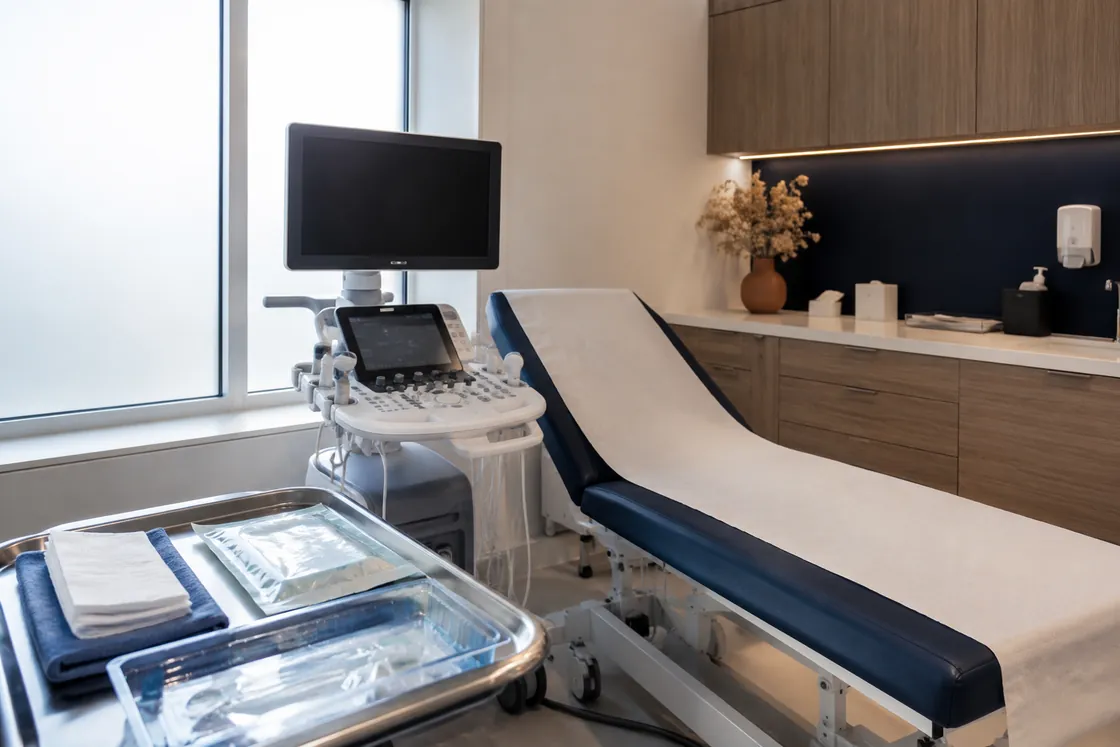
Hysteroscopy is a short procedure, performed as a day case in the vast majority of cases. Here are the steps, from preparation to going home.
The right timing
The procedure is scheduled outside of menstruation where possible. Heavy bleeding on the planned day may lead to postponing the procedure to ensure a clear view.
Anaesthetic consultation
A pre-anaesthetic consultation takes place at least 48 hours before the procedure. This is the time to report your personal medications — some may need to be paused.
Which anaesthesia?
Operative hysteroscopy is performed under general anaesthesia. Locoregional (spinal) anaesthesia is possible but rare, decided case by case with the anaesthetist. Dr Zeitoun performs his hysteroscopies in the operating theatre: this guarantees a completely pain-free procedure and, if an abnormality is found, the ability to proceed straight to the operative step in the same session.
The procedure
Speculum placement, introduction of the hysteroscope, distension of the cavity, full inspection, then treatment if needed. Duration: a few minutes to 30 minutes.
Recovery room
After the procedure, you spend time in the recovery room before returning to your room. The team monitors bleeding.
Going home
You can eat and go home once the surgeon agrees, usually the same day. A prescription for simple painkillers is given to you.
During the procedure: what may be done
As with any gynaecological surgery, certain steps may be carried out as needed during the procedure:
- A vaginal or rectal examination under anaesthesia.
- Injection of a dye at the uterine, bladder or rectal level in some cases.
- Temporary placement of a urinary catheter or a vaginal pack.
- Sometimes a combined laparoscopy in the same session (for example in a fertility workup).
Recovery after hysteroscopy

Recovery is usually simple and not very painful. Here is what to expect in the days and weeks that follow.
Mild cramping
A feeling of cramping or mild period-like pain is common in the first hours. It is well relieved by the simple painkillers prescribed.
Moderate bleeding
Bleeding or watery discharge may last from a few days to two to three weeks. This is normal and usually harmless.
Activity the next day
Return to normal activity is generally possible the next day. A few days of sick leave may be prescribed but is not systematic.
The advice to follow
While bleeding related to the procedure continues (about two weeks), it is recommended to avoid:
- baths and water activities;
- tampons and menstrual cups (use external protection);
- intercourse.
And the results?
When a sample has been taken (polyp, biopsy, fibroid), it is sent for histological analysis. The results are given to you by the surgeon at a follow-up consultation, within about two weeks.
Are there any risks?

Hysteroscopy is a common and safe procedure, with a simple recovery in the vast majority of cases. Like any surgery, it nonetheless carries some rare risks worth knowing.
Uterine perforation
A perforation may occur and lead to interrupting the procedure, which is then rescheduled. A check laparoscopy is occasionally needed. The risk is higher in menopausal patients, those who have never given birth vaginally, or with a history of cervical conisation.
Uterine infection
Endometritis (infection of the uterine lining) is rare and may require antibiotics. This is one of the reasons we avoid tampons, baths and intercourse after the procedure.
Fluid reabsorption
Excessive reabsorption of the distension fluid has been exceptionally described (particularly with glycine), which may cause disorders. This risk is monitored throughout the procedure.
When to seek advice after the procedure?
Contact the surgical team without delay if you notice:
- continuous, very heavy bleeding;
- foul-smelling discharge;
- unusual pain or a fever.
Good to know: smoking
Smoking increases the risk of complications of any surgery. Stopping smoking 6 to 8 weeks before the procedure removes this additional risk. Discuss it with your surgeon and anaesthetist.
Frequently asked questions
The questions that come up most often in consultation. If yours is not here, feel free to ask at your appointment — or to Sophie, the site assistant, at the bottom right.
Is hysteroscopy painful?
No. Dr Zeitoun performs hysteroscopy — both diagnostic and operative — in the operating theatre under anaesthesia: you feel nothing during the procedure. This is precisely the advantage of doing it in theatre rather than in clinic. Recovery is generally not very painful: some patients feel cramps similar to period pain in the hours that follow, well relieved by simple painkillers.
What is the difference between diagnostic and operative hysteroscopy?
Diagnostic hysteroscopy is only to look inside the uterus with a thin camera. Operative hysteroscopy uses instruments through the same channel to treat an abnormality: removing a polyp, a submucosal fibroid, dividing a septum or adhesions. Very often, diagnosis and treatment are carried out in the same session.
What anaesthesia is used for hysteroscopy?
Dr Zeitoun performs operative hysteroscopy under general anaesthesia. Locoregional (spinal) anaesthesia is possible but rare, decided case by case with the anaesthetist. Everything takes place in the operating theatre: this guarantees a pain-free procedure and the ability, if an abnormality is found during the examination, to proceed directly to treatment. A pre-anaesthetic consultation takes place at least 48 hours before.
How long does a hysteroscopy take and when can I go home?
Diagnostic hysteroscopy takes a few minutes. Operative hysteroscopy usually takes between 15 and 30 minutes. The procedure is performed as a day case in the vast majority of cases: carried out in theatre under anaesthesia, you go home the same day after a stay in the recovery room.
What is recovery like after hysteroscopy?
Moderate vaginal bleeding is normal and may last from a few days to two to three weeks. Pain is usually mild. Return to normal activity is generally possible the next day. Avoid baths, tampons, menstrual cups and intercourse while bleeding related to the procedure continues — around two weeks.
Are there any risks with hysteroscopy?
It is a common procedure with a simple recovery in the vast majority of cases. Complications are rare: uterine perforation (which may interrupt the procedure and occasionally require a check laparoscopy), uterine infection (endometritis), and, exceptionally, disorders related to reabsorption of the distension fluid. The risk of perforation is higher in menopausal patients, those who have never given birth vaginally, or those with a history of cervical conisation.
Does hysteroscopy leave a scar?
No. Hysteroscopy is performed entirely through the natural passages — vagina then cervix. There is no incision on the abdomen and therefore no visible scar.
Should I stop smoking before a hysteroscopy?
Smoking increases the risk of complications of any surgery. Stopping 6 to 8 weeks before the procedure reduces this risk. If you smoke, discuss it with your surgeon and anaesthetist.
Is endometrial ablation a form of contraception?
No. Endometrial ablation (destruction of the endometrium) greatly reduces fertility but is not a reliable contraceptive: pregnancy is still possible and would then be high-risk, so contraception must be continued. The procedure does not cause menopause: the ovaries keep working normally. It is intended for women who no longer wish to become pregnant and who suffer from very heavy periods.
Does a hysteroscopy require an overnight hospital stay?
No, in the vast majority of cases. A hysteroscopy is performed as day surgery: you come in during the morning, the procedure usually takes 15 to 30 minutes, and you go home the same day after a stay in the recovery room. Arrange for someone to take you home, as you will not be able to drive after the anaesthesia.
When can I resume sex and exercise after a hysteroscopy?
You can usually return to everyday activities the next day. However, it is advisable to avoid sexual intercourse, baths, tampons and menstrual cups for about two weeks while the uterine cavity heals, to reduce the risk of infection. Returning to intense exercise should be discussed with your surgeon depending on the procedure performed.
Can a hysteroscopy be done during a period?
The procedure is scheduled outside menstruation where possible: heavy bleeding obscures the view of the uterine cavity. If your period starts on the planned day, the procedure may be postponed to ensure a good-quality examination. The first part of the cycle, just after the period, is often the ideal time.
Dr Zeitoun performs hysteroscopy in theatre under anaesthesia, as a day case in most cases.