Home
Breast & Breast cancer
Breast cancerBenign breast conditionsProphylactic mastectomy
Breast reconstruction
All techniquesImplant & expanderLatissimus dorsi flapDIEP flapBreast lipofillingFlat reconstruction
Gynaecological surgery
UterusFallopian tubes & ovariesCervixVulva & vagina
Gynaecological cancers
Cervical cancerOvarian cancerUterine cancerVulvar cancerBorderline tumours Articles About
Book an appointment →Request a callback
Navy and terracotta editorial illustration evoking the reconstructed nipple-areola complex after mastectomy — areola tattoo, Dr Jérémie Zeitoun, Paris
Breast reconstruction

Areola tattoo and nipple reconstruction after mastectomy

Areola tattooing and nipple reconstruction are the final stage of breast reconstruction, performed at a distance to let the reconstructed breast settle. The nipple can be rebuilt with a small local flap or suggested in trompe-l'œil by 3D tattooing; the areola is redrawn by dermopigmentation.

Dr Jérémie ZeitounSurgical oncologist · Breast surgeonParis · Clinique Hartmann

The finishing touch of reconstruction

After a mastectomy for breast cancer, reconstruction first restores the breast's volume and shape — with an implant, a DIEP flap, a latissimus dorsi flap, an inner-thigh flap or lipofilling. One last step then remains, often deeply meaningful: recreating the look of the nipple and areola.

Many patients describe this moment as a kind of full stop: the breast stops being ‘under construction’ and simply becomes theirs again. It is an aesthetic, non-vital step and, above all, a choice: you may want it complete, partial, or decide to do without it. My role is to present the options and let you decide, without imposing anything.

This fine reconstruction follows the same logic as breast reconstruction surgery and, more broadly, intimate reconstructive surgery: repairing what the disease has changed. Its indication and timing are decided with you, after a breast assessment — it is not a decision validated in a multidisciplinary team meeting, unlike the cancer treatment itself.
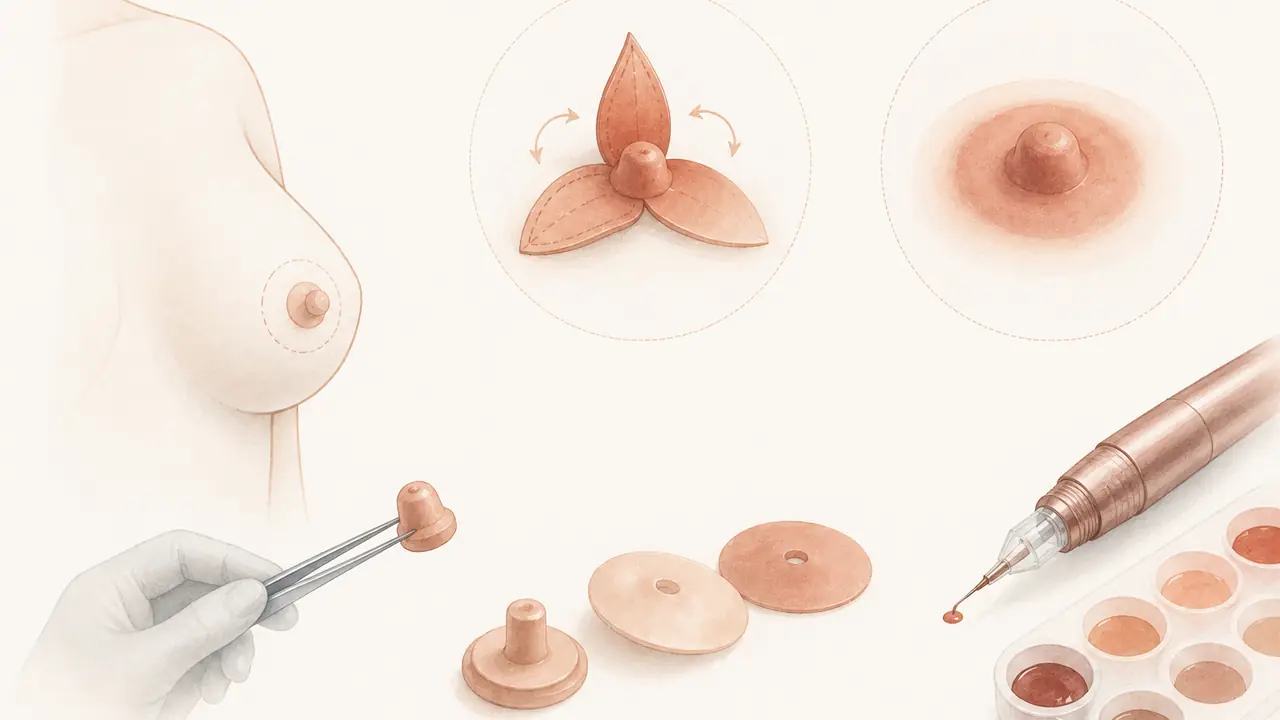
Three ways to get a nipple back

These options are not mutually exclusive and none is mandatory. The areola's colour, for its part, is obtained with a tattoo, covered a little further down.

1

Graft the nipple

From the other breast's nipple: the most common option after a mastectomy with immediate reconstruction. The projection and colour are those of a real nipple.

2

The trifoliate flap

A local three-lobe flap that rebuilds the projection when the areola and nipple have been removed — that is, after a pamectomy.

3

The silicone prosthesis

A custom, removable silicone nipple-areola prosthesis, often offered: no surgery, no tattoo.

Illustrated plate of the three routes to nipple-areola reconstruction: contralateral nipple graft, trifoliate flap, silicone prosthesis and dermopigmentation with a tattoo machine
The main options for restoring a nipple and areola: surgery, external silicone prosthesis, dermopigmentation — illustrative representation.
3 to 4 monthsindicative delayUsual wait after breast reconstruction, so volume and scars can settle.
2 sessionstypicallyA tattoo session then a touch-up a few weeks later to adjust the colour.
7 to 10 dayshealingUsual duration of simple local care after a tattoo session.

These are orders of magnitude from the literature and practice; your situation may justify a different schedule.

Reconstructing the nipple: the projection

When you want a real projection back — the small prominence of the nipple — two techniques can recreate it, chosen with you according to your situation.

The contralateral nipple graft

This is the most commonly offered technique, particularly after a mastectomy with immediate breast reconstruction. When the other breast's nipple is projected enough, part of it — never more than half — is taken and grafted where the new nipple will be. The benefit is clear: projection, colour and texture are naturally those of a nipple — a common option after prophylactic mastectomy with immediate reconstruction. Worth knowing: this harvest can slightly reduce sensitivity in the original nipple.

The trifoliate flap, after a pamectomy

In a particular situation — when the nipple-areola complex has been removed but the rest of the breast preserved (this is called a pamectomy, for example after removing a tumour located just under the areola) — the projection is rebuilt with a local trifoliate flap: three small skin lobes drawn where the new nipple will be, raised then folded together to form the prominence, with no graft and no distant scar. The areola's colour is then added by tattooing. Other local-flap designs exist — the ‘F’ flap, the Little flap, the starflap — used according to each team's habits; here, the contralateral nipple graft and the trifoliate flap remain the two preferred procedures.

A known limit: flattening

Let's be clear: a reconstructed nipple tends to lose part of its projection over time, and the areola to fade gradually. This is a known and expected feature of these techniques, not a complication. That is why the nipple is drawn larger at the outset; a revision remains possible later, possibly with a fat injection to add back a little volume. It is also one reason many patients today choose the tattoo, alone or in addition.

Stylised medical diagram showing nipple projection rebuilt by graft or trifoliate flap on a reconstructed breast
Nipple projection rebuilt (contralateral nipple graft or trifoliate flap) — schematic representation.

The areola tattoo

The tattoo restores the areola's colour — and, in its 3D version, simulates the nipple's projection. It is not performed by the surgeon: once the breast has healed, the patient is referred to a tattooist who specialises in areola tattooing and does this for a living.

Medical dermopigmentation or 3D tattoo?

Medical dermopigmentation (or reparative tattooing) uses so-called medical, semi-permanent pigments that fade gradually; it is performed by trained healthcare professionals. The 3D trompe-l'oeil tattoo, done by specialised tattooists with tattoo inks, gives a very realistic and more durable result, using shadows to mimic projection. The choice depends on your priorities: reversibility and a medical setting, or realism and longevity.

How a session unfolds

1

Choosing the shade

The colour and diameter are chosen by the patient together with the tattooist, from the remaining areola or the opposite breast. The chosen shade is a little deeper, as it lightens while healing.

2

The first session

Pigments are deposited into the skin, usually over one to two hours. As the area is not very sensitive after mastectomy, the procedure is most often almost painless.

3

Healing

Simple local care for about seven to ten days. Avoid prolonged water, direct sun and rubbing while the skin closes.

4

The touch-up

A few weeks later (often six to eight), a short session adjusts colour and intensity. Further touch-ups are possible later, as the shade fades over the years.

Editorial illustration of an areola dermopigmentation session, understated medical mood
Areola dermopigmentation session — editorial representation.

When to do it, and does it hurt?

The right time

We usually wait several months after volume reconstruction — often three to four months — so that shape and scars have settled: we work on a ‘stable’ breast, most often at least two months after any change in volume, and always once treatments are over. After radiotherapy the delay is longer and the skin needs more care. There is no universal rule: the date is set with you, according to your skin and your journey, whether it involved immediate or delayed reconstruction.

Pain

This is one of the good surprises of this step. As the reconstructed area has lost much of its sensitivity after mastectomy, the tattoo is generally low-pain, sometimes done without anaesthetic. Surgical reconstruction of the projection is done under local anaesthetic, like other breast procedures carried out as day cases.

Compare the options at a glance
OptionWhat it givesOver timeComfort / setting
Contralateral nipple graftReal projection and natural colourTends to flatten a little over timeAfter mastectomy + immediate reconstruction
Trifoliate flap (after pamectomy)Rebuilds projection without a graftAreola completed by tattooWhen the complex has been removed
Medical dermopigmentationAreola colour, care settingSemi-permanent, regular touch-upsLow pain, no surgery
3D trompe-l'oeil tattooVery realistic illusion of projectionMore durable, spaced-out touch-upsNo surgery, done by a tattooist
External silicone nipple-areola prosthesisImmediate projection, reversibleReplaced periodicallyNo medical procedure — often offered

Tattoo alone, flat reconstruction, decorative tattoo

More and more patients choose the 3D tattoo alone, without surgically rebuilding the projection: less invasive, faster recovery, striking result. This is a fully valid choice. Others, after a flat reconstruction or without breast reconstruction, opt for a decorative or artistic tattoo over the mastectomy scar — a way of reclaiming their body.

These aesthetic choices are far from trivial: they are part of life after cancer, just like managing benign breast conditions or following up a prophylactic mastectomy. What matters is that they feel like you.

Terracotta floral motif on a navy background evoking a decorative tattoo over a mastectomy scar after flat reconstruction
Decorative or artistic tattoo over a mastectomy scar — graphic evocation, after flat reconstruction or with no reconstruction.

The external silicone nipple-areola prosthesis

This is a solution people overlook, and yet one that is often offered. It is a silicone nipple-areola piece, tinted to match the opposite breast and made to measure, that you stick on and remove at will. It gives immediate projection, needs neither surgery nor a scar, and is simply replaced when it wears out. Many patients adopt it, either for good or while they decide whether they want to go further.

Tinted silicone nipple-areola piece, front view, showing the removable external prosthesis placed on a reconstructed breast
External silicone nipple-areola prosthesis, custom-made and removable — neither surgery nor tattoo.

What may postpone the procedure

An ongoing treatment (chemotherapy, radiotherapy): we wait until it ends
Thin or fragile irradiated skin: caution, sometimes postponement
A scar or volume not yet stabilised
A local skin infection: to be treated first
A known pigment allergy: to be reported
A clinical doubt about the area: we examine it first

Precautions: irradiated skin, MRI, surveillance

Irradiated skin

Radiotherapy weakens the skin and slows healing. So we tattoo after radiation ends, with caution; very thinned skin may lead to postponing or advising against the procedure. This is assessed at examination before a date is set.

Other risks

Like any tattoo, dermopigmentation carries rare risks of infection or allergic reaction to pigments. These are limited by a trained operator, rigorous hygiene and pigments compliant with European regulations. Loss of sensitivity in the area is usual after mastectomy — which is also what makes the procedure low-pain.

Tattoos and MRI

You sometimes hear that tattoos are dangerous during a breast MRI. In practice the risk is very low: in the largest prospective study (330 people, 932 tattoos, 3-tesla MRI, published in the New England Journal of Medicine in 2019), only one minor, transient reaction was observed. The sensible precaution remains to mention your tattoos before any imaging exam.

It does not replace surveillance

An important point: tattooing the areola neither hides nor pauses surveillance of the reconstructed breast. Clinical examination, mammography and, where relevant, breast ultrasound or the pathology analysis of any sample keep their full place. The tattoo is superficial and aesthetic: it does not interfere with your follow-up.

Coverage in France

Nipple reconstruction and medical areola tattooing are part of the coverage of breast reconstruction after cancer. One point deserves to be clear, as it is often misunderstood.

Surgical reconstruction of the nipple-areola complex and medical dermopigmentation have French health-insurance codes (CCAM), based on a regulated tariff. According to the Government's official reply to a Senate question (2024), only medical tattooing performed by a healthcare professional — surgeon, nurse, dermatologist — is covered, at around €125 per session for patients with a long-term condition.

Conversely, a 3D artistic tattoo done by a tattooist, who is not a healthcare professional, is not covered by health insurance, even though it often gives the most realistic result. Any remaining cost then depends on your complementary insurance; the details are set out during the consultation. You are guided toward the route best suited to your project, with clear information on what is covered or not.

A reconstruction plan, a question about the areola?

Let's discuss it in consultation, in Paris or at Clinique Hartmann.

Your pathway with Dr Zeitoun

Paris & Clinique Hartmann

As a surgical oncologist, breast and gynaecological surgeon, I support breast reconstruction from start to finish — from volume to the finishing touch of the areola. You can read my background and all of my patient articles to prepare your consultation.

Some techniques (robotic surgery, vNOTES) are not part of my practice: when they are indicated, you are referred to a colleague. For the areola tattoo, you are referred to a specialised tattooist; an external silicone prosthesis remains a readily offered alternative.

Request a callback

The simplest thing is to talk it through: you can request a callback and together we'll set the right time for this last step.

Related reading

Frequently asked questions

Does the areola tattoo hurt?

It is generally well tolerated and often described as almost painless: after a mastectomy, the reconstructed skin has lost much of its sensitivity — see post-mastectomy pain syndrome. A local anaesthetic can be offered if needed. It is not comparable to a tattoo on normally sensitive skin.

How long should I wait after breast reconstruction?

Usually several months — often around three to four months — so the volume and scars can settle, and once all treatments are finished — the overall timeline is set out in immediate or delayed reconstruction. After radiotherapy, we wait longer. The right timing is set with you, according to your situation; there is no single rule.

Does it last over time?

The colour fades gradually, more so with medical dermopigmentation, which uses semi-permanent pigments. This is expected: touch-up sessions refresh the result, sometimes several years later. A surgically reconstructed nipple's projection also tends to flatten somewhat over time; lipofilling can then restore some volume.

Can I have it if I've had radiotherapy?

Most often yes, but after radiotherapy has ended and with caution: irradiated skin is more fragile and heals less well. Very thinned skin may lead to postponing or advising against the procedure. The skin is assessed before a date is set, as part of your ongoing breast cancer follow-up.

What if I don't want more surgery?

This is a common and perfectly legitimate choice. A 3D trompe-l'oeil tattoo recreates the illusion of the nipple and areola, with shadows and colour, without surgery. Another option often offered: an external silicone nipple-areola prosthesis, custom-made and removable, that you put on and take off at will. This choice sits alongside going flat, which is equally valid.

Who performs the tattoo?

Not the surgeon: the areola tattoo is entrusted to specialised tattooists, who do this for a living. A so-called medical dermopigmentation can also be done by a trained healthcare professional (nurse, dermatologist) — and it is that route which qualifies for reimbursement by French health insurance. You can request a callback to be pointed in the right direction.

How many sessions are needed?

Usually two: an initial session of about one to two hours, then a touch-up a few weeks later (often six to eight weeks) to adjust the colour, which lightens a little during healing. Other steps of the pathway are explained in my patient articles.

Is there an MRI risk because of the tattoo?

The risk is very low. In the largest prospective study available (330 people, 932 tattoos, 3-tesla MRI, NEJM 2019), only one minor, transient reaction was observed. Always mention your tattoos before an imaging exam — in particular before a surveillance MRI or a dense-breast work-up; a risk exists but remains rare under the studied conditions.

Sources

  1. Callaghan MF et al. — Safety of Tattoos in Persons Undergoing MRI — N Engl J Med, 2019 — pubmed.ncbi.nlm.nih.gov/30699316/
  2. Cassar A, Bosc R — Tattooing to reconstruct the nipple-areola complex after mastectomy (medical dermopigmentation / 3D tattoo) — 2020
  3. Assessment of long-term nipple projection: a comparison of three techniques — Plast Reconstr Surg, 2002 — pubmed.ncbi.nlm.nih.gov/12172139/
  4. Fitoussi A, Reyal F et al. — Nipple-areola complex reconstruction — chapter in oncoplastic and breast reconstruction surgery (nipple grafts, local flaps, tattooing)
  5. French Senate — Written question on access to reparative areola tattooing — Government reply, 2024
  6. French national health insurance (ameli.fr) — Tattooing and permanent make-up; CCAM classification (nipple-areola reconstruction, dermopigmentation)
  7. Unicancer / Institut de Cancerologie de l'Ouest — Tattooing an areola after breast reconstruction, 2018
  8. Breastcancer.org — Nipple Tattoos or Nipple Reconstruction (reviewed 2026); Mayo Clinic — 3D tattooing after breast reconstruction, 2024

This article is for information only and does not replace a personalised medical consultation. Recommendations evolve; the information reflects data available at the date of publication. Only an examination allows advice tailored to your situation. No individual prognosis can be inferred from this text.

Let's talk about your reconstruction

Whether you are at the reconstruction plan or its very last step, your questions can be answered in consultation, in Paris or at Clinique Hartmann in Neuilly.

FREN