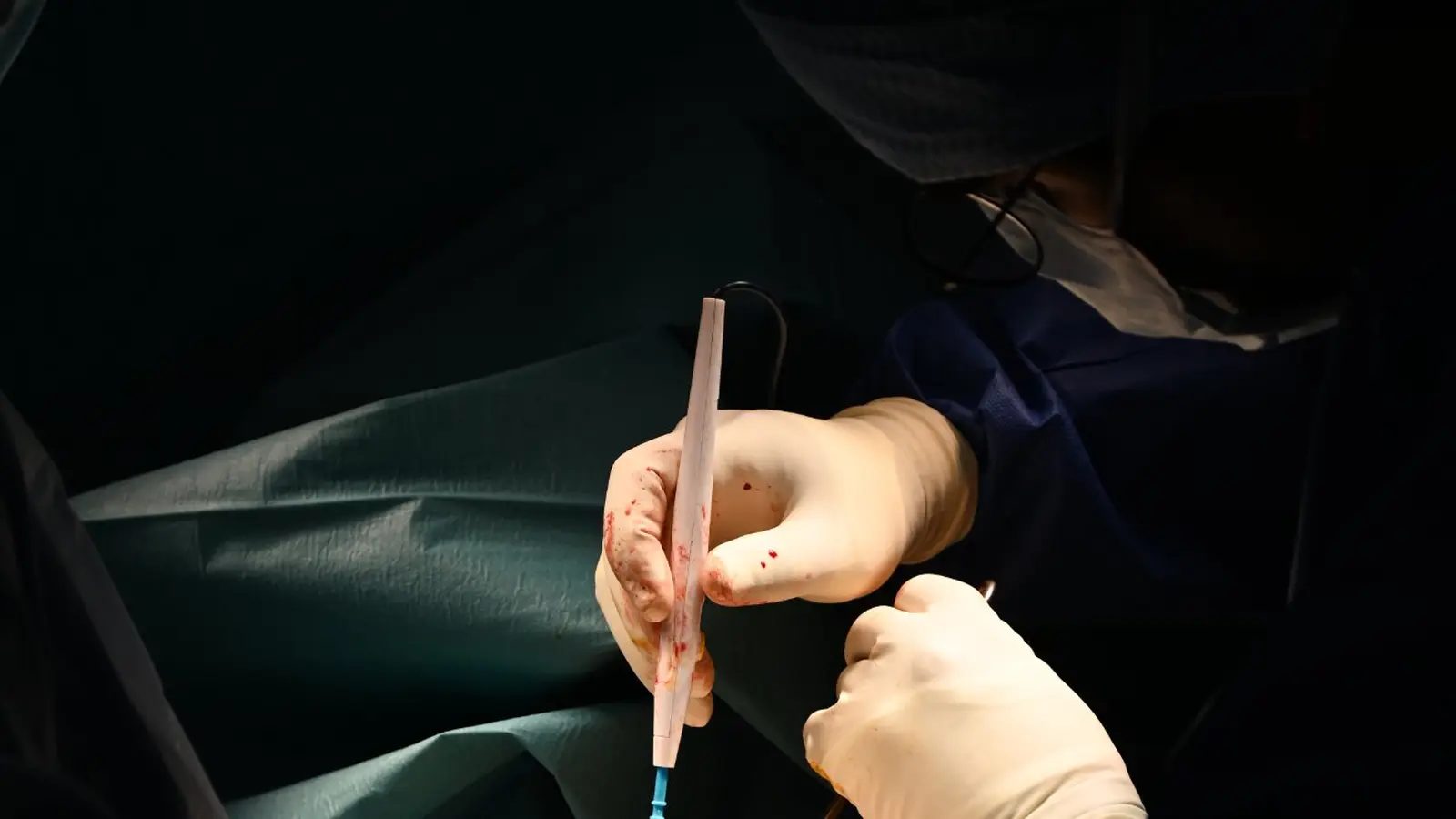


Functional discomfort or personal choice — vulvo-vaginal and intimate surgery are performed with the same rigour as any other surgical procedure.

VIN (Vulvar Intraepithelial Neoplasia) refers to lesions of the vulvar skin that are not yet cancer — but can become so if left untreated. They mainly affect post-menopausal women and are often linked to chronic lichen sclerosus or, in younger women, to HPV. First-line treatment is medical, with potent topical corticosteroids. Surgical excision is indicated when there is diagnostic doubt, to obtain histological analysis and rule out early cancer.
The vast majority of VIN are treated first-line with local application of potent topical corticosteroids. This medical treatment can often make lesions regress or stabilise, without recourse to surgery. Regular clinical monitoring is organised to track the response to treatment and detect any progression.
When a lesion presents an unusual clinical appearance — atypical zone, indurated area, or aspect that cannot be reliably characterised without analysis — surgical excision provides the definitive histological diagnosis. The specimen is analysed in its entirety to rule out any invasive component.
The procedure is performed under local or general anaesthesia as day surgery at Clinique Hartmann, Neuilly-sur-Seine. Follow-up colposcopy at 3 to 6 months is systematic.
Condylomas are genital warts caused by the human papillomavirus (HPV). Benign in the vast majority of cases, they can be large, uncomfortable, or resistant to local medical treatments. The reference medical treatment is imiquimod, applied locally over 14 weeks — effective but often very painful and poorly tolerated. When it fails or lesions are too extensive, CO₂ laser or surgical excision takes over.
The laser vaporises condylomas with precision, respecting the healthy skin around them. This is the technique of choice for multiple or extensive lesions — a single session is often sufficient to treat all visible lesions. Performed as day surgery under local or general anaesthesia. Simple recovery, return to normal life within a few days.
For isolated or pedunculated condylomas, simple excision or electrocoagulation with an electrosurgical scalpel is often sufficient. A quick procedure, under local anaesthesia, in the consultation room or operating theatre depending on location.
Lichen sclerosus is a chronic inflammatory disease of the vulvar skin. It causes intense itching, white and fragile skin, painful fissures, and can in time alter vulvar anatomy. Untreated, it represents a risk factor for VIN and gynaecological cancer.
Treatment of lichen sclerosus relies on local application of potent topical corticosteroids. Well conducted, it controls symptoms, reduces lesions and limits the risk of progression to VIN. This is a long-term treatment, with regular follow-up. Surgery intervenes only for anatomical complications (stenosis, clitoral phimosis) or when a suspicious lesion requires biopsy.
Uncontrolled lichen sclerosus or suspicious area? A consultation allows the response to treatment to be assessed, a biopsy performed if necessary, and management adjusted.
The Bartholin gland is located on each side of the vaginal entrance. Two distinct situations may require intervention: a cyst, when the duct becomes blocked and forms a fluid-filled sac, and bartholinitis, when the gland becomes infected and forms an abscess.
In an emergency, the abscess is incised to drain pus and immediately relieve pain. This quick procedure is performed under local anaesthesia. It does not treat the gland definitively — marsupialization or excision can be proposed at a later stage to prevent recurrence.
Marsupialization involves opening the cyst and suturing its edges to the skin, creating a permanent opening that allows the gland to continue functioning and draining naturally. This is the reference treatment for symptomatic cysts — it preserves the gland while preventing recurrence. Performed under local or general anaesthesia as day surgery. Return home the same day.
In cases of multiple recurrences despite marsupialization, or when the gland is severely altered, complete excision is the definitive solution. Performed under general anaesthesia as day surgery. The gland is removed in its entirety with its wall, eliminating all risk of new recurrence.
The vulva can harbour several types of benign cysts — epidermal cysts, sebaceous cysts, Skene's duct cysts. Most are asymptomatic and require no treatment. When they grow, become infected or cause discomfort, simple excision is sufficient.
The cyst is removed in its entirety — including the wall — under local or general anaesthesia as day surgery, depending on location and size. Removing only the contents without the wall risks recurrence. Pathological analysis of the specimen is performed systematically to confirm benign nature.
A troublesome or infected vulvar cyst? Excision under local anaesthesia is often performed as day surgery, with return home the same day.
The vagina can be the site of precancerous lesions (VAIN), congenital cysts or anatomical septa. These conditions are often overlooked, diagnosed during a smear or colposcopy, and very well treated surgically. They fall within the scope of benign gynaecological surgery at Paris 8th and Clinique Hartmann.
VAIN lesions are most often monitored without immediate surgical treatment. Vaginal excision is reserved for cases where there is doubt about an associated cancer — a suspicious, indurated or atypical area that requires complete histological analysis to formally rule out an invasive lesion.
The cyst is removed via the vaginal route, without external incision. The procedure is performed under general anaesthesia as day surgery. Simple recovery, return home the same day.
The septum is divided via the vaginal route under direct vision, under general anaesthesia. Simple and quick, this procedure restores normal anatomy and eliminates functional discomfort. Day surgery.
Each situation is different. The consultation allows examination, explanation and the most appropriate solution to be proposed.