Breast surgeryBreastOncoplastic SurgeryPreserve the breast · Preserve oncology
Oncoplastic surgery combines the oncological rigour of lumpectomy with the aesthetic finesse of plastic surgery. Remove the tumour with clear margins, preserve the shape and symmetry of the breast.
Scroll
Section 01 · Principle
Breast-conserving treatment — with or without oncoplastic surgery
Remove the tumour, preserve the breast. This is the principle of conservative treatment — possible in the majority of small to moderate-sized breast cancers.
A lumpectomy removes the tumour with a safety margin of healthy tissue around it — this is the essential condition to limit the risk of local recurrence. The procedure is performed under general anaesthesia, lasts one to two hours, and is most often carried out as day surgery — you go home the same day.
In most cases, a simple scar is sufficient — either over the tumour or periareolar — without the need for oncoplastic surgery. This is the most common situation, and the aesthetic result is usually very satisfactory when the amount of tissue removed remains moderate relative to breast volume.
In-office consultation — walking through the principles of oncoplastic surgery: replacing and reshaping glandular tissue after lumpectomy.
When reshaping is needed — oncoplastic surgery. When the amount of tissue removed is significant relative to breast volume, letting the cavity fill on its own would risk deforming the breast or creating marked asymmetry. In this case, the remaining glandular tissue is reshaped at the end of the procedure to restore a harmonious shape to the breast — this is called oncoplastic surgery. Oncoplastic surgery consists of applying techniques from aesthetic surgery to the treatment of breast cancer. Several techniques exist depending on tumour location and breast morphology: Round Block (incision around the areola), medial or lateral radial mammoplasty, inverted-T for larger breasts, local perforator flap when the defect is difficult to fill otherwise, or Batwing mammoplasty for central tumours. There is no standard incision — the technique is chosen on a case-by-case basis.
Who is it for? Oncoplastic surgery is offered whenever a glandular reshaping procedure can improve the aesthetic result without compromising oncological quality. It is particularly indicated when the ratio between breast volume and tumour size leads to significant tissue loss, in cases of delicate localisation (lower quadrants, tumours close to the areola, central retro-areolar tumours, tumours in the décolleté or inner quadrants), or in cases of marked hypertrophy or ptosis — the inverted-T then allows combining the oncological procedure with breast reduction and lifting, an indication often appreciated by patients with pre-existing functional discomfort. The limitations of oncoplastic surgery are very large tumours in small breasts, extensive multifocal tumours, and contraindications to radiotherapy — in these situations, mastectomy with possible immediate reconstruction is generally preferable. The decision is discussed in consultation and at the multidisciplinary team meeting.
After conservative treatment, radiotherapy is usually offered to reduce the risk of local recurrence. The modalities are discussed with the radiotherapy team, usually 2 to 3 months after surgery, over 1, 3 or 5 weeks.
If margins prove insufficient on the final pathology report, a re-excision is organised. This result is communicated at the 15-day consultation, which also marks the reading of the final pathology report.
— Section 02 · The techniques
The 5 techniques
Click on a technique to discover its indication, procedure and practical details.
01
Quadrants supérieurs · Aréole
Round Block (periareolar mammoplasty)
The Round Block is the most discreet of oncoplastic techniques. The incision is hidden around the areola — the scar follows the natural contour of the junction between the breast skin and the areola, and becomes almost invisible with time.
This technique is favoured for upper quadrant tumours close to the areola. It also allows for discreet repositioning of the areola if the lumpectomy creates a slight deviation.
Its limit: it is not suitable for very ptotic breasts — in these situations, an inverted-T is preferred, which will also provide a lifting effect.
02
Sein volumineux · Ptose
Inverted-T (oncologic reduction mammoplasty)
The inverted-T applies the principle of reduction mammoplasty and adapts it to cancer treatment. It leaves three scars: around the areola, one vertical between the areola and the inframammary fold, and one horizontal hidden in that same fold.
It is the technique of choice for lower quadrant tumours on large or ptotic breasts. It combines in a single procedure the oncological procedure, breast volume reduction and a lift — often appreciated by patients who already had functional discomfort (back, shoulder pain).
Symmetrisation of the opposite breast is almost always performed at the same time to obtain two harmonious breasts.
03
Quadrants externes
Radial mammoplasty lateral
Radial mammoplasty is one of the most commonly used techniques in everyday practice. The incision runs from the areola towards the breast periphery, following the natural tension lines of the skin.
It is favoured for outer quadrant tumours. The scar remains visible on the breast but fades with time and remains well hidden under a bra or swimsuit.
Its advantage: simplicity and reliability, particularly suited to medium-sized breasts.
04
Défects glandulaires importants
Local perforator flap
When the cavity after lumpectomy is too large for simple reshaping to suffice, a flap of skin and subcutaneous tissue harvested near the breast is used.
This flap is rotated into the excised area to fill it and reconstruct the breast contour, without needing an implant or more complex reconstructive surgery.
Preferred indication: small to medium-sized breasts with a tumour whose excision would create a significant cavity, and patients who do not wish to have surgery on the opposite breast.
05
Tumeurs centrales · Rétro-aréolaires
Batwing (bat-wing)
The pattern evokes bat wings — hence the name. Two skin triangles are removed above and below the areola, and the tumour is excised en bloc with the surrounding tissue.
It is the technique of choice for central tumours, located just behind the areola or in contact with it. When the tumour requires removal of the areola, it can be reconstructed later (medical tattooing, grafting).
The final scar is horizontal and often produces a slight breast lifting effect. An interesting alternative to mastectomy for central tumours.
Section 03 · Preoperative localisation
When the tumour is not palpable
More and more breast cancers are diagnosed at an early stage, before a tumour is palpable. For these lesions invisible on examination but visible on imaging, preoperative localisation is essential to guide surgery with millimetre precision. Several techniques exist: hookwire, Magseed (magnetic seed), Sirius Localizer (radio-opaque clip).
Announcement of investigation results, clinical examination, presentation of possible surgical techniques with anatomical model, joint choice of technique. Reflection time guaranteed.
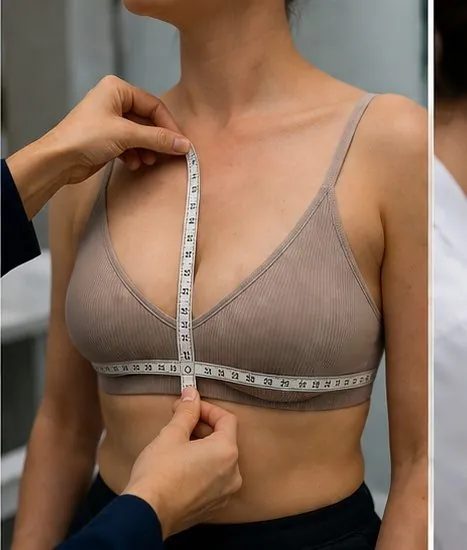
Measurements and clinical examination: volume, ptosis, tumour location — the parameters that guide the choice of technique.
02
RCP & consultation d'anesthésie
Validation of the treatment plan at the multidisciplinary team meeting (medical oncologist, radiotherapist, pathologist, surgeon). Anaesthetic consultation at least 48h before the procedure.
03
The morning of the procedure
Standing surgical marking, just before theatre — drawing the incision lines and the reshaping zones.
If non-palpable lesion: radiological localisation. Standing surgical marking by the surgeon (essential step for inverted-T mammoplasty). Tracer injection for the sentinel node. Operating theatre.
04
The procedure
General anaesthesia. Lumpectomy with safety margins, sentinel lymph node biopsy if indicated, glandular reshaping using the chosen technique, contralateral symmetrisation if planned. Compression dressing. Clinique Hartmann or Hôpital Américain.
In theatre — surgical step of lumpectomy and glandular reshaping under sterile drapes.
05
Consultation at day 15
Examination of scars. Reading of the final pathology report (histological type, grade, margins, lymph nodes). Presentation of the complementary treatment plan validated at MDT: radiotherapy, chemotherapy, hormone therapy as appropriate.
"The rigour of the gesture — at the service of the beauty of the result."
Section 05 · After the procedure
Post-operative course
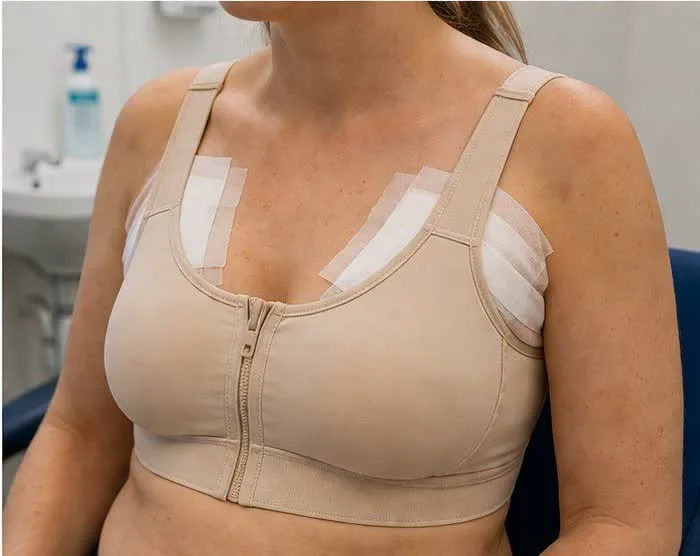
In the vast majority of cases, the post-operative course is simple and minimally painful. Moderate tension-type pain, relieved by simple analgesics (paracetamol ± anti-inflammatories), may persist for a few days. A compression bra-shaped dressing is applied and kept on for 24 to 48 hours.
Compression bra and shaping dressings — to be kept on during the first 24 to 48 hours, then for the first month.
Sutures are usually absorbable — no need to remove them. A nurse contacts the patient the day after surgery to check for any complications. A support bra is recommended for 1 month.
Bruising is common and disappears within a few weeks. If a blue dye injection was used for the sentinel node, the skin may remain coloured for several months — this is harmless.
Baths and sports activities are contraindicated for 1 month. All daily activities are permitted. Adjuvant radiotherapy will usually begin 2 to 3 months after surgery, over 1, 3 or 5 weeks depending on the protocol.
Section 06 · Possible complications
Possible complications
Oncoplastic surgery remains a surgical procedure and carries a low but real risk of complications. True complications are rare following oncoplastic surgery performed according to the rules. Here are the main ones:
Seroma
Fluid accumulation in the surgical cavity or armpit. Most often resolves spontaneously. If large: evacuation aspirations in consultation, painless.
Haematoma
Blood accumulation in the operated area. May require surgical evacuation if large or painful.
Delayed healing
Slower than expected healing, sometimes limited scar opening. Suitable dressings, usually resolves. Increased risk in case of smoking or diabetes.
Fat necrosis
Local fat tissue distress, sometimes creating a palpable indurated area. Rare but without oncological significance. May require imaging follow-up.
Residual asymmetry
Difference in volume or shape with the contralateral breast, often increased by radiotherapy. Secondary symmetrisation can be offered later (at least 1 year after the end of radiotherapy).
Insufficient margins
If pathology shows insufficient margins, a re-excision is organised — usually a new lumpectomy, more rarely a mastectomy.
Sentinel node complications
If a sentinel node was sampled: numbness of the inner arm, shoulder stiffness, lymphoedema (rare in case of isolated sentinel node without clearance).
Section 07 · Your questions
Detailed FAQ
How long does oncoplastic surgery take?▾
30 to 40 minutes for most techniques (Round Block, Batwing, radial mammoplasty, local perforator flap), except the inverted T which lasts 40 minutes to 1h10 depending on the breast and the volume to remove. General anaesthesia in all cases. Excluding the procedure on the sentinel node or any axillary clearance.
Is oncoplastic surgery performed as a day case?▾
Yes, in most cases. Round Block, Batwing and radial mammoplasty are almost systematically performed as day cases — discharge on the same day. Inverted-T with symmetrisation and perforator flap may require a 1 to 2 night stay.
Will I have radiotherapy after oncoplastic surgery?▾
Yes, systematically. Whenever there is breast-conserving treatment, adjuvant radiotherapy is delivered afterwards. It usually starts 2 to 3 months after surgery, over 1, 3 or 5 weeks depending on the protocol. The modalities are discussed with the radiotherapy team.
What will my scars look like?▾
It depends on the technique. Round Block: single periareolar scar, almost invisible with time. Inverted-T: 3 scars (periareolar + vertical + inframammary fold). Radial mammoplasty: lateral radial scar. Perforator flap: extended scar. Batwing: horizontal V-shaped scar.
When is contralateral symmetrisation performed?▾
Contralateral symmetrisation is offered in the same operative session mainly for the inverted-T and the Round Block, which modify the shape and volume of the operated breast. For the other techniques (radial mammoplasty, local perforator flap, Batwing), it is not usually required initially — a touch-up can be offered later if needed (at least 1 year after radiotherapy).
What happens if the margins are insufficient?▾
If the final pathology report (result at 15 days) shows insufficient margins, a re-excision is organised. This procedure is usually simpler — either a new lumpectomy, or, more rarely, a mastectomy depending on the residual extent.
Can I have oncoplastic surgery after neoadjuvant chemotherapy?▾
Yes, and it is even common. Preoperative chemotherapy can shrink the tumour and allow breast-conserving treatment that was initially not feasible. Oncoplastic surgery is then discussed based on treatment response and residual tumour size.
Can I breastfeed after oncoplastic surgery?▾
Breastfeeding remains possible after oncoplastic surgery, especially if the surgery was conservative and limited. It may be reduced or impossible on the operated side depending on the technique (inverted-T, perforator flap). Subsequent radiotherapy significantly reduces breastfeeding capacity on the irradiated side. Discuss this with your surgeon if you have pregnancy plans.