Intraductal lesion of uncertain malignant potential (B3). Systematic core biopsy, excision discussed case-by-case at MDT according to the French SENORIF 2025-2026 reference.
Author and medical review: Dr Jérémie Zeitoun, cancer surgeon (breast & gynaecology) — RPPS 10101463296 — trained at Institut Gustave Roussy, Institut Curie and Centre François Baclesse. See full background →
Last updated: · Sources: SENORIF 2025-2026, SFSPM, CNGOF, Rubio EJSO 2024, NICE. References at the bottom of the page.
An intraductal papilloma is a small outgrowth that develops inside a galactophoric duct of the breast. We distinguish between central papilloma — located in a large retroareolar duct, often symptomatic — and peripheral papilloma, further from the nipple, usually an imaging finding. A papilloma is most often benign; in a minority of cases, it may be associated with atypical cells or in-situ cancer.
Why it is called an "at-risk lesion": a papilloma does not degenerate into cancer. It is classified B3 (uncertain malignant potential) because it may, exceptionally, be colonised by atypical or in-situ lesions. The same logic places in this category atypical ductal hyperplasia (ADH), atypical lobular hyperplasia, classic lobular carcinoma in situ and radial scar.
Published series report that 10 to 30 % of papillary lesions diagnosed on biopsy reveal cancer on final excision histology. This finding historically justified systematic excision. Recent recommendations (SENORIF 2025-2026, Rubio EJSO 2024, Elfgen Virchow Archiv 2023) now propose a more nuanced strategy, with vacuum-assisted excision or surveillance as valid alternatives under specific conditions.
The central papilloma sits in the large retroareolar ducts. It often presents with spontaneous nipple discharge — sometimes bloody — from a single pore, which is its most characteristic clinical sign. The peripheral papilloma is further from the nipple, usually asymptomatic, found on screening imaging or during a workup for another reason. The management strategy is modulated by this location — the retroareolar central papilloma more readily benefits from surgical excision (microdochectomy) when the discharge is bothersome.
An intraductal papilloma is a benign epithelial proliferation that develops from the inner wall of a galactophoric duct. There is no single identified cause. Several factors contribute to its appearance.
Central papilloma is more common in women aged 40 to 60. Peripheral papilloma may be diagnosed at any age, often on routine imaging.
Breast tissue responds variably to hormonal stimulation. Peripheral papillomas may be multiple (papillomatosis), in one or both breasts, reflecting an individual tendency.
Important: the presence of a papilloma, as an at-risk lesion (B3), justifies appropriate radiological follow-up even after excision. The risk of later developing a breast lesion is increased, particularly with multiple papillomatosis or associated atypia.
Source: SENORIF 2025-2026 · SFSPM
Peripheral papilloma is most often asymptomatic — found on ultrasound or mammography. Central papilloma may, on the contrary, produce a characteristic clinical sign: spontaneous nipple discharge.
The most characteristic sign of central papilloma: spontaneous discharge, unilateral, from a single pore, often serosanguineous or bloody. Warrants prompt breast workup.
Many papillomas, especially peripheral, are found on screening ultrasound or mammography. Often non-palpable lesion.
Rarely, a papilloma may be palpable as a small retroareolar nodule, particularly for larger central papillomas.
Warning signs: spontaneous, unilateral, single-pore nipple discharge (especially if bloody), or a new palpable nodule. Discharge elicited by pressure, bilateral, from multiple pores, milky or greenish, rarely has pathological significance.
Source: SFSPM · HAS
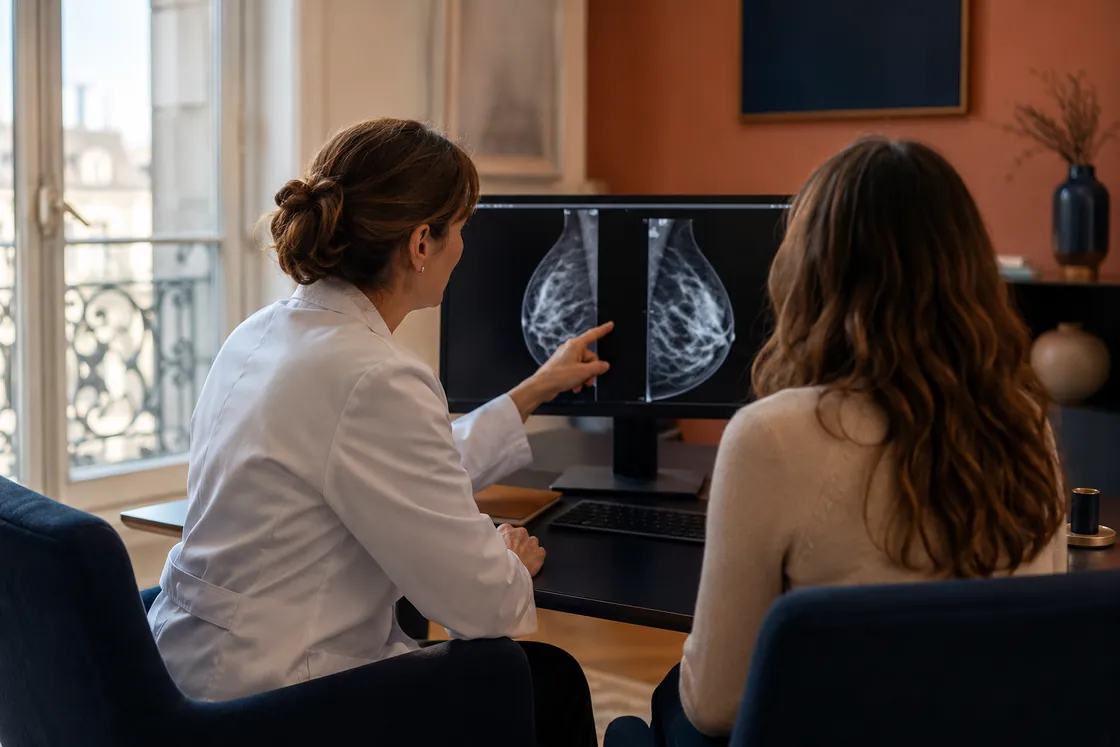
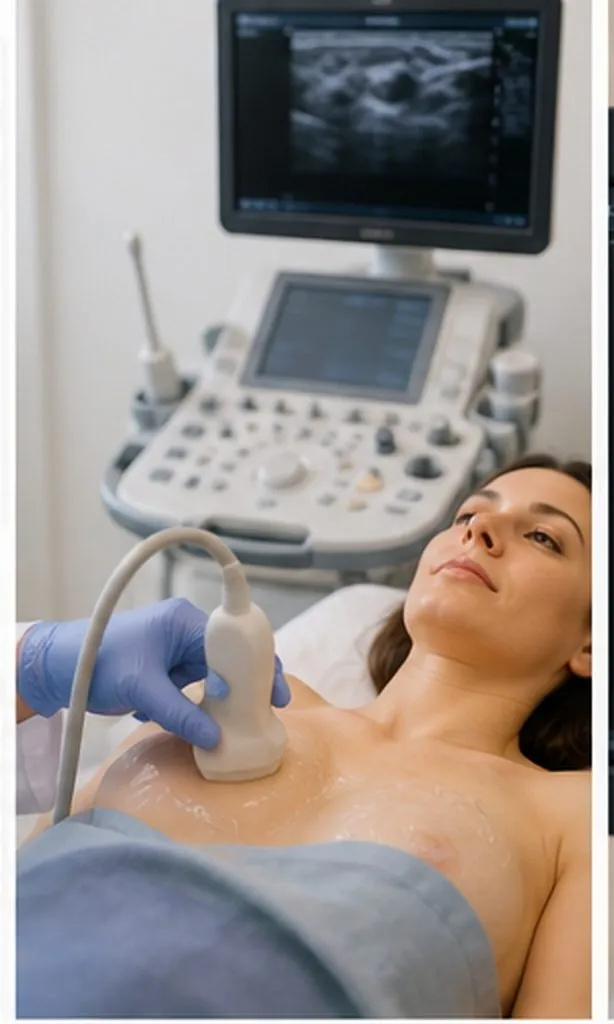
Diagnosis relies on a structured approach: clinical examination, targeted breast imaging, then systematic core biopsy. Core biopsy is mandatory before any therapeutic decision — this is the central rule of management.
Bilateral palpation of breasts and lymph node areas. Discharge test (unilateral or bilateral, number of pores, colour). Inspection of the nipple.
Ultrasound and mammography according to age. Galactography or breast MRI in selected cases (isolated discharge without visible lesion). Systematic placement of a metal clip (e.g. Twirl) at biopsy, to mark the target in case the lesion disappears after sampling.
Percutaneous core biopsy mandatory before any decision. Confirms the papillary nature, searches for any atypia, rules out adenomyoepithelioma or papillary carcinoma.
Core biopsy is not always enough: inter-pathologist concordance is lower for B3 lesions than for cancers. If there is any doubt on the biopsy, Dr Zeitoun may request expert review by the SEIN-PATH group or present the case at MDT. The definitive diagnosis is only made on analysis of the excision specimen when surgery is performed.
Source: SENORIF 2025-2026 · HAS · SFSPM
According to the SENORIF 2025-2026 recommendations, a papilloma is not systematically excised. What is mandatory is the core biopsy. Then three pathways are possible, discussed at MDT and with the patient: radiological surveillance, vacuum-assisted excision, or surgical excision. The choice is made case-by-case according to several criteria.
Acceptable if SENORIF criteria are met: radio-histological concordance, foci < 15 mm, fewer than 2 foci, asymptomatic, no personal or genetic risk factor, patient accepting close follow-up.
Percutaneous alternative to surgery (Mammotome vacuum-assisted system). Performed in the radiology clinic, ultrasound- or stereotaxy-guided. Indicated if the lesion is accessible, no atypia, no proximity to the nipple-areolar complex.
Indicated for associated atypia, lesion too large for vacuum excision, proximity to the nipple-areolar complex (central papilloma), bloody discharge, or in the context of an ART project.
During the initial core or vacuum biopsy, the radiologist deposits a small metal clip (e.g. Twirl) at the exact site of the sampled lesion. This clip has two roles: to mark the target in case the lesion disappears after sampling (which notably happens with larger vacuum-assisted biopsies), and to serve as a reference point if surgery is later decided. The clip is biologically inert, does not interfere with MRI or mammography, and can stay in place indefinitely without issue.
A papilloma is almost always a non-palpable lesion. When surgical excision is decided, pre-operative localisation is essential to guide the surgeon. This localisation is placed at the metal clip that was deposited at biopsy. Two techniques are available — the choice is made with the patient and the radiologist according to organisation and patient preference.
A thin metal wire with one end anchored at the biopsy clip and the other end exiting the skin. Placed under ultrasound or stereotactic guidance, the day before or the morning of surgery. This is the historical technique, still widely used today — reliable and inexpensive.
A small magnetic seed (e.g. Magseed, Localizer or Sirius) placed at the metal clip. Detected intra-operatively by a dedicated probe. Can be placed several weeks before surgery, simplifying logistics — the patient does not have to arrive fasting with a wire exiting the skin.
The surgical objective: to remove en-bloc the localisation marker (hookwire or magnetic seed), the metal clip placed at biopsy, and the lesion surrounding them. A specimen radiograph is performed at the end of surgery to confirm that both markers have been removed. The procedure is performed in theatre as day surgery, under general anaesthesia in most cases. The scar is usually peri-areolar, discreet. Systematic histopathology.
Further reading: pre-operative localisation deserves its own page — technique, workflow, practical differences between hookwire and magnetic seed (Magseed, Localizer, Sirius), specimen radiography. Read the full page on pre-operative localisation →
When nipple discharge is found intra-operatively, the reference technique is microdochectomy. It consists in isolating the dilated galactophoric duct responsible for the discharge, then, through a peri-areolar incision, excising en-bloc this duct together with the clipped and localised lesion. Histopathology looks for the causative lesion and any associated lesions.
Mastectomy for diffuse papillomatosis remains exceptional. The usual approach, when papillomatosis is extensive, is a two-step surgery with a wide lumpectomy — when feasible — after one or two core or vacuum-assisted biopsies confirm the extent of the lesion. As a general rule, mastectomy is not performed for benign lesions, except in exceptional cases adapted to age, personal and family history, and possible genetic predisposition (particularly BRCA mutations).
Source: SENORIF 2025-2026 · Rubio EJSO 2024 · Elfgen Virchow Archiv 2023
Recovery after papilloma excision is usually straightforward. The procedure is performed as day surgery, with return home on the same day.
Moderate during the first 48 hours, well relieved by simple analgesics (paracetamol).
3 to 7 days for sedentary work. 10 to 15 days for physical work.
Light sport at 2-3 weeks. Activities with arms above the head to be deferred 3-4 weeks.
Peri-areolar scar in place over 6 to 12 months. Generally favourable evolution.
Report available in 2 to 3 weeks. Dedicated follow-up consultation to organise ongoing follow-up.
Key principle for papilloma: a papilloma is never re-excised, even if margins are involved or atypia is found on the specimen (SENORIF 2025). Only the discovery of an associated cancer changes management.
Source: SENORIF 2025-2026 · SFSPM
Papilloma excision is a very safe procedure, with a very low rate of complications. Dr Zeitoun details each risk during the pre-operative consultation — this information is part of shared decision-making and is systematic before any surgery.
The most common post-operative risk. Usually moderate, it resolves spontaneously within a few days. A large haematoma rarely requires re-operation.
Very low risk (< 1 %) thanks to strict theatre asepsis. Warning signs (redness, discharge, fever) should prompt consultation without delay.
Keloid or hypertrophic scar possible depending on individual tendency. Scar massage from 4 weeks onwards optimises the result.
Transient change in nipple sensation is possible after microdochectomy, due to the proximity of the incision to nerve endings. Usual recovery within a few months.
10 to 30 % of papillary lesions reveal cancer on surgical pathology. In this case, management is adapted according to type and extent — an anticipated and planned situation.
Microdochectomy removes one galactophoric duct. Breast-feeding remains possible after surgery — the other ducts of the breast function normally.
Source: SENORIF 2025-2026 · SFSPM · CNGOF
Paris 8e practice · Clinique Hartmann Neuilly · Sector 2 non-OPTAM
The answers below are based on the SENORIF 2025-2026 reference, CNGOF and SFSPM recommendations, and daily clinical practice.
A papilloma itself does not degenerate into cancer. It is called an "at-risk lesion" because, in a minority of cases, it may be associated with atypical cells or in-situ cancer. Published series report that 10 to 30 % of papillomas diagnosed on biopsy reveal cancer on final excision. This is why core biopsy is systematic and the strategy is discussed at MDT.
No. According to the latest recommendations (SENORIF 2025-2026, Rubio EJSO 2024, Elfgen Virchow Archiv 2023), papillomas are not systematically excised. What is mandatory is the core biopsy. Then three options are possible, discussed at MDT and with the patient: radiological surveillance, vacuum-assisted excision, or surgical excision.
Vacuum-assisted excision (Mammotome or other vacuum-assisted systems) is a non-surgical alternative to lumpectomy. It allows removal of the entire lesion percutaneously, under ultrasound or stereotactic guidance, in the radiology clinic. It is a validated option in SENORIF under specific conditions: accessible size, no atypia, radio-histological concordance, patient accepting close follow-up.
A papilloma is almost always a non-palpable lesion. A metal clip (e.g. Twirl) was placed at the initial core biopsy — it marks the target and serves as a reference point if the lesion disappears after sampling. When surgical excision is decided, pre-operative localisation is placed at this metal clip, either by wire localisation (hookwire) — a thin wire exiting the skin, placed the day before or the morning of surgery — or by magnetic seed (Magseed, Localizer or Sirius), which can be placed several weeks before surgery. The surgical objective is to remove en-bloc the hookwire or magnetic seed, the biopsy metal clip and the associated lesion. Day surgery in theatre, usually peri-areolar scar.
Microdochectomy is the reference technique when bloody nipple discharge is found intra-operatively. It consists in isolating the dilated galactophoric duct responsible for the discharge, then excising en-bloc this duct with the clipped lesion through a peri-areolar incision. Histopathology looks for the causative lesion and any associated lesions.
The 15 mm threshold is acknowledged by the SENORIF 2025-2026 reference and European guidelines (Rubio EJSO 2024) as a criterion for discussion: beyond this size, vacuum-assisted excision is technically more difficult and surgical excision is often preferred. This is not a rigid cut-off: the decision is always made case-by-case, at MDT, integrating age, history, symptoms, proximity to the nipple-areolar complex and the patient\u0027s choice.
Mastectomy for diffuse papillomatosis remains exceptional. The usual approach is a two-step surgery with a wide lumpectomy — when feasible — after one or two core or vacuum-assisted biopsies confirm the extent. As a general rule, mastectomy is not performed for benign lesions, except in exceptional cases adapted to age, history, and possible genetic predisposition (particularly BRCA mutations).
Yes. In the context of an assisted reproductive technology (ART/IVF) project, most teams favour surgical excision rather than surveillance or vacuum-assisted excision, in order to obtain rapid and complete histological diagnosis without delaying the ART pathway.
No. A papilloma is never re-excised — even if the excision is not in sano (involved margins) or if atypia is found on the surgical specimen (SENORIF 2025-2026). This is an important rule: unlike cancer, where clear margins are mandatory, papilloma benefits from a conservative strategy confirmed by the latest recommendations. Only the discovery of an associated cancer on histopathology changes management — it is then adapted at MDT.
Dr Zeitoun practises in sector 2 non-OPTAM: additional fees apply. Excision is covered by French Assurance Maladie at the contractual rate. A personalised quote is systematically provided after the consultation. Out-of-pocket expenses depend on your complementary health insurance.
This page relies on the French SENORIF 2025-2026 reference, recommendations from French and international medical societies, and on recent medical literature indexed in PubMed.
Last reviewed: 22 April 2026 · Next scheduled update: October 2026.
Paris 8th clinic or Clinique Hartmann Neuilly. Second opinion possible on records.